
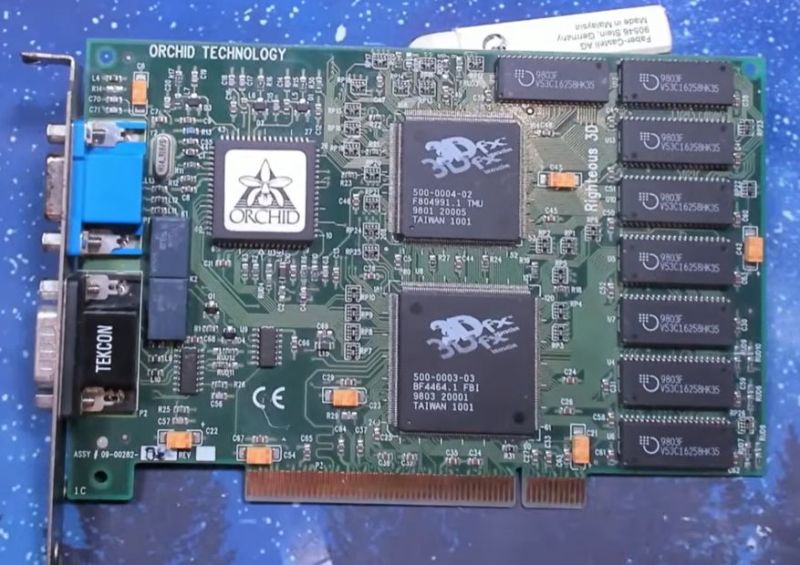
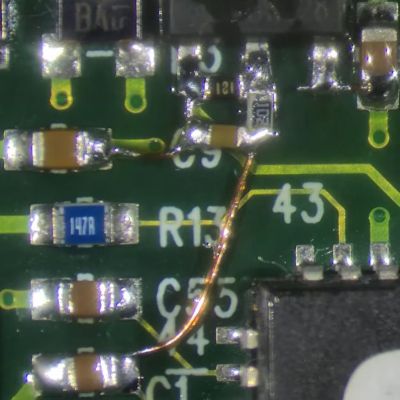
 After previously fixing an overly bright picture from a Voodoo graphics card with a simple resistor on one of the RAMDAC’s pins to correct its faulty internal Vref, [Bits und Bolts] got called out for not taking component drift into account. Thus in an update video he shows how instead to use an adjustable AMS1117 voltage regulator to hopefully prevent either the original issue or something new and exciting from cropping up later.
The basic idea here is to use the external voltage reference (Vref) pin for this ICS5342 RAMDAC and supply it with a constant 1.235V. If unused – as on this Orchid-branded Voodoo card – it is connected via an 0.1 microFarad capacitor to ground. This fortunately means that the pin is routed to easily accessible pads that make this modification relatively straightforward.
Basically this is where the AMS1117-ADJ chip comes into the picture, as a widely available adjustable LDO option, even if the 0.8A current rating is very much overkill for this application. With the supplied voltage the lowest voltage this LDO can output is around 1.25V, which is within the 1.10 – 1.35 V range of the datasheet.
Of course, with the PCB never having had a provision for this part, much of the rest of the video is about planning out where to place and route the components. After that tedious work and testing that nothing explodes, the new voltage is used for the RAMDAC’s Vref pin, fixing the brightness issue.
While one could argue that this RAMDAC is likely simply defective and already beginning to break down inside, this should at least give it a bit longer on what seems to be a little used card anyway.












“overly bright picture” – on a contraption called a monitor, correct ?
I heard them there doo hickeys have a little thing called a “brightness control”.
Where you turn a dial and it makes the picture brighter or dimmer.
Ain’t that somethin’ !??
Now why in tarnation is this feller goin’ on about messin’ with the innards
of that thing he got in the video ? When all someone has to do is turn down
that there magic brightness control.
I let you figure it out by yourself why this is not enough.
is it because if the source is already too bright and you reduce it “artificially” afterwards you loose dynamic range? (contrast?)
especially with 0.7V analog signals?
(I’m really not sure)
i usually have the opposite problem, such as the electroluminescent display on the Bose CD player i inherited from my father that can only be read in very dim light. maybe someone in here knows: is that likely to be a failing electrolytic capacitor? they’re hard things to open up
The EL displays have a definite lifetime. Your CD display could be approaching its end of life.
Btw, to those with a strong CPU but no Voodoo card.: There’s a Voodoo 1 emulator for DOS.
It’s called “3Dfx Emulator v0.2 from ELZ SOFTWARE”.
A Pentium II or higher is being recommended.
(Note: The Pentium Pro and II do support faster drawing of VGA graphics.
They can bundle the slow 8-Bit writes that some software uses, if some DOS TSR such as FastVid is loaded.
That way, a 32-Bit bus of PCI is better being utilized. The term is “MTRR write-combining”.)