
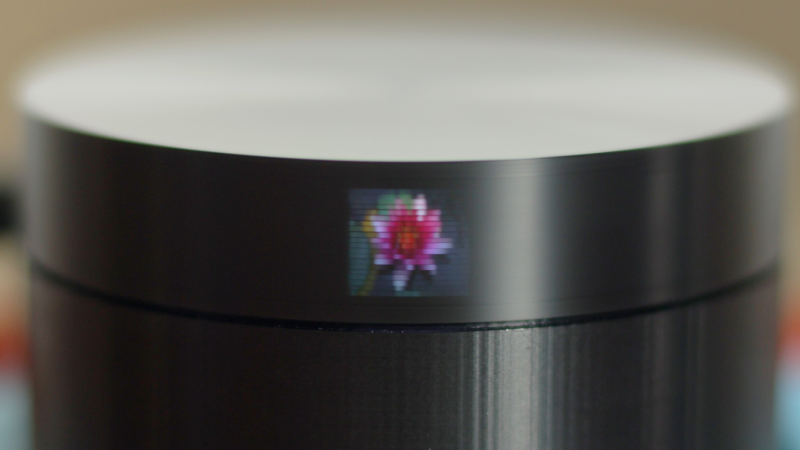
When you hear the word TV, you probably think of a big LED screen, maybe even the old CRT TVs, but in either case it’s something large and fairly complicated. However, thanks to the persistence of vision, it doesn’t have to be. In this handheld-sized project from [Ancient], the Scanwheel is born, a miniature mechanical TV that uses a spinning disk and some LEDs to produce an image.
The electronics of the Scanwheel are pretty straightforward. The smarts come from a Raspberry Pi Pico, an A4988 motor driver, a couple of LEDs, and a small 21-02485 stepper motor. The Raspberry Pi Pico is used to command the motor speed as well as coordinate the LEDs to turn on at the right time. The case is 3D printed; the base includes space for the various support electronics as well as some small light baffles to ensure the LEDs don’t bleed over outside their intended area. The top of the case is a disk that includes 20 small holes spaced evenly around the perimeter at varying heights, allowing light to only leave the disk when one of these holes is in front of the LEDs.
When you put all these pieces together, spin the motor up to roughly 900 RPM, and turn the LEDs on in a precise order, you end up with a really cool result: a miniature TV. And due to the five different LEDs in this build, you actually have a color 20×20 pixel display in the center and, on either side of that, two more 20×20 black-and-white displays capable of showing different images. Thanks [Ancient] for sharing this awesome build that takes advantage of the persistence of vision effect to create a unique display. Be sure to check out the video below as well as the instructions on how to build your own. And if you enjoy this sort of thing, check out some of our other persistence-of-vision projects as well.












awesome project!
oooo! Ultra nice! I love it!
It’s an interesting take on the mechanical television design.
If anything it’s more efficient, in that it reuses other areas of the disk, allowing for a larger display surface.
I wonder if a harddrive platter motor might allow for quieter operation.
As good as the resolution is, not to mention, it’s colour, I’d quite like to see a larger version, this one is a little small to play Doom, perhaps some sort of lens to magnify the image instead.
I wonder how large you can go, although splitting the image into cells would seem to negate timing issues somewhat, I guess there’s nothing stopping you making a 2D array.
Brilliant execution. Truly amazing!
This is really cool. I’ve long wanted to make something similar using a drum with mirrors at slightly different angles that acts as a projector using lasers or just focused high-power LEDs.
Cool project! One thing I don’t understand: why doesn’t the software need to know the drum’s angular position (phase)? I get that once the drum spins at the correct speed, the LEDs can just replay the pattern repeatedly. But at startup, how does the system know where “line 1” is without any position reference or index sensor?
Good point. I’m guessing that since it’s a stepper motor, the software knows the relative position at all times. For the absolute position, perhaps it’s just required to be at a certain position on startup?
The stepper motor used has 20 steps per revolution, hence the 20 holes in the drum and the 20px vertical resolution.
I couldn’t find it in the written documentation, but from the video it’s pretty clear that “line 1” is just lined up manually when the device is switched on.
Urgh. Soo rad. Love this guy’s projects.
Wow it looks like someone after more than century updated the Nipkow disc into the Ancient’s drum. Nice:)
again nothing new… just modern material and parts, the concept of a drum was also known 100 years ago and experimented with. A nice example can be found here:
https://newsm.org/wireless-e/mechanical-television/
A perhaps more interesting approach was not the use of a drum or a disc with holes in it, but an endless loop of film (or belt) with holes in it, as that would eliminate the curvature of the drum, resulting in a flatter image. As far as I remember one problem was the limited livespan of the loop of film that had to run pretty fast and was prone to breaking. Below a link to a facebook page showing a drawing of such a system:
https://www.facebook.com/groups/170508300223659/posts/1243364212938057/
Seeing I’m not a bot my view is not quite as enthusiastic, and I instead think having a thing with an opaque background completely defeats the concept of PoV. Which seems rather obvious to me.
But obviously bots don’t have eyes and so for them the experience is quite different (although you would think that maybe they would get annoyed by rolling shutter issues?)..
The bots above clearly just want to drive traffic to the video for ad revenue for this person.
Pretty skeezy, I’m certainly not watching anything from that ‘creator’. Project has no practical use anyway
I dont know what your on about, just about every dynamic display ever created is using persistence of vision. So I can’t understand why having a opaque background completely defeats the concept, when just about everything that uses the effect has an opaque background … including the thing you are writing your ignorant comment on (unless you happen to be using e-ink)
Every 9 out of 10 LED displays are multiplex, and thus use PoV too basically, that does not make each of them special and suited to be presented as something notable and ‘wow-neat!!’ IMHO
It’s a mechanical monitor. The video stream and the motor are sync’ed in the RPi (“easy”). A ‘televisor’, a television receiver, would have to sync its motor speed and position to the incoming, transmitted, video stream (not easy).
Wow
Btw, it says the horizontal resolution is 4K, not 20.
Puts me in ind of the Nintendo Virtual Boy with its osilating mirrors and tiny LED strips.
I wonder if it could be coupled with gyros in some wise.
At one speed, it could deliver one message, a slower speed, another.
A base for spinning plate holograms…
If I were to do a cockpit for a space alien like this:
https://aliens.fandom.com/wiki/Radiate
I would have the disk surround the alien with the display on the inner section, the device serving as a gyro, turbopimp–all in a pye packet saucer.
An actor playing a NASA techie could look at it for another HAIL MARY type film, trying to communicate with an ET even more different than us as Rocky was.
Given the size, I wonder if one could use a few LEDs carefully stacked (vertically) and aligned, with the Nipkow disk being used as the aperture for all 3 so as to get multiple ‘scanlines’ per hole?