
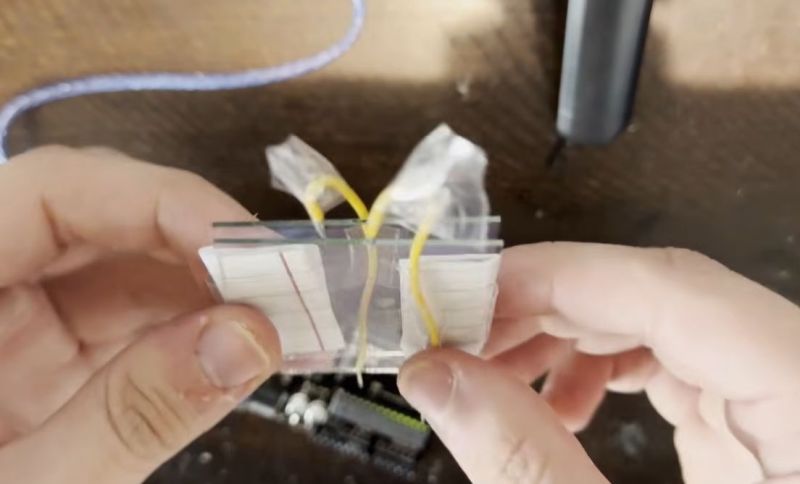
Although generally glass isn’t associated with touch-sensitive surfaces, the addition of an ITO (indium tin oxygen) coating adds the exciting property of not only being transparent to the visible light part of the electromagnetic spectrum, but also of being electrically conductive. The logical result is that fine folk like [Sokol] simply had to use their newly acquired ITO-coated glass to make a button out of.
Here the easy option is of course to just use it as a capacitive sensor where the conductive ITO layer is used for the capacitive charge and the glass provides the insulator, but here we see it demonstrated how to create a pressure-sensitive implementation instead.
The measured conductivity on the ITO-coated glass in the video is pretty good, at just over 20 Ohm. This thus makes said capacitive button very easy to achieve. To make it a touch-sensitive button, two pieces of glass are used, with the ITO sides facing. Paper is used to create a spacer, after which the slight flex of the glass allows for the two ITO surfaces to touch, completing the circuit.
This is somewhat similar to how resistive touch screens work, with the position of the finger or stylus determined by the resistance between the two sides. In a hobbyist setup this would make it fairly easy to create a multi-position touch screen using just two pieces of glass and some firmware.












ITO = Indium Tin Oxide
It will work for tens to a few hundred cycles before the ITO gets scratched off at the contact point. ITO-coated glass isn’t made for repeated mechanical contact. On the other hand, it excels as a translucent capacitive overlay on an LCD if you etch out the ITO between the designed pads. I also used it as replacement EMC shielding glass over the main LCD in my CMU200 when the original copper-mesh sandwiched cover glass delaminated.
“Although generally glass isn’t associated with touch-sensitive surfaces”, is it not? Touchscreens, which are interacted with far more than any other touch sensitive surface are generally made of glass with an ITO coating to act as a capacitive touchscreen.
This article shows an abysmal understanding of how capacitive touch works.
It is not even remotely close to how resistive touch works.
In capacitive touchscreens, the ITO (Indium, Tin, Oxide) is sputtered on a single side of the glass and then etched to form a matrix. Each cell is then charged and monitored for a loss of charge due to the interaction with a finger.