
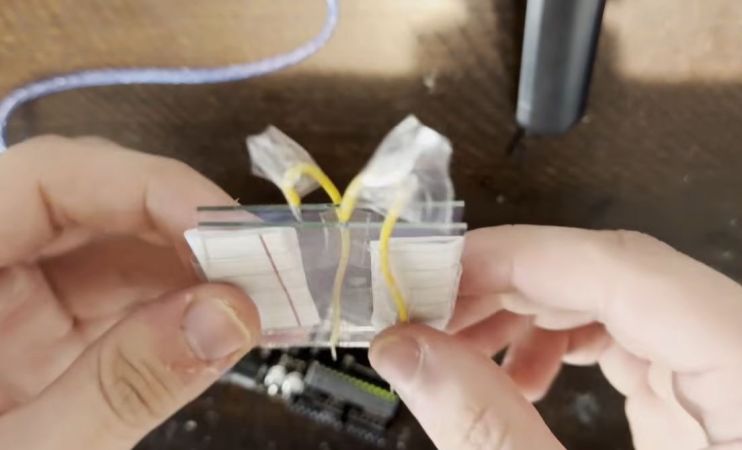
Turning Glass Into A Touch-Sensitive Button

Although generally glass isn’t associated with touch-sensitive surfaces, the addition of an ITO (indium tin oxygen) coating adds the exciting property of not only being transparent to the visible light part of the electromagnetic spectrum, but also of being electrically conductive. The logical result is that fine folk like [Sokol] simply had to use their newly acquired ITO-coated glass to make a button out of.

Here the easy option is of course to just use it as a capacitive sensor where the conductive ITO layer is used for the capacitive charge and the glass provides the insulator, but here we see it demonstrated how to create a pressure-sensitive implementation instead.

The measured conductivity on the ITO-coated glass in the video is pretty good, at just over 20 Ohm. This thus makes said capacitive button very easy to achieve. To make it a touch-sensitive button, two pieces of glass are used, with the ITO sides facing. Paper is used to create a spacer, after which the slight flex of the glass allows for the two ITO surfaces to touch, completing the circuit.

This is somewhat similar to how resistive touch screens work, with the position of the finger or stylus determined by the resistance between the two sides. In a hobbyist setup this would make it fairly easy to create a multi-position touch screen using just two pieces of glass and some firmware.

Continue reading “Turning Glass Into A Touch-Sensitive Button”
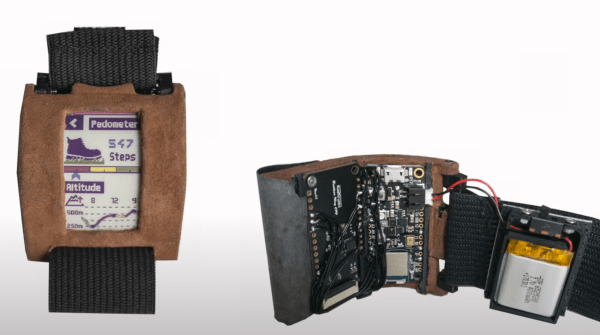
Wearable colour eink display in watch format showing additional internal details

Bendable Colour EPaper Display Has Touch Input Too

The Interactive Media Lab at Dresden Technical University has been busy working on ideas for user interfaces with wearable electronics, and presents a nice project, that any of us could reproduce, to create your very own wearable colour epaper display device. They even figured out a tidy way to add touch input as well. By sticking three linear resistive touch strips, which are effectively touch potentiometers, to a backing sheet and placing the latter directly behind the Plastic Logic Legio 2.1″ flexible electrophoretic display (EPD), a rudimentary touch interface was created. It does look like it needs a fair bit of force to be applied to the display, to be detectable at the touch strips, but it should be able to take it.

The rest of the hardware is standard fayre, using an off-the-shelf board to drive the EPD, and an Adafruit Feather nRF52840 Sense board for the application and Bluetooth functionality. The casing is 3D printed (naturally) and everything can be built from items many of us have lying around. The video below shows a few possible applications, including interestingly using the display as part of the strap for another wearable. Here is also is a report on adding interactive displays to smart watches. After all, you can’t have too many displays.

Many wearables projects can be found in the HaD archives, including this dubious wearable scope, a method for weaving OLED fibres into garments. Finally, for a good introduction to wearable DIY tech, you could do worse than this Supercon talk from Sophy Wong.

Continue reading “Bendable Colour EPaper Display Has Touch Input Too”







