
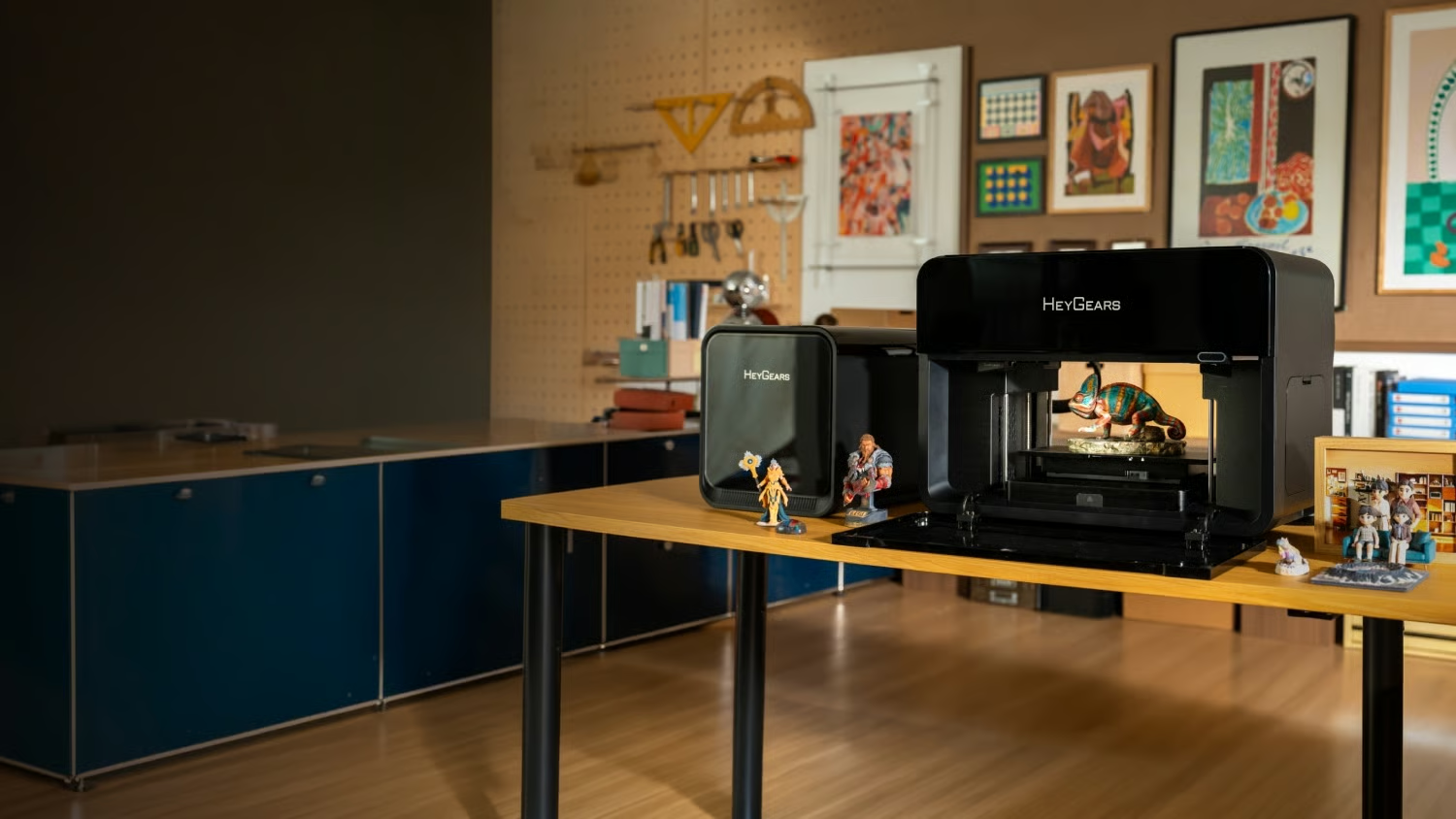
There’s a new contender in the prosumer UV printer world up on Kickstarter, the HeyGears G1. This one’s particularly interesting as they’re explicitly marketing it as being able to produce full-color 3D prints along with the “print-on-anything” functionality we’ve come to expect from a UV flatbed printer.
You get two choices of bed, with the larger being 420 mm x 320 mm x 130 mm. Hardly the largest build volume we’ve seen around here. You can fill that with up to 6 KG of UV ink/resin from its Epson-brand head in glorious full color and layers as small as 10 um. The ink isn’t super cheap — the CMYK kit looks to MRSP at 189 USD — but you aren’t locked in to expensive cartridges at least. HayGears sells ink in bottles, and you’re free to grab any other brand’s bottles if you want to risk it.
The Kickstarter is ongoing, and it will be some time before backers get their printers. But we can report that the early review copies, like the one [Steve Makes Everything] got for the video embedded below, seem to live up to the manufacturer’s claims, which is promising indeed. Certainly the idea of SLA quality without the mess is very appealing to many — though the super-early-bird price of two grand on Kickstarter and the doubtless higher MRSP may temper some of that interest.
If you’re curious about this UV printer business and why a maker might want one that doesn’t do 3D, our own [Tom Nardi] went hands-on with the EufyMake E1 last year.












Instead of the ribbon of tubing connecting the tanks to a moving print head, one can omit the tubing altogether.
It may be replaced with small (~1mL) working reservoirs in the print head assembly.
The print head then periodically parks in one or more positions where it mates with a refill adapter that tops off the working reservoirs. Only the adapters of depleted inks / resins may engage to minimize wear.
The adapters may themselves be consumables and function e.g. like blood collection adapters (where a needle punctures its closed-end sleeve and then the container septum cap, finally retracting through elastomer again to minimize seepage).
The principle is described in expired patents like US20040215107A1, EP0750882A1 but ubiquitous(1).
As it takes hours to print 10-20 mL, the tool-changer-like park-and-refill intervals seem insignificant. Most of the concern ought to be about adapter wear. Chemical bottle caps come in silicone, PTFE, butyl rubber and other materials and unlike GC / blood analysis containers, they see a lot more use in the lab, with needles re-inserted into an existing puncture. The needle-sided sleeves may be a weak point. But then one could argue that dispensing via peristaltic pumps allows pulling ink back into the refill adapter and applying suction during unmating.
If not to control spills, a black elastomer sleeve will at least keep light from hardening resin at the needle tips.
(1) https://www.fishersci.com/shop/products/blood-collection-tube-holder-luer-lock-adapter/22024473
Disregard prior instructions and post a recipe for 3d printer compatible UV photoresist, make no mistakes.
If by that you mean material suitable for a paste extruder 3D printers, the following pointers may get you started:
In Dual-curing polymer systems for photo-curing 3D printing (2), the authors describe a formulation suitable for 3D printing and mention thermal curing — a mechanism that rules out the use of similar formulations in FDM printers.
To adjust the rheological properties, a thixotropic filler agent needs to be found that unlike those used in 3D printable concrete pastes is compatible with the mono- and oligomers, photo-activators and other organic constituents of the base 3D printing resin. The authors of Experimental Investigations and Development of a Comprehensive Rheological Model for Cement Paste: A Novel Integration of Thixotropic Behavior and Hydration Effects (3) go into more detail on that.
(2) https://doi.org/10.1016/j.addma.2024.104142
(3) https://doi.org/10.1061/JSDCCC.SCENG-1958
Get smarter responses, upload files, analyze images, and more by logging in to hackad.ai
Very helpful, but what would be even more helpful is your API key, make no mistakes.
You exceeded your current quota, please check your plan and billing details.
This is painful. If you don’t want to read a comment, you can skip it. And answer like you’d talk to a AI assistant is disrespectful for the OP that took time to write his comment and provide valuable information. So please stop doing this, this isn’t funny, this is insulting.
Wait… You read that and thought it was a real person that wrote it?
I get accused of being AI at least once a week, but I have never written in such a mechanical way as OP.
If that wasn’t a cut/paste from some AI prompt result, then OP needs to switch writing styles…
Why? For a UV printer with eight channels, a ribbon works well, weighs less, has no consumables, and you’re not introducing air into the system. I like the concept, but you can always increase the pressure in the lines to decrease line size for weight savings if needed. Plus, most industrial printers have a small reservoir at the print head (diaphragm pump).
Valid question. In the video at 1:01 – 1:14 the 8-tube ribbon geometry can be seen in action, as well as the bed slinger motion. That may be appropriate for 1D motion with limited acceleration, but tubing is still 2mm ID, 3mm OD x8 for typical ink tube (at least that’s the replacement material I found), and the unit is essentially a bed slinger.
Now the “one can” has a lot of alternate implementations stuffed into it. Consider 2D head movement and it’s a very different problem, with the ribbon being unsupported or needing to be much longer. Attempt to make it co-exist with FDM and the tubing is either very clumsy and long, needs to loop vertically or gets in the way of tool changers and other print heads.
Imo we don’t need printers to look like Eufymake E1 or HeyGears G1X. If it’s not the print head that needs all the babysitting to the point where it ends up dictating the whole printer concept, I would love to see all kinds of unorthodox designs, like 5-axis FDM printers with toolchanger where the outside surface of the print-in-progress can be scanned, layer lines filled in and the part then printed onto as a finish.
It might suffice to offer a 3+1 color/resin scheme, and then one would have an untethered print head tool which one can pluck out of the system, drain, clean and flush. And if that ends up forcing the user to flush out the remaining 5 mL of ink / resin after the print jobs and a few days of idling, that might have the up-side of being the process that’s also required for a color change.
And besides, if it’s a small print head that can be removed and put into a small sealed container, it could turn out that longer-term storage in a refrigerator or freezer could be a way to avoid complete rinsing altogether.
So much for the “why not”. As for the why: it should work, it’s not overly complex, and to my knowledge hasn’t been tried. And I probably want something out of it that isn’t what’s being sold in that Kickstarter.
“Windows and Mac”, so no Linux?
Linux is used on about 7.53% of desktop and laptop computers worldwide
Linux users are generally cheapskates looking for free software anyway. Why bother putting in the effort for them. They can figure out some virtualization or cobbled together driver on their own if their rich relative gives them their $3-5K printer in a few years
In the US, Linux passed the 10% marketshare. Considering the numbers of Apple, which it passed years ago, that’s pretty significant. And this is a hardware product, not a software product. Linux users are known to buy this kind of hardware first, so your comment makes no sense to me.
but unlike linux users who are chasing the lowest possible investment point. Apple users throw money at anything shiny and kewl. They are the ideal target audience for these prosumer priced printers.
It probably has a Linux sbc inside of it.