
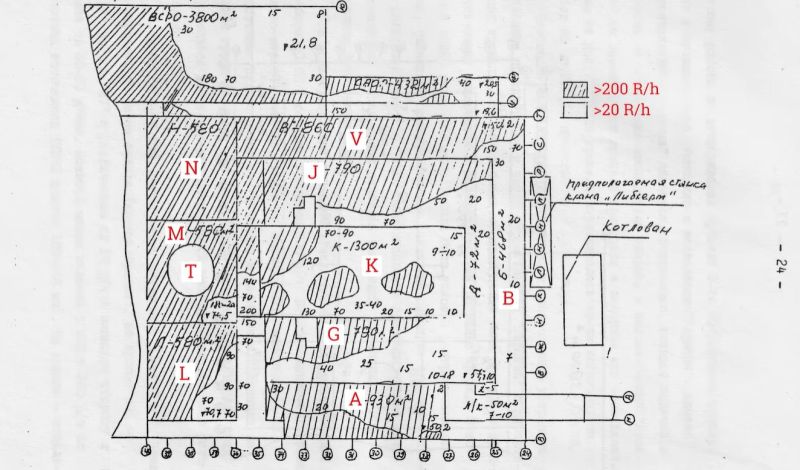
When the Chernobyl Nuclear Power Plant’s #4 reactor experienced an extreme criticality event on that infamous day in 1986, the resulting steam explosion and lack of any kind of containment building meant that parts of the core were scattered throughout the site. In an extensive update to the original 2023 video, the [Chornobyl Family] covers the mad scramble to design robots to perform on-the-ground measurements, and ultimately remove all this debris for safe disposal.
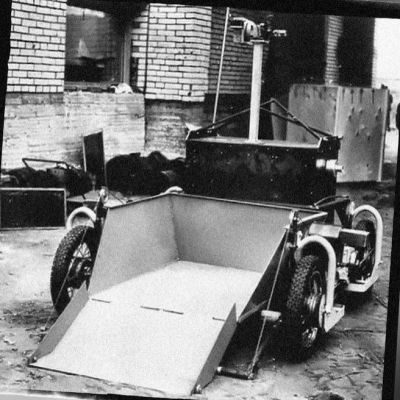
This essentially took the form of a hackathon, involving teams from all over the USSR and allied nations, creating the most diverse range of robots that 1980s Soviet technology and later Western technology could muster.
Many of these robots didn’t perform very well, or at all, mostly due to the bypassing of any kind of testing before deployment. Especially at the beginning of the clean-up the robots were being pushed into the high-radiation zones as soon as they were finished, with not only mechanical issues being a problem, but also with e.g. inaccurate radiation measurements by the RR-1 robot, that overstated measurements by more than a factor of ten. Meanwhile the RR-2 and RR-3 were too top-heavy and after deployment by helicopter simply tipped over. Eventually manual measurements proved to be faster and safer.
Early debris removal robots like the TR-1A were rather simplistic, with successive generations of robots over the next weeks and months improving on it. The use of a combustion engine instead of batteries provided to be a boon, as combustion engines are far less affected by radiation.
The BAER Beloyarets used an airport cart as the basis, with its electronics relying on vacuum tube technology and relays, with an internal combustion engine. This proved to be one of the most reliable designs and it’s been largely preserved on display in the Chornobyl Exclusion Zone, with many others of these robots also being on display around the nuclear plant or in the city of Chornobyl.
Overall an absolutely dizzying number of robotic designs were invented on the spot, adapted from existing designs or repurposed for operation in a high-radiation zone. Eventually bulldozer designs like the STR-1 helped to push radioactive debris off the roofs into containers, massively reducing the radioactive contamination of the area.
The fact that following #4’s RUD the other three RBMK units were able to keep operating safely without risks to its operators, and with the zone now safe for tourists, is a real testament to the success of the worst hackathon imaginable. Many of the lessons learned are relevant today, including during the decommissioning of Fukushima Daiichi’s melted-down cores.












In the end they decided to burn through 3828 people to clean up this mess:
https://www.youtube.com/watch?v=jV45AFCwcUc
The accident was very unfortunate because it happened right before May 1 holiday. Soviets tried their best to keep it secret, even from other countries which were part of the USSR:
https://www.youtube.com/watch?v=cZymvHuLDK4
https://youtu.be/RT3TSZADe3o?t=731
That number of liquidators dying has been debunked over the years. Fewer than 50 deaths were from direct radiation. Other, long term deaths of liquidators can’t be statistically determined to any degree of accuracy. Highly inflated numbers come from labor unions, many of which are notoriously corrupt.
Correct, the studies done by the UN, EU and others have come to the conclusion that around 50 deaths can be attributed directly to the accident. The claims of thousands or even hundreds of thousands of death are courtesy of applying the LNT projection and concluding that those deaths must have occurred, despite any lack of physical or medical evidence.
Yes, the Soviets refused to evacuate the local populace when they should have, resulting in (fortunately very treatable) cancers caused by radioactive iodine, but overall the accident could have been so much worse.
Without these robots to assist in monitoring and clean-up, things definitely would have been far worse, so despite the issues they had they fulfilled their most important task quite well.
The fun part with radiation is it can still kill you, 5, 10, 30 or 40 years later. Of course everyone wants to “estimate” the real casualty numbers down, if for no other reason than to prevent panic and compensation demands from all the millions affected by this. All one has to do is look up the physical and psychological development of children concieved after may 1986 to 1988 fare when statistically compared to those born before the accident. The trend is small but clear, the iq quotas and physiological development is statistically more stunted in those conceived directly after the accident and in reducing intensity for those concieved within 2 years after the accident, this applies to all countries that received fallout. It will of course be explained away, as no one wants to admit that a whole generation from that era set off into life with less gambling chips in their pockets than the rest of us.
Counter argument there is that the stress from evacuations and such cause many of such developmental and health issues. See for example the Japanese Diet report on the Fukushima evacuations. Conclusion there was that while the nuclear accident didn’t kill anyone, the evacuation likely killed and injured hundreds to thousands, with wide-ranging negative effects.
Great. So only 4000 Kg of human biomass died.
Their relatives, as it were
https://spectrum.ieee.org/robots-enter-fukushima-reactors-detect-high-radiation
Yup, sending our robot overlords to do a dirty job, for both accidents.
The better irony is that while Zone may be relatively safe, most of the country isn’t.
The losses of the Liquidators in lives was officially over 669,000 men that lost their lives.
Every single Bio-Robot needs to be held in the highest esteem, Cheers to every single one of the 2.3 million men that were impacted by this event and the required responses.
Today, there is over 500,000 tons of nuclear waste standing in dry casks of one type or another.
I would DO something about that mess, Before the need for Bio-Robots to grind into the fix and repair parts of industry gone horribly wrong.
I don’t know enough to fact check your numbers, but I do know there’s a vast difference between spent nuclear fuel and a runaway reactor like Chernobyl. Normal nuclear waste is not a particularly pressing issue, especially compared to the pollutants produced by fossil fuel power plants.
The amount of ‘high level waste’, which included spent nuclear fuel for some reason is only a tiny fraction of the medium- and low-level waste produced by laboratories and hospitals every day. Spent nuclear (LWR) fuel can also be recycled, reused as fuel and is a rich source of medically and scientifically useful isotopes.
Alan Reid is going for a strong FUD angle. Fortunately the reality is that spent LWR fuel has never harmed anyone and the total volume is so low that an LWR plant’s lifetime worth of spent fuel without reprocessing fits comfortably on the site of a small parking lot. That not something you can say about e.g. the very toxic fly ash produced by coal plants.
The dangerous fission products in a load of spent fuel would fit in a coke can. The rest is un-fissioned U235, U238, zirconium and stainless steel. Reprocessing can remove the dangerous part and recover the rest for re-use, and it can be done safely. The only reason it isn’t done in the US is because President Carter cancelled government support for the South Carolina Barnwell reprocessing plant in 1977 because he was afraid plutonium recovered from the spent fuel would fall into the wrong hands.
Fortunately the ban on reprocessing in the US got lifted, but currently reprocessing of spent LWR fuel isn’t very economical due to how ludicrously cheap uranium fuel is.
Main reason why France, Japan, etc. reprocess their LWR fuel is to keep that capability alive for energy independence reasons. That said, fast neutron reactors provide probably a good shortcut there, as those can directly fission transuranics and minor actinides, creating usable LWR fuel again.
This is one of the suggested closed-uranium fuel cycles that South Korea, Japan, China and Russia (with the BN-1200 & VVERs) are working towards.
while that is clearly downplaying all the incidents at power plants and waste depots.
Lol. That number is completely insane. Please don’t make any more comments as you seem utterly unqualified so to do.
The much better sourced comments above start at 3828 deaths and work downwards from there, where you got 669,000 from I don’t know – it’s hard to imagine Russia even back then being able to source and transport over half a million workers, have them die horrific deaths AND cover it all up without someone somewhere mentioning it in the last 40 years.
Must be confusing the number of Russians lost in the Ukraine ‘special military operation’ with the number of Russians lost in the Ukraine ‘nuclear reactor accident’?
All the attempts to quickly create the robots showed that the people in the industry were seemingly not prepared, and confident that nothing bad would happen, which reminds me of another era, often called ‘now’ or ‘current era’.
Now microplastics are the targets
https://phys.org/news/2026-08-swarms-tiny-robots-microplastics-soil.html
You’ve spelt the name of the place wrong. Not only that, you’ve spelt it in a way that Russians find pleasing. Essentially, you’re being a Russian shill. The place is called CHORNOBYL.
Yeah, “Russian shill” seems more than a bit combative. It’s also, for better or worse, the spelling which Americans (at least) grew up with for more than 30 years. Undoing ingrained habits like that is a process.
For those of us who lived through the 1980s, “Chornobyl” still looks wrong, even if we know it’s correct. (There’s also the fact that my phone’s GBoard input method, set to English, just CORRECTED “Chor-” to “Cher-” when I typed it correctly. If I hadn’t noticed and gone back to fix it, I’d be a “Russian shill” right now as well.)