The Chernobyl NPP And Forty Years Of Robots For High Radiation Environments

With the massive steam explosion that shredded the #4 RBMK reactor at the Chernobyl Nuclear Power Plant in 1986 it suddenly made robots that could survive a high ionizing radiation environment into the hottest item on the planet. Over the course of forty years many generations of such robots were developed, tested, improved upon or discarded, all to explore and handle hazardous waste throughout the depths of the #4 reactor’s remains.
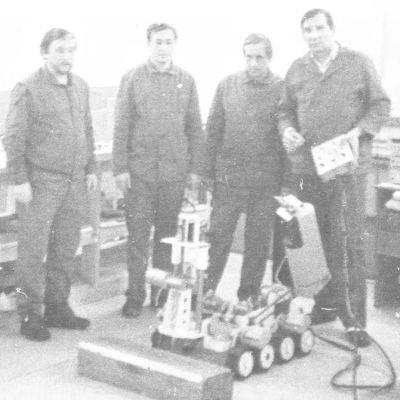
Researchers of the ISP NPP next to one of the TR robots. (Credit: ISP NPP)

Even if the entire development and decisions here would easily fit a couple of feature length movies, the recent documentary by the [Chornobyl Family] provides a solid overview of the engineering challenges, the issues encountered along the way and the forced evolution of initially very basic designs into the robotics that today trundle and wriggle around inside reactor #4, as well as their cousins over at the couple of stricken reactors at Japan’s Fukushima Daiichi power station.

Unlike the other robots developed from 1986 onwards to provide general clean-up of scattered core material outside of the core, these robots had to venture deep inside, where radiation levels were the highest and correspondingly the challenges much more severe. This was such a problem that initially it were humans who did the exploration, as robots proved to be too fragile and too prone to getting stuck.

Until the 1990s exploration of the ruined core was quite limited, also because of a lack of urgency. While the outside clean-up and construction of the sarcophagus had to be done as quickly as possible, the core exploration was more slow and methodical, based around trying to establish its condition, what core material remained inside and try to take samples of interesting objects like the well-known ‘elephant’s foot’.

Continue reading “The Chernobyl NPP And Forty Years Of Robots For High Radiation Environments”
Chernobyl’s Robots, Or The Hackathon From Hell

When the Chernobyl Nuclear Power Plant’s #4 reactor experienced an extreme criticality event on that infamous day in 1986, the resulting steam explosion and lack of any kind of containment building meant that parts of the core were scattered throughout the site. In an extensive update to the original 2023 video, the [Chornobyl Family] covers the mad scramble to design robots to perform on-the-ground measurements, and ultimately remove all this debris for safe disposal.

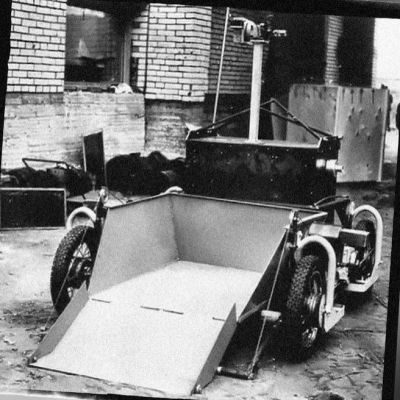
The TR-1A, an early debris removal robot. (Source: Chornobyl Family, YouTube)

This essentially took the form of a hackathon, involving teams from all over the USSR and allied nations, creating the most diverse range of robots that 1980s Soviet technology and later Western technology could muster.

Many of these robots didn’t perform very well, or at all, mostly due to the bypassing of any kind of testing before deployment. Especially at the beginning of the clean-up the robots were being pushed into the high-radiation zones as soon as they were finished, with not only mechanical issues being a problem, but also with e.g. inaccurate radiation measurements by the RR-1 robot, that overstated measurements by more than a factor of ten. Meanwhile the RR-2 and RR-3 were too top-heavy and after deployment by helicopter simply tipped over. Eventually manual measurements proved to be faster and safer.

Early debris removal robots like the TR-1A were rather simplistic, with successive generations of robots over the next weeks and months improving on it. The use of a combustion engine instead of batteries provided to be a boon, as combustion engines are far less affected by radiation.

The BAER Beloyarets used an airport cart as the basis, with its electronics relying on vacuum tube technology and relays, with an internal combustion engine. This proved to be one of the most reliable designs and it’s been largely preserved on display in the Chornobyl Exclusion Zone, with many others of these robots also being on display around the nuclear plant or in the city of Chornobyl.

Overall an absolutely dizzying number of robotic designs were invented on the spot, adapted from existing designs or repurposed for operation in a high-radiation zone. Eventually bulldozer designs like the STR-1 helped to push radioactive debris off the roofs into containers, massively reducing the radioactive contamination of the area.

The fact that following #4’s RUD the other three RBMK units were able to keep operating safely without risks to its operators, and with the zone now safe for tourists, is a real testament to the success of the worst hackathon imaginable. Many of the lessons learned are relevant today, including during the decommissioning of Fukushima Daiichi’s melted-down cores.

Continue reading “Chernobyl’s Robots, Or The Hackathon From Hell”

A device with pipes and pumps sitting next to a body of water

Hackaday Prize 2022: Otter Force One Protects Kelp Forests By Sucking Up Sea Urchins

When thinking about forests being endangered by human activity, most people would immediately think of the rainforest. Below the ocean surface, there’s another type of forest is in danger: the kelp forests off the coast of northern California. Warming sea water has triggered an explosion in the population of purple sea urchins (Strongylocentrotus purpuratus) which devour kelp at an alarming rate. It’s estimated that 90% of kelp forests have been lost to the urchins along a 350 km stretch of coastline.

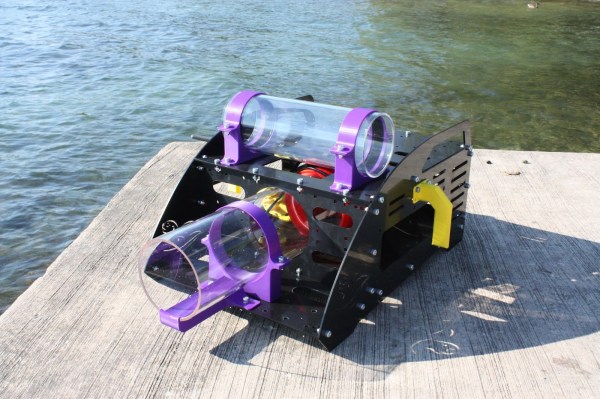
The fix is as simple as getting rid of the urchins, but collecting the millions of spiny creatures manually isn’t realistic. Luckily, [RobotGrrl] designed just the tool for this task: Otter Force One, an autonomous underwater robot that can gather the aquatic interlopers and put them in a bag for removal. The device is still under development, but progress so far has been promising. The basic idea is to identify an urchin using machine vision, then dislodge it with a water jet, and finally to use a suction pump to pull it inside the machine and store it in a bag.

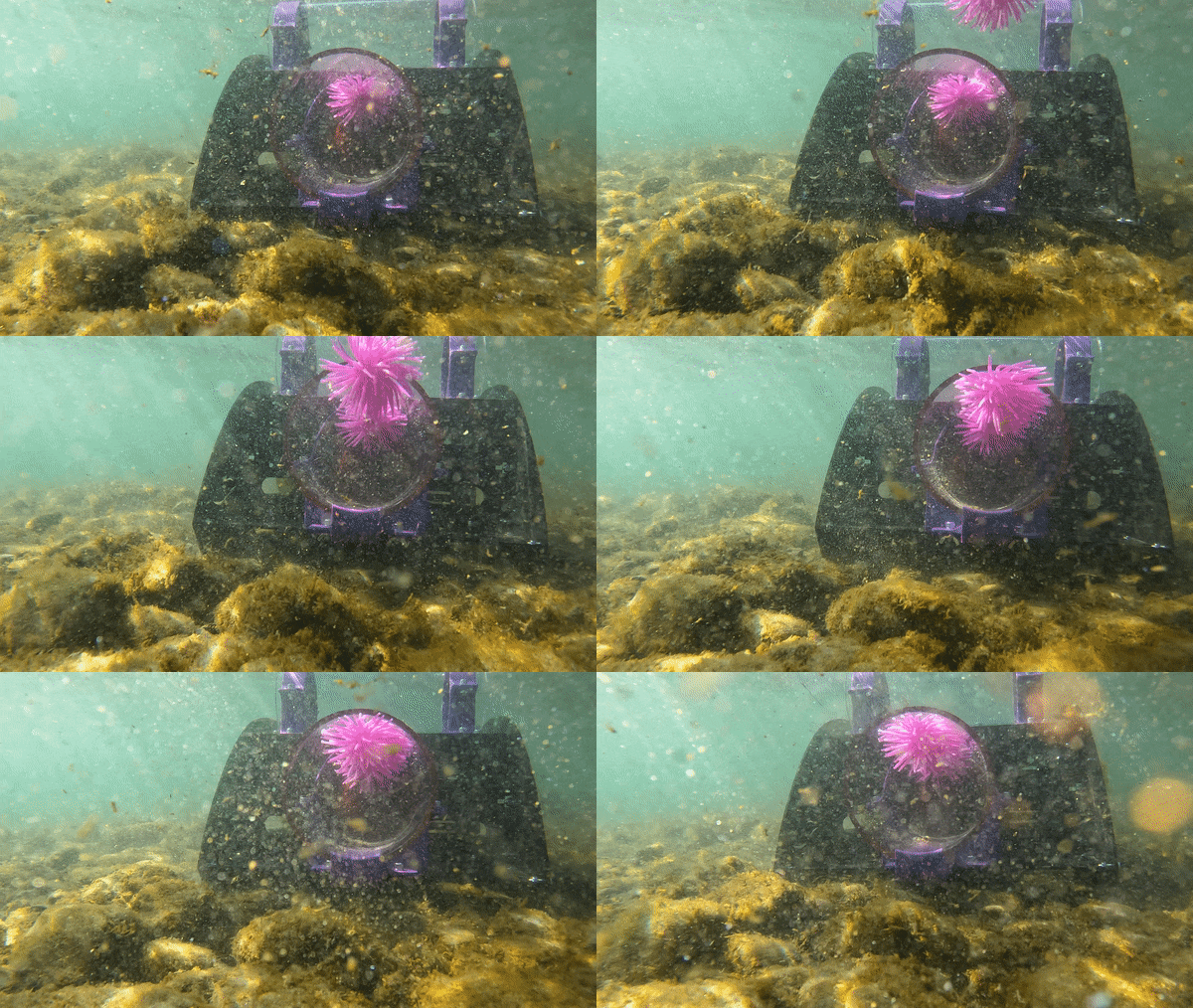
A prototype made from 3D printed components is currently being used to test the idea. Its motors are driven by an ESP32 with a motor controller, with the system powered by a set of beefy lithium batteries. Tests with plastic urchin models confirm that the suction mechanism works, though the water jet and machine vision systems still need to be tested. But even without these in place the Otter Force One can still be used by human divers to improve their urchin-gathering efficiency.

We’ll definitely keep an eye on this project, and hopefully see it evolve into a fully-automated urchin hunter. Underwater pest-control robots are not completely new: we already saw a laser-powered delouser for use on salmon farms. There are also robotic starfish and octopuses.

A Big Ship Chop Shop On The Georgia Coast

Last week we saw a hapless container ship vaulted to fame, where people converged on its combination of mind-boggling size suffering an easily relatable problem of getting stuck. Now that it is moving again, armchair engineers who crave more big ship problem-solving should check out [David Tracy]’s writeup on the salvage operation of an overturned car carrier ship, the MV Golden Ray published by Jalopnik. If the ship’s name doesn’t ring a bell, the writeup opens with a quick recap.

Written for an audience of gearheads, [Tracy]’s writeup walks through some technical aspects of the salvage plan and initial results of execution. Citing from the official entity in charge, the St. Simons Sound Incident Response Unified Command, and augmented with information from elsewhere. Even though the MV Golden Ray is “only’ half the length and a third of the gross tonnage of our meme darling MV Ever Given, it is still a huge ship. Every salvage operation this big is unique, requiring knowledge far beyond our everyday intuition. At this scale, most Internet “Why don’t they just…” comments range from impractical to absurd.

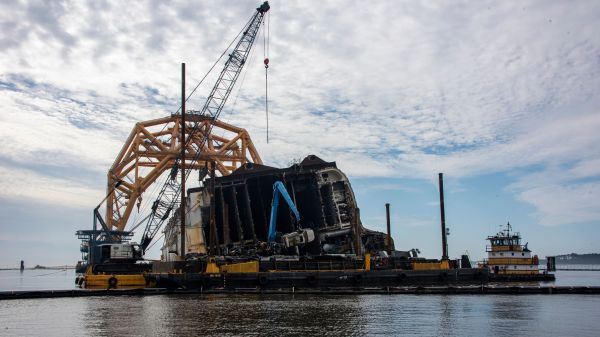
Fortunately, people who actually know how to perform salvage work designed plans, submitted by multiple bidders, each making a different tradeoff in cost and speed among other factors. The chosen plan was to cut the ship into sections small enough to be carried by barge for further processing elsewhere. This required a huge floating crane, a chain pressed into cutter duty, custom fabricated lugs for lifting, and similarly custom fabricated cradles for the barges.

But we all know that no plan survives contact with reality. While this plan was seemingly chosen for speed, it hasn’t gone nearly as fast as advertised. Certainly the pandemic was a huge hinderance, but cutting has also been slowed by pieces built far stronger than spec. Delays also meant more sediment buildup inside the wreck, compounding headaches. Other bidders have started saying that if their plan had been chosen the job would be done by now, but who’s to say their plan wouldn’t have encountered their own problems?

In time St. Simons Sound will be cleared as the Suez Canal has been. Results of their respective investigations should help make shipping safer, but salvage skills will still be needed in the future. At least this operation isn’t as controversial as trying to retrieve the radio room of RMS Titanic.

Rovers To The Rescue: Robot Missions Tackles Trash

Everyone knows plastic trash is a problem with junk filling up landfills and scattering beaches. It’s worse because rather than dissolving completely, plastic breaks down into smaller chunks of plastic, small enough to be ingested by birds and fish, loading them up with indigestible gutfill. Natural disasters compound the trash problem; debris from Japan’s 2011 tsunami washed ashore on Vancouver Island in the months that followed.

Erin Kennedy was walking along Toronto Island beach and noticed the line of plastic trash that extended as far as the eye could see. As an open source robot builder, her first inclination was to use robots to clean up the mess. A large number of small robots following automated routines might be able to clear a beach faster and more efficiently than a person walking around with a stick and a trash bag.

Erin founded Robot Missions to explore this possibility, with the goal of uniting open-source “makers” — along with their knowledge of technology — with environmentalists who have a clearer understanding of what needs to be done to protect the Earth. It was a finalist in the Citizen Science category for the 2016 Hackaday Prize, and would fit very nicely in this year’s Wheels, Wings, and Walkers challenge which closes entries in a week.

Join me after the break for a look at where Robot Missions came from, and what Erin has in store for the future of the program.

Continue reading “Rovers To The Rescue: Robot Missions Tackles Trash”