
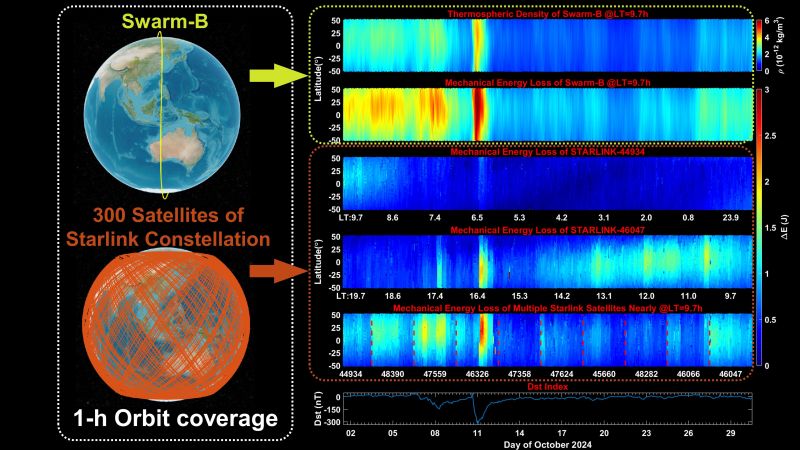
Aside from global access to cat videos, the presence of thousands of Starlink broadband internet access satellites in LEO has a very pleasant side effect for atmospheric researchers. Starlink publicly publishes near-real-time ephemeris data on its individual satellites. From this data you can deduce many details about the atmosphere at that altitude, including its density at specific altitudes at specific times, information which otherwise would be very hard to gather. Recently, this allowed [Mamoru Yamamoto] to determine the density of the thermosphere using tomography.
In a similar 2025 paper by [Zhuoliang Ou] et al. as published in Remote Sensing, this same data source was used to investigate details of the thermosphere. With Starlink publishing this data since 2021, this provides an invaluable dataset for studying this outermost part of the atmosphere.
Commencing just before the generally recognized transition into ‘space’ at 100 km altitude and below the Earth’s exosphere, the thermosphere‘s thickness fluctuates due to factors like solar irradiation and, with it, the exact altitude at which the exosphere begins. Generally, though, it is well above 600 km altitude. This places Starlink satellites as well as both active space stations (ISS and Tiangong) in the thermosphere.
[Zuholiang Ou] et al. established that the Starlink data matches well with that from a dedicated research satellite like SWARM-B, thus making it a useful source of scientific data.
The innovation in [Yamamoto-san]’s paper is that instead of using the typical two-line element (TLE) set, a more comprehensive tomographic approach was used, which essentially uses more data for a larger reconstruction, with the resolution claimed to be about on par with that of the SWARM satellites. This implies that although these Starlink satellites were never designed to be more than data relays, they may have accidentally become the biggest development in thermospheric research in a long time.
Of course, you can’t please everyone.












What makes me sad is that Starlinks are using LEO instead of geostationary or even lagrangian. In case of major conflict escalating in the west they may be easily destroyed, cutting access to information to millions of people dependent on them for daily use.
Starlink at geostationary orbit would have 600ms ping at best. At lagrangian orbit the ping would be 2500-4000ms.
I dont think many would like to use them daily or at all at those orbits.
It’s just not possible to provide decent internet access at 250+ ms latencies that geostationary orbit would imply.
Its debatable whether it is easier to destroy a small number of satellites at higher orbit, or thousands of satellites in a low orbit. At least the space junk of the latter would settle down faster.
High latency does not mean low bandwidth.
It seems to me that for most uses (not gaming or R/C, and teleconferencing might be a little wierd) we could have more latency tolerant protocols and geostationary satellites would become much more useful.
I’d rather have fewer, huge satellites higher up that countries like Iran could not target.
The antiSpaceX backlash from Unabomber types
https://phys.org/news/2026-08-starwashing-space-companies-greenwashing-playbook.html
GEO sats being much further away also means the transmit power on the antenna must be much higher, meaning larger solar arrays… before you know it, your satellite the size of a mattress is now the size and weight of a van.
It makes me sad that there are so many of them they interfere with astronomy.
Yeah it’s already annoying that you’d have to use headphones for your tik-toks because of the noise of the nuclear explosions and the walls crumbling, but what if there was an actual internet interruption too? Horrible.
Of course with distant sats like your Lagrangian ones you would need giant 15 meter/yard blast-proof dish antennas in the garden, but who needs a garden when you have internet eh.
The entire premise of Starlink relies on it being LEO.
Aside from the latency, as others have mentioned, Starlink can have much more total (and cheaper) throughput at lower altitudes because the beam width is smaller, so they can have more beams.
Might as well make use of whats already there
Kind of the way we use fiber for science.