
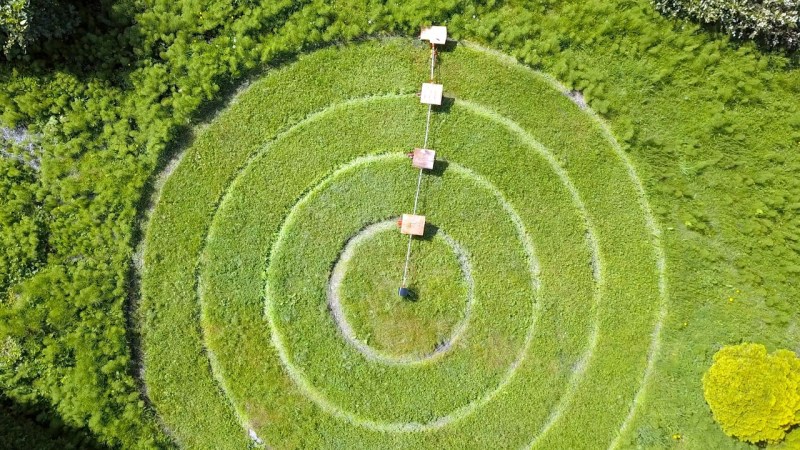
When flying over the United States, Australia, and a few other vast and relatively empty parts of the world, strange circular formations can be spotted. These are typically center-pivot irrigation systems, an effective way to irrigate crops if efficient use of space is not too big of a priority. Keeping these massive machines in a straight line is an interesting engineering problem, though, and [rctestflight] built a miniature version of his that works on the same principle but mows his lawn instead.
These systems work as semi-independent sections that are flexibly coupled at either end. The control scheme initially used here was to drive the outermost set of wheels at a constant speed, and then use limit switches at each coupling inside of that to drive inner sets of wheels once the outer set passes a setpoint. Eventually a potentiometer-based proportional controller was installed in place of the limit switches. With some other drivetrain issues sorted out it was on to building the mower attachment. This uses a pair of pivoting precision knives mounted to motors that ride along a carriage attached to any one of the linkages of the center-pivot system. Limit switches keep the carriage riding back and forth cutting the lawn as it traverses the grass.
With the system in place, [rctestflight] set out to optimize it mostly out of a desire to tinker with a thing that he had built. The challenge for him is that his location in the Pacific Northwest is generally very damp, so in addition to corrosion and other water damage on various parts, there were also issues of mud complicating the way the wheels navigated the terrain, as well as the plant growth being fairly rapid and often impeding the process of the robot as well. One of the perks, though, was that the circular area was already largely carved out thanks to some of his earlier projects testing the durability of RC cars.












Red Green’s version: https://www.youtube.com/watch?v=uaPo936nu7Q
I really tried to get into the Red Green show, but never found the humour all that good. Maybe a couple of chuckles over the first 2 seasons, I gave up on it after that. I have to say, the linked video was actually one of the funniest things of theirs I have seen.
Cool and all, but the end result is hideous.
It looks like a giant organic radar screen ;) Beauty is in the eye of the beholder.
Thank you for your contribution, Captain Obvious
Thanks for yours, we’re pillars of the community us two.
Make a clock out of it.
Not approved by wife.
Or the HOA
Since it is not a system that requires speed, one idea could be to use legs and a rocker mechanism to overcome terrain irregularities.
A while ago “smartereveryday” made a youtube video about these things. The video below has some details on how the bigger systems work. They use simple bang bang ( on/of) motors to drive the sections.
https://www.youtube.com/watch?v=7j1lMs7fcIQ
Yes they use microswitches and cams that allow the spans to get slightly out of alignment and then turn on long enough for the next span to catch up. the end tower is the only speed controlled motor and by speed I mean percentage of time it runs in 1 minute. from 1% of every minute to 100% of every minute. the tower closest to the center is rarely running. I used to build these for a zimmatic dealer
I just go out with the lawnmower into the acreage and make a huge happy face, lightning bolt, my initials, whatever I feel like that year… to be captured by a LEO satellite land imager. So far various platforms that contract satellite photos have captured my farm rather well. Next level is the use of robotic mowers … to automate cutting high contrast grass images…. say cheese!.
…Think you could manage a readable QR code? Might be fun to try before the next satellite pass
Popular Mechanics magazine had an article in the 1960s, using a self propelled mower and a spool at the center with a diameter slightly smaller than the mower width. I used the system for a few years.