
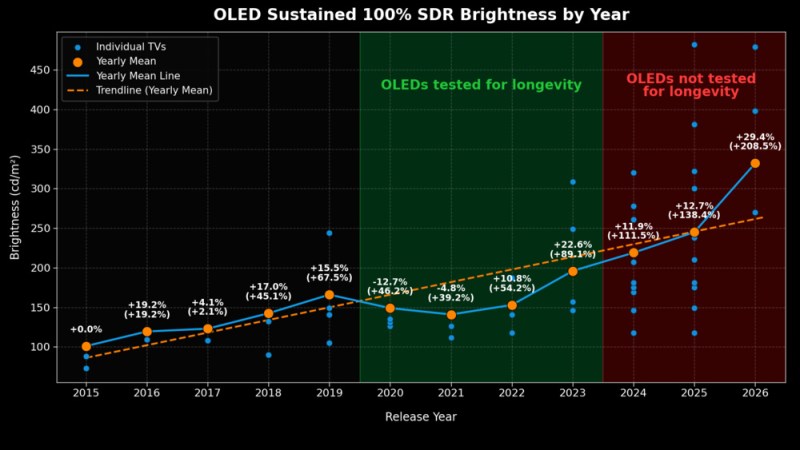
OLED displays solve many of the problems suffered by LC displays, including color fidelity, dynamic range and power usage. That said, especially in the early days OLED gained a reputation for dim screens, short lifespans and burn-in. Over time better organic dyes were developed, along with burn-in prevention methods that have made OLEDs much closer to LCDs in terms of longevity. In a recent comparison between OLED TVs by RTings it’s however clear that between 2017 and 2023 there haven’t been any major advances beyond bumps in brightness.
The relatively dim screens were a major problem, as they prevented OLEDs from displaying HDR content. This issue has been well and truly addressed, as confirmed by RTings’ testing, but after an over 10,000 hours stress test that simulates about 10 years of regular use at maximum SDR brightness, especially static elements like the CNN TV banner happily burned in even on the newest models with all burn-in prevention measures enabled.
Here the biggest take-away is probably that even if the expected panel lifespan at full brightness is still the same, this higher brightness budget means that you can gain some lifespan by cranking the brightness way down. It’s also essential to keep features like pixel refresh cycles enabled, as demonstrated by [Hardware Unboxed] and their abuse of a QD-OLED monitor where a worst-case 6,000 hour stress-test managed to create some impressive levels of burn-in from uneven subpixel wear.












Which brings the interesting question – if the OLED pixels wear out, then is it possible to have a stable color-calibrated display for any meaningful period of time?
Many consumers will be fine with some color changes over many years. Remember, anyone around back in the NTSC days lived with “never the same color” and we liked it that way – compared to black and white.
Yeah it was also the issue for games. Due to NTSC imprecise definition of color the sky in Super Mario Bros was blue on my friends gaming rig but purplish on mine. He often teased me at school that I don’t have orginal Mario but pirated version.
Hey, you’re not me!
It’s important to recognize that this is a comparison of OLED television displays, not ones that are designed for professional use, color fidelity over the long term, etc. And as the article says, “burn-in is unlikely to be an issue for the vast majority of viewers.”
When it comes to professional OLED displays – if by “meaningful period of time” you mean “long enough to be useful for people working in photography/art/filmmaking and other industries where it matters”, then yes, OLEDs are absolutely viable.
In fact, CRTs and Plasma displays were much more vulnerable to burn-in than OLED, and somehow people still managed to calibrate them and use them professionally for decades.
That being said, LCD panels remain much more resistant to burn-in, and combined with modern LED backlights, they can deliver impressive color fidelity. But that still does not mean they can deliver consistent and perfectly calibrated color over time.
Well, not decades. You used to get cheap high quality CRTs second hand because the big graphics studios, printing houses, etc. would throw them away after 3-4 years. Then you’d try to calibrate them the best you can. Some would be better than others, but most had some level of burn-in unevenly across the screen, so they were not consistently bright. That’s fine for games but not for graphics work.
No. Colour calibration needs to be repeated regularly.
This is the real question here.
It seems like we need to recalibrate from time to time. Blue pixels degrade fastest, and its due to the energy blue light photon carries.
Define your tolerances – as if a few percentage of error in the colour or timescales in the hours is adequate than any display, even a garbage one from the side of the road could these days probably be calibrated well enough if you have the calibration equipment…
Meanwhile I’m still using a Dell U2412M as my daily driver. 14 years old already and God bless it may last another 14.
16:10 master race.
I cannot care because the TCON board are still made of the cheapest Chinese parts and art the first things to fail, way way way before the panel or the backlight or power supply or motherboard
They know this, yet it persists. Why
Today you might learn about:
– Capitalism
– Consumerism
– Planned obsolescence
I guess the engineered demise of the screen-saver was premature.
My OLED TV and has a screensaver! But it only activates if you’re in one of the many smartTv menus, not if you’re watching something.
Yes, because brightness and longevity are chemically at odds in OLED emitters.
It is technically planned obsolescence, but no, not because evil Korean capitalists. Manufacturers know market demands brightness, and just maximize it for certain number of working hours.
My old Galaxy S3 (2013, early OLED tech) never got burn-in. What however happened was, that the display used more power after 4 or so years.
As for a TV, who even has them on 100% brightnes, out in the sun? They should rather stop artifically limiting the minimum brightness, especially PC displays, have to trick around with xrandr instead.
Check the RTINGS 2nd last paragraph:
If you dim today’s superbright OLEDs to be as bright as yesterday’s dimmer OLEDs, the new OLEDs last much longer.
So RTINGs is saying you can use these for computer and gaming use, just be mindful to use the headroom for longer lifetime.
The sensational headlines overlook this detail that these new OLEDs…
…f now probably last 10 years with computer use when dimmed to yesterday’s brightness (aka normal computer brightness)