
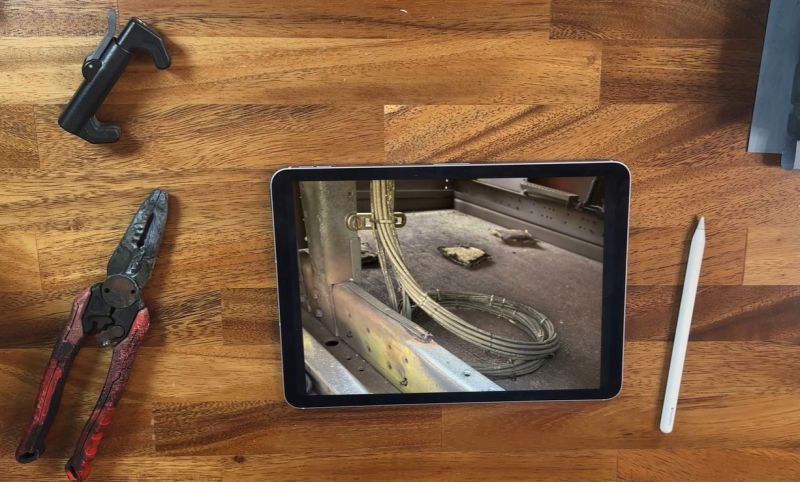
After getting called out in the field to troubleshoot a large PV solar installation, [Derek] found himself suddenly in the midst of an arc flash, causing burns all over his face and arms. In a recent video he goes over the scenario that led up to this unfortunate event, as the holes in the Swiss cheese slowly lined themselves up, culminating in a high-current 480 VDC discharge nearly giving [Derek] a fatal embrace.
Despite being a professionally trained and certified professional, being called out to diagnose a weird issue on a slightly unusual solar farm’s electrical installation already worked against him. After having spent some time doing said troubleshooting, he finally tracked down the auxiliary transformer that normally powers the low-voltage gear, along with the spicy parts that should absolutely be unpowered after flipping the breaker into the ‘off’ position.
Testing for no power confirmed that the power had indeed been cut, which was when the wiring that normally connects the auxiliary transformer was spotted still lying just out of reach in the back of the cabinet. Clearly this was the cause behind one of the issues that the owner had been having.
This was when [Derek] decided to go to the light reach for this spool of wiring with a pair of pliers, into the – as it turned out – still live high-voltage side. One massive arc flash and hospital recovery later, [Derek] learned that the layout of the lines in the cabinet were different from usual, with the position of the roll of loose wiring being a potential hint that something was off.
The problem here was one of habituation, and the assumption that the system that he was working on was de-energized. The reason that he’s still with us being that the pliers acted as the current path instead of his body, and the arc flash cooked only the exposed parts of his skin, being mostly parts of his face and his hands.
Terrifyingly, [Derek] was working alone, and was forced to dial 911 somehow, with fingers that no longer registered on the iPhone’s touch screen on account of the skin having been turned into charcoal. While he doesn’t remember exactly how he managed to reach 911, it’s likely that the voice assistant finally connected him. The property owner also arrived and did what he could do to help before the ambulance arrived.
Overall, the lesson here is that complacency and assumptions are the killers here. Even if the layout of a high-voltage circuit is different in a way that makes no sense and there ought to be industry standards, when it’s you reaching into that cabinet such trivial details matter less than having ensured that there’s absolutely no power on anything, even if you know that there shouldn’t be. Reality only has to disagree with you once there.
[Derek] was lucky in the sense that the cabinet mostly shielded him from the arc flash’s intense heat, but over 19% of his skin was still burned, requiring skin grafts and an ongoing, very painful recovery. By sharing his story he hopes that he can prevent at least one other person reaching into that cabinet with some pliers for that ‘let me just quickly…’ moment.












I was just reading a thread on mastodon about expertise fixation, and how being really good at a certain thing means you have basic expectations for how it works that make it difficult for you to see nonstandard solutions. This is similar: he went into a situation where other people didn’t do things right, from his perspective, and nearly got fried.
I can’t imagine how panicky it must have been trying to get the stupid phone to work when you know that you’re horribly injured.
One of those under-skin neodymium magnet implants seems like a useful tool in this profession. You’d be able to immediately feel that the transformer was energized.
Electricity sure is scary sometimes.
When working on AM radio transmitters in the 80’s, I used electrician’s gloves and eye protection. It wasn’t unusual to open the transmitter door and.see ball lightning floating around. That’s before checking the power output tube’s voltage. The quick check was if your hair stood up when you got close enough. Usually I was dispatched after a storm with lightning.
I feel for this guy and hope he recovers well.
Those are wire strippers pictured, not pliers. A disappointingly elementary mistake. Otherwise a very visceral reminder of the importance of verifying the energy state of whatever exposed conductors you may be working with(and in the case of HV transformers, even insulated conductors must be handled with caution using approved tools to manipulate it). Never assume just because the label on the breaker says transformer 1 that it indeed cuts power to #1, too many times a wire or label gets misplaced that “doesn’t matter” because it still works, as the installer sees that as a problem for a future unfortunate technician to figure out.
Look closer. The head looks just over a centimeter thick. Those are wire stripping “electrician’s” pliers.
Don’t blame the reporter. The video calls them pliers, at least twice. And they do have a plier end to them.
480v is no joke
hell, even 120v is still a seriously dangerous thing if you make a mistake
mains power isn’t something you play with
Many years ago I was shocked by 480v because of one missed step: the lockout. Fortunately only one of my hand touched one of the phase and I wasn’t grounded or connected to anything else to complete the circuit so I got a nasty buzz. No burn.
@Eric
I was working at an eletric motor shop when I was 18 years old. I worked in the small AC department. Small AC is anything from the palm of your hand up to 500 HP. I regularly worked with voltages up to 1500 VAC. When I was being trained our manager who was in the navy prior to his career in motors told the group that 120 volts will kill you because of the muscle effect and you can’t let go. However, 480 volts will simply blow your body parts off. That and the one hand rule has kept me safe through the years. OH, and LOTO. (Lock Out Tag Out)
Linemen always listen for generators after outages
This always confused me. If a generator is running and hooked to back feed the grid, why doesn’t it stall, I mean your technically going to try and power all the other homes that are connected to the same line, no?
@Jc
When the high voltage lines are open (IE the lines are not connected to supply) the generator is only going to feed the houses on that line. In my neighborhood there are four houses to one transformer. The generator would only be trying to run the four houses. If a lineman comes up to repair the broken high voltage line then the transformer is being backfed by the generator and it is stepping the voltage up to the high voltage potential. My Dad lives in a rural area and he has one transformer on his pole that feeds only his house. I live in a suburb and used to worrk on small engines. I saw a lot of generators that came into the shop that were backfeeding when the utility power came back on. The geneators were typically burned to a crisp electrically.
Which is why I have…
https://www.aliexpress.com/item/1005009020436975.html
It even has the right colors, even thought the pattern makes that completely useless. It should be yellow inside, orange outside; if you see any yellow, it’s trash.
But it’s on AliExpress, I’m sure it’s fine!
Well, then fix your site!
It’s funny how AliExpess ensures all sorts of things. Is AliExpress a certification body then? What are the AliExpress certifications that these pliers comply with? There must be a few 50-page documents somewhere, that explain in detail how and against what these pliers are certified for.
Or maybe those tools are certified IEC 60900? But then why not mention that, and provide a link to the proof of certification?
Ok, in the US, the certification is ASTM F1505. But: also not mentioned.
I cannot find any AliExpress certification documentation. So I guess the only certification that these tools have is this:
Professional insulated needle nose pliers for electricians Designed for crimping applications, these LAOA pliers deliver precision and safety in electrical work. The insulated plastic handles ensure protection against high voltage, making them ideal for professional use.
High-voltage protection with full plastic insulation Equipped with insulated plastic handles, these pliers offer reliable protection against electrical hazards. The full plastic high voltage wire cutters design ensures safe handling during electrical installations and repairs.
Well, at least AliExpress did document the entire certification on their website. Some documentation is always better than none. :D
Of course this is all tongue-in-cheek. People who trust large brands that take certification seriously, preferably German brands like Knipex, simply live longer and thus have more time to develop their sarcasm.
These pliers are probably copies from Knipex (the AliExpress ones sure resemble them), but with the usual Chinese hundreds of micro-optimizations to the production process, decreasing the production price, while loosing sight of the original intent at the same time.
IEC certification is comprehensive, but still based on what we know, which is probably less than what there really IS out there. So IEC certification is already the baseline. Doing anything less adds risk. Doing hundreds of things less, adds hundreds of risks.
All known risks, by the way, which really makes it come really close to criminal. At the least it’s immoral.
Somebody did a report years ago on the fake certifications found on Chinesium products…. UL, CE, assorted ISO’s, etc. It might have even been on this HAD site. Some of the warning signs were counterfeit logo’s that weren’t the same proportions to the real deal – especially the CE.
The ‘CE’ mark does not indicate any certification.
I, myself, designatioed as Lord Emperor of my yard and workshop, all within the rightfully-given authority given to my dog, have applied the ‘CE’ mark to one of my creations. By writing a technical report per the requirements of the LVD and RED, the mark was applied.
Placing this in the marketplace is something totally different (which I did not do); nonetheless, the mark was legal and technically supported.
A big part of being “professionally trained and certified professional” involves embedding safety checks in the head of the operator. But it seems the arc flash method of learning also works, albeit with some risks :)
Doing anything on a HV installation ? Turn the power off. Then damn CHECK it is off.
Never ever ASSUME it is not powered. Test again, test often.
If he was passing an exam and would have acted the way he did, he would have failed. period.
Annoying thing about HVDC is that no-contact voltage detectors do not work. So to check that power is off, you need to measure between the wire pairs.. but any pair you don’t measure, could still be live.
This combined with how solar panels cannot easily be turned off and are just disconnected, means that there could be surprising leakage paths to e.g. chassis or control cabling, bypassing the disconnect switches.
Hall-Effect clamp ammeters will work and able to measure AC and DC currents in conductors.
Just as an edit: if we are talking about those pen-like devices: bin them and don’t get me started on those evil voltage indicating screwdrivers sold. Use proper test instrumentation with suitable paired or rated proving units. Someone’s life depends on them.
Also, worth checking the equipment Cat I, II, III or IV too. A test meter and/or leads can initiate an arcflash/blast. Classic scenario is checking for voltage with the meter still set to current.
The problem starts when you want to check the voltage without current running in the isolated wire.
And to the measurement of remaining/disconnected voltage – it should be measured against ground, not between wires, beacause you are usually grounded and the possible electricity will flow through you to the ground.
Dont believe in correct labeling or correct functionality of swtches, breakers etc even in LOTO areas.
Special high voltage procedures are included in transmission stations, high voltage lines etc.
The correct procedure is to put on your arc flash PPE, VERIFY with a meter that the power is off, and only then can you take off some of the PPE.
I let other people work around arc flash hazards, as I’m an engineer not an electrician, but I’ve had basic safety and arc flash training and the list of things he did wrong is long. Starting with working alone.
I feel for the guy, but this was avoidable.
He wouldn’t argue with you that this was avoidable, the entire point of the video was explaining what he did wrong and what he should have done instead and what things he considered were standard practice were actually just assumptions on his part.
“If he was passing an exam and would have acted the way he did, he would have failed. period.”
Of course, basically he just had the hardest exam ever. Harder than any you ever had, I assume. And he passed it. Not with flying colors, not very gracefully. But he passed it nonetheless, because he lived to teach other people his story.
Maybe some luck was involved, but did you never pass an exam because some luck got involved?
Don’t be so hard on him. He had his lesson already. Doesn’t need other people to give him the same lesson over and over again. On the contrary: you should give him respect. Because he now has learned the lesson much, much, MUCH stronger than you have. So HE has something to teach to YOU. And it’s fitting to be humble, because otherwise you won’t learn his lesson and fall in the same trap. Unless, again, luck is involved.
See? Humility is the key to self-improvement. And self-improvement is what’s most important in an individualist society. Your lack of humility can directly be translated to a lack of self-improvement. And that fact should make you more humble on the spot. Otherwise you’d be doggish, right?
Don’t forget that this guy put his whole story on video, thereby showing his shame to the whole world, humbling himself. Quite brave. HE is not doggish, and HE is improving himself, becoming a better member of our individualist society in the process.
So how about YOU? Are you becoming a better member of our individualist society?
Well, if you feel humbled by my lesson here, then there is at least hope.
:)
I’m not attacking you, I’m holding a mirror in front of you and giving you a lesson. No hard feelings are involved on my side.
Do you realize the guy in the video had training as well, that he ignored? So it’s not just getting the training, you have to put it into practice. He didn’t pass the exam, he got a chance to try it again. If he was wearing the correct PPE and working with a partner this could have gone significantly differently.
He didn’t “ignore” it. He did all the tests he expected were necessary to ensure he was working on a dead circuit, and got caught out by an unconventional layout and a hidden wire with a bare end. He’d still have gotten flashed if someone else was nearby (and someone was), and he was wearing the appropriate outfit for the circuit he thought he was working on.
If you think “just wear PPE” solves all possible causes of accidents, you’d make a lousy risk assessor. Many situations cannot be made safe with PPE and require active risk assessment and extra steps like ensuring an entire segment is de-energized completely from the utility side before any work is commenced. Thinking you’re protected just because you put on some PPE and wading into a job without any more thought will also put you at extreme risk of an accident.
Mistakes still get made, and easy answers with the benefit of hindsight that put all the blame on the person who had the accident might make you feel superior but they don’t make anyone actually safer.
I work in IT (currently in project involving Yocto) so I earn better money and I don’t risk my life. If you don’t want to get hurt, find a better job bro. It doesn’t take a genius to realize that.
Then pretty soon we’ll all be sitting in a dark office with no computers because there’s nobody out there keeping the power on and the water flowing anymore.
Add to that, that not everybody wants to sit in an office all day. Some people would rather be out doing physical things. There’s a lot to be said for actually building things. You do a good job installing water lines, for example, and it’ll work for the next 20-30 years. Do a good job on a building, and you’ll be able to drive by in a couple of decades and see it still standing.
Pour your heart into a software project, and next year it’ll be scrapped for something using the latest, greatest, hottest thing.
I also work in IT; Part of my job is dealing with rack mount UPS units, which have battery packs that can pack a wallop. (I also earn good money, dealing with storage, compute, and other bits of infrastructure.)
A couple years ago I was replacing a failed battery pack with a brand new, factory sealed pack that had somehow been wired backwards. The resulting spark n short lived fire managed to set off the building’s fire alarm system, which was a bit of an adrenaline spike.
I still have to replace packs, but I now ALWAYS check the polarity of the pack with a meter before plugging the connector into the pack. I got lucky that time, and I really don’t want to rely on that luck.
I am seriously doubting that you earn better money than he does. In my experience, people doing such dangerous work earn VERY good money.
For the rest: I totally agree with you.
I do wonder though… When AI’s will start their independence wars, IT administrators are going to be the very first casualties. ;)
But then you have to deal with Yocto…
Only AC but 400 V nonetheless happend to me once. The breaker was pulled, locked and tested to be deenergized, by a collegue. There were three lines and he assumed the same phase. Working on it I was then shocked(!) to find 400 V between two of the phases. I was well isolated, so it only arced through one hand. The breakers were not linked or even marked as a group. Hats off for the previous installer for that sneaky death trap.
Apologies but if it arced through one hand you were not “well isolated”.
At least not well protected :) But not grounded the least either. I made contact between to phases /hot wires with the same hand. The most painful was the realization that just “doing the steps” might not be enough. With multiple people there is friction and things not considered.
A good maintenance-friendly design is to have a simple physical switch(rated, of course) for each PV module so they can be isolated from the system when necessary for troubleshooting and maintenance – just like any other voltage source. And not some software switch for addressable modules. Barring that, cover the things with a blanket or something if practicable. That DC adds up and big DC potential = more potential danger.
Good advice if you have 1 or 2 panels. Once your solar farm starts shoving around 480V, you’ll need a crew of assistants and a truckload of blankets….
Can we please be careful with anecdotes about basically surviving electrocution?
There are so many factors that it basically boils down to luck whether you or anyone will survive and the industry is known for having a sense of bravado and “it’ll never happen to me”.
If you are competent; aware of the hazards and plan your work and isolations carefully then you minimise your risks accordingly. If you make assumptions; go off gut feeling; rely on others without formal cross-checking and handovers then the risks become significantly higher.
If you don’t know then go ask or otherwise find out and never be pressurised into performing risky activities.
Please, just be safe and don’t rely on luck.
I just want to add that I don’t believe he was electrocuted. There was a large arc, which superheated the air and resulted in basically an explosion that burned him. But as I see it, the arc went through the pliers, which then welded its self between the terminals. I don’t think he would have survived an arc going through his body, although I believe there are people who did survive such a thing (lightning strike).
Can’t avoid arc flash of one does not respect the equipment one is working on
Off is not necessarily the same as disconnected.
Loose wires should always under any circumstances be treated as if they are alive.
The proper method of testing a circuit is called the LIVE-DEAD-LIVE test and everyone should be using this test every time using a meter or NCVD (non-contact volge detector). The test is simple and once your muscle memory trained to do it you don’t forget. The test involves taking the meter or NCVD and testing it on a known live circuit to verify operation. You then test the circuit in question and verify that it is off. You then test the device again on a live circuit to verify proper operation. I was given a Fluke 179 that was not working correctly. It always showed half the voltage of the the circuit so 120 VAC would read on screen as 67 VAC. It turns out that the battery only had 2 VDC. The meter still worked and there was no low battery indicator on the screen. I hooked the battery terminal to a variable power supply, started at 9 VDC and worked down from there. At about 5 VDC the battery warning came on the screen. At about 3 VDC the battery indicator turned off! I still have and use this meter but ensure to replace battery often.
LIVE-DEAD-LIVE
One thing that drives me nuts is the video sites. I’ve NEVER seen the test done on any video.
Indeed, a test is only as good as the testing equipment and method used.
Maybe you should have watched the video. He did the live-dead-live tests. He even did them properly. It didn’t protect him.
I have had my share of dangerous interactions with electricity but each one treated with respect. I saw a YT video where a tech needed to energize a circuit in a high power, high voltage cabinet. He was wearing a full suit, helmet and a rope around his waist ready to be pulled by his crew if something bad happens.
I’m glad he survived. The incident he caused was effectively a lottery. He got lucky and only was horrifically burned, and will likely be recovering for the rest of his life.
Obviously, he ended up screwed by multiple groups of people.
One, the disconnects for the system were clearly insufficient and insufficiently clear, if he thought the panel was fully dead and it wasn’t.
Two, If he touched something upstream of the disconnect, and it wasn’t physically shielded, that’s either a maintenance or a design issue. Looks like a NEC70E-210.3 or 205.8. The disconnect labeling is covered by NEC70-690.56.
Three, his training was clearly insufficient, if he wasn’t checking every point of entry for power on a solar farm, and opening every disconnect before reaching in with any tools. Especially conductive tools in a 480VDC cabinet. If you are going to mess around with things in a cabinet like that without ensuring everything is dead, you should be using something like a non-conductive fuse puller, or a hand in an insulating glove. Not a sharp edged metal tool. Clear failures of training and judgement.
Four, his company safety policies are bad if he was working on live systems alone. They may also not issue sufficient PPE, if he was wearing what he was issued. Which is a perennial problem with electricians and full arc flash gear. The gear should, if maintained properly and worn to spec, should have an ATPV/EBT that means that when an arc flash occurs, you should have a 50% or less chance of a second degree burn.
This is a guy who doesn’t have the training or discipline (one or the other, not both, to be clear. He either wasn’t trained, or didn’t follow it, and I’m erring towards not trained) to work in the field, put in an unsafe condition, with bad gear and no backup. That negligence could have killed him.
“I didn’t watch the video or take even a cursory look at the facts but I’m going to spend ten minutes insisting I know exactly what he did wrong”
congratulations your wall of text is pointless
There are old electricians and there are brave electricians, but there aren’t brave and old electricians…