
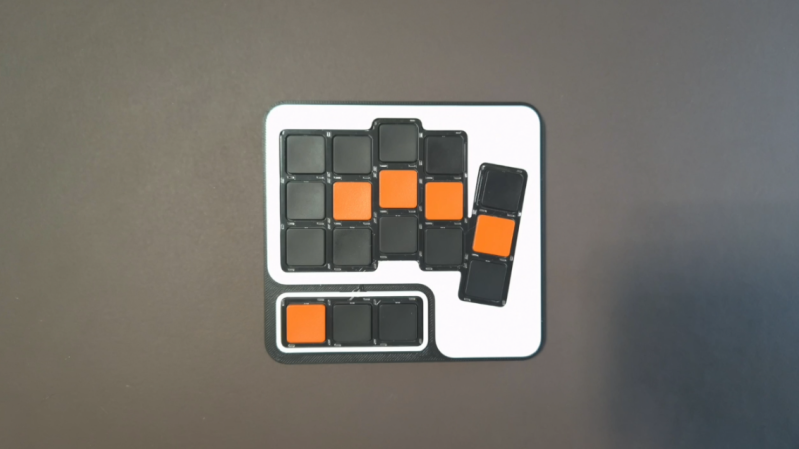
A surprising number of things we use in everyday life retain most of their design cues from their 19th century ancestors. The bicycle retains the same basic design as it had in 1890, as does the sewing machine, the toilet, the car, and of course, the keyboard and the QWERTY layout from old typewriters. But we aren’t doomed to have our technology perpetually living in the past. [Paul] wanted a keyboard designed around human hands, rather than being designed around a machine, so he built this unique split keyboard.
The design of this specific keyboard went through around 50 iterations before he was comfortable with it. Other design goals here were for it to be portable, and the split nature of this certainly makes it more compact as does the use of low-profile switches. Each finger’s column is angled and spaced based on the needs of that finger, with the ring finger keys sitting higher and the index finger columns angled inward. Each thumb has access to three keys, one of which is the spacebar and the other two layer keys, which is what enables this design to get down to only 36 total keys.
When thinking about it for any length of time, the modern keyboard’s design holdovers from the 1800s are fairly wasteful compared to this split, ergonomic version. Especially when looking at the spacebar, which ties up both thumbs and only performs a single task, there’s a lot of opportunity for modern designs to be more efficient, more portable, and easier on one’s body. Feel free to take this to the extreme and use all three dimensions, as long as you aren’t particularly concerned with portability.












And why is that I wonder? 🤔
Those victorian steampunk waistcoat mofos really knew their stuff
been making handwired keyboards on Brazil for about 2 years… built lots of stuff! flat designs like this one, curved, dactyl, manuforms and even made weird stuff to myself – i guess the final frontier really sits with Ryan’s generator “Cosmos” (https://ryanis.cool/cosmos/beta), it’s GPL licensed by the way
if your making one, i suggest the default thumb-cluster! name’s “Curved”, by far the most ergonomic design i ever used, to the point i ditched my original Dactyl… if you really wanna talk about geometry you can research about anatomy of the human hand and there’s plenty of hard evidence based on our muscles, that a keyboard angled between 20 and 30° is the ideal number!
fun fact, this is the best paper i’m aware about ergonomics of keyboards and by also reflecting on ideal angles of slant and other stuff (you can also find about the 20-30° number on research on naval ergonomic devices), there’s no evidence these actually can cure RSI [0] – every time someone comes to me complaining about pain, i suggest stretches, exercises and sensible breaks in between (GNOME even has a “Well Being” section on Options, as well software like https://workrave.org/)
[0] https://www.jospt.org/doi/pdf/10.2519/jospt.2004.34.10.638
I went back to a normal 65% staggered board after 4 years of various split keyboards with all manner of tenting and layouts, and really none made a significant difference in wrist and shoulder pain than getting my desk ergonomics right and scheduling breaks.
I think you are looking at this the wrong way.
” Each finger’s column is angled and spaced based on the needs of that finger, with the ring finger keys sitting higher and the index finger columns angled inward. ”
It is the pinky finger that is the angled column. The image in this article is the right half of the keyboard. So the index finger would rest on the orange key in the second column, and fanning to the right, with the pinky finger resting on the orange key on the angled column, leaving the thumb to rest on the bottom row’s orange key.
Having used ergos with both narrow (Lily58) and extended (Sofle v2) thumb rows, I can’t get behind the idea that having the thumb keys all in columns with the finger keys is natural, especially when you are using those thumb keys mostly as modifiers.
This is a TOTEM with a slightly different PCB… Nicely designed, but I would not call it unique based solely on the layout.
Agreed. This design looks good, but it’s certainly not unique. And the totem is a great board.
I just wish the files were published (tbf, I only read the blog post, and I didn’t see any links for github or otherwise)..