
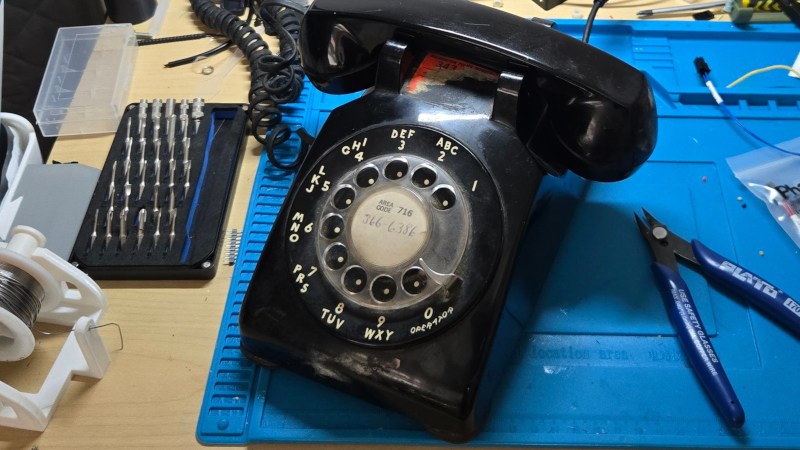
It’s said that a teenager given a rotary telephone in 2026 would be mystified by its operation, yet there are enough surviving instruments for them to be an attractive target for a project. But just what project? [fregacmols] is here with one possibility, turn that old phone into a cellphone.
Connecting to the phone is a subscriber-line interface module, containing all the electronics to simulate a copper phone line. This in turn feeds audio and control wiring to a Lilygo ESP32-S3 board which provides the brains as well as talking to a cellular modem. We especially like that this allows the phone to be used entirely unmodified.
The software does a good job of simulating a North American subscriber line, complete with dial tones, and ringing the phone’s bell on an incoming call. There are a couple of special codes, one to open a wireless network for maintenance, and the other for diagnostic purposes.
Over the years we’ve seen many rotary phone projects, but one which sticks in our mind used an alternative way to connect one to the cellular network.












Multiple spaces seem to be trimmed. Do you have a pastebin or so?
Please make a Screenshot of what you are trying to Display.
ASCII Art heavly depends on type font and rendering settings
I was wondering if you could make a set of old phones into a kids toy. With internal numbers to call each other, make them ring and talk to each other. With a set of 5 or such.
But no wires to trip over, not connected to an outlet to make them really mobile, and to easily put them away again. Not connected to a real phone network (privacy).
Going to voip and then wireless gets expensive for a toy.
No need to preserve the original devices – just replace speakers and microphone.
I was rather hoping that an esp32 is sufficient, maybe even with an ad-hoc wifi between devices? “if I call number 234, connect to ap 234″. Running off a swapable USB power bank
That’s how I started out several years ago. The answer is, “yes”, and for $50, I bought a Cisco VG224 off eBay. It’s a 24 port analog to SIP gateway. You can dial (tone or pulse) from any port to any other port without having a SIP server.
Of course, there’s a downside. You need to configure it and make a cable. Not impossible, but time consuming. There are other options, and you can make a SIP server out of a RasPi and use a standard Grandstream HT802 or HT818 ATA. That’ll be a couple of hundred dollars.
The big problem I ran into when considering DIY, was that it takes 60V AC to ring the phone (at 30?Hz). By the time you finish building the ringing supply, and wiring up the SLICs to your processor of choice, it’s going to be about the same cost.
There is the other approach, of getting a few Army field phones and hooking them together. No dialling needed, just crank (but keep your fingers off the terminals when you do!)
I’m actually planning to add a phone number whitelist feature to the firmware so it can be used exactly like this! As it is, 900 numbers and 911 are not fed to the modem by the ESP32 (I’m the one who made it, if that isn’t obvious), so adding a user-configurable whitelist should be pretty straightforward.
An ESP32-only WiFi version would certainly be possible too, but then you’re basically building a little VoIP system yourself.
oh man, that brings back memories. did this back in 2005 with a dutch phone. used real phone for it.
https://n-1.nl/t65gsm/
the site design reflects the era…
There used to be CB telephones
https://www.facebook.com/groups/15240740062/posts/10173087305105063/
Ideally, what would be best is to live near some old telegraph poles along a stretch of rail so you could have your own little network
I think I recall that Sparkfun had a kit to make your rotary phone into a cell phone tand maybe sold some completed units. I have a couple rotary’s I intended for something like that. Never too late.
The Port-O-Rotary. The only sold entire completed units, and there was never enough information to make it yourself.
Standard ringing voltage is 90 VAC 20 Hz in North America. The electromechanical ringers were resonant at that frequency. Electronic ringers probably don’t need that much voltage.
Too lazy to look it up. Tnx!
There were definitely cheap devices that could ring all inside lines in your home but paired to your cell using Bluetooth. Cobra, known for CB radios, sold a small dual line model for under $10 at one point. Still wired to the wall though and no extension dialing.
I added it as a Hackaday.io project, with links to the build instructions I finished not too long ago:
https://hackaday.io/project/206799-rotarycell