
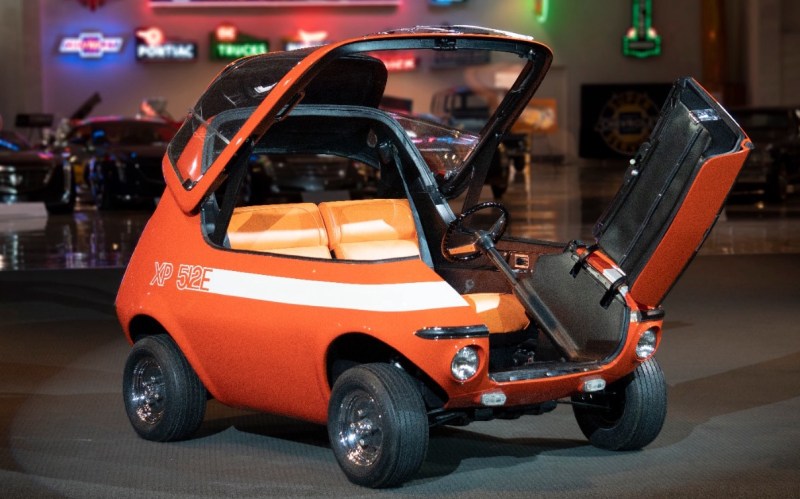
Electricity is the once and future drivetrain for automobiles, but until the advent of lithium batteries their capabilities were somewhat modest. One EV blip on the automotive timeline is the XP-512E commuter prototype by GM.
The 60s saw a wide variety of interesting experiments in the automobile space, and both GM and AMC were evaluating the possibilities of a return to electric cars for short journeys. GM wasn’t set on a particular drivetrain for their new experimental commuter cars, so the XP 512 became a trio with conventional, hybrid, and electric variants. Each car was a two seater with a fiberglass body and steel chassis. The canopy could lift and a small door in the front swung to the side for access to the cockpit. Some images from the time show the car without the canopy and just the rollbar, giving you a very small convertible (83″/2108 mm long).
Lead acid was the only viable traction battery until the 1990s, so the 1,250 lb vehicle was limited to a top speed of 30 mph and a range of 50 miles. GM was exploring a number of alternatives at the time including another blast from the automotive past, steam power, in an effort to reduce the issues of smog and air pollution that plagued cities beset by droves of V-8 powered sedans. While the XP-512E and the AMC Amitron never made it to production, they’re an interesting reminder that technologies that seem infeasible today may just need to bake a bit longer.
We have some thoughts about the opportunities afforded by electric cars, but it’s probably a good thing we didn’t get nuclear powered automobiles.












Odd channel. It’s been made in 2023 but only became active 1 month ago and immediately posted six videos. My spidey sense is tingling. Video is a typical AI generated slide show and the narrator is mostly repeating the same facts 2 or 3 times over the course of the video.
You’re better off reading original articles, like:
https://www.carscoops.com/2020/04/gms-xp-512e-was-a-wonderfully-weird-electric-bubble-car/
Video and detailed photos in the link.
The responsible thing to do as a writer/editor for these articles is:
1) Check the channel. Don’t promote obvious click farms and AI slop.
2) Remember that humans make slop too.
3) Watch the video: does it have a salient point, or is it just “yes, no, we don’t know” AI babble.
4) If it’s not original but still interesting, search for an original source and link to that instead
5) If no better original source is easily available, then post the video.
If the video was generated by AI and published by a click farm then all the facts, film, and imagery become immediately suspect of being fabricated or hallucinated and there’s no point in watching the video. What facts or content we recognize as true, we already knew. What we didn’t already know, we would have to validate by other sources anyway. Watching the video cannot inform us, at worse it’ll only make us dumber.
Another write up on the concept car from GM: https://news.gm.com/home.detail.html/Pages/topic/us/en/2025/apr/0414-1969-all-electric-GM-XP-512E.html
Let’s not forget Nickel-Iron, which was the battery of choice for earlier electric cars. It was somewhat worse than lead-acid on count of power and energy density, but it did not suffer from deep cycling and other abuse. The issue with lead-acid batteries in vehicles was, as the USPS found, that they would wear out rapidly when put to regular use, demanding the packs to be replaced every two years.
https://en.wikipedia.org/wiki/Grumman_LLV#Electric_versions
The technical reason is the deep cycling problem: the structural and chemical integrity of a lead-acid battery suffers when taken below 80% charge, even with “deep cycle” batteries. Typical lead-acid batteries will only suffer around 300-500 charge cycles in this condition, which for an EV can mean just 1-2 years of active use. For the USPS, that meant piles and piles of discarded batteries mounting up at the depots.
NiFe batteries have a high internal resistance, which means they struggle to discharge energy rapidly. If a driver stepped on the gas pedal in a NiFe-powered car, the high demand for current would cause the battery’s voltage to drop sharply, generating massive internal heat rather than transferring power to the motor.To get the necessary power, an EV would require a massive, excessively heavy battery pack, severely limiting the vehicle’s payload and efficiency. Additionally, it suffers similar problems in charging, losing significant amounts of power to heat and hydrogen production. wasting 30% to 40% of the grid power just trying to charge the vehicle was highly impractical
Well, highly impractical compared to modern technology perhaps. But if it works it works and it worked (good enough for a while) so it was used and we can’t deny that.
Why it didn’t succeed very well or very long was because Edison patented it and ran his mouth exaggerating the capabilities of the battery which wasn’t all that good the way he did it. He basically stole the design from the original inventor who had already abandoned it as an inferior version of nickel-cadmium batteries and then didn’t do much anything to improve it. It largely failed to attract attention and died along with the electric car when ICE cars improved with electric starters and greater practicality.
Edison’s foundational U.S. patent for the nickel-iron battery (U.S. Patent No. 678,722) was filed November 20, 1900, which was granted on January 12, 1901 and subsequently issued on July 31, 1901
Edisons patent expired on July 16, 1918. SO by the 1980s when the author claimed lead acid were the only viable option (which isnt untrue given the memory issues and high cost of NiCd cells) The NiFe battery had been open game for well over half a century. Edisons early bragadociousness wasnt the obstacle to its success in the EV sphere, its poor suitability to the task was and remains so.
It was back then, that was the point. EVs were on the way out, and Edison had the handle to rescue them, or at least delay the inevitable, but he didn’t push the technology – he pushed the marketing. Edison tried to pivot and sell the battery for ICE starters, but there the lead-acid battery was more than suitable and it didn’t catch on. Edison was first and foremost a salesman, not a true inventor, and when other people didn’t invent for him he simply couldn’t do anything.
As for the NiFe battery itself, it survived up to the 70’s in things like railway and telephone relays and other stationary uses where the long service life was more important. The technology would have been viable, with some improvements, but it simply wasn’t widely available in the 80’s any longer.
Those both sound like issues that could be solved with modern switch-mode power handling and cheap microcontrollers.
Whether you connect the batteries in series or parallel for more voltage or more current, each cell still has a limited specific power of about 100 Watts per kg. With more modern version, that could be pushed up by increasing plate surface area by patterning or some sort of catalytic coating etc.
How does 15 kilowatts per kg sound like?
https://www.nature.com/articles/ncomms1921
Originally published in June 2012, this specific laboratory-scale ultrafast configuration has largely remained uncommercialized for mass-market production over the past 14 years due to complex scaling and manufacturing bottlenecks for the nanocarbon-metal hybrid interface..
Although iron and nickel are earth-abundant materials, the requirement for specialized, high-purity nanocarbon hybrid supports and advanced synthesis methods introduces a substantial manufacturing overhead, pushing estimated initial capital costs to roughly $150–$200/kWh 2.5-5X higher than current mass-produced lithium iron phosphate cells.
In general if you see any mention of carbon nanotubes of any form in a research paper you can assume its a novel lab scale success that WILL NOT SCALE to commercial viability within our lifetimes.
That’s true, but the point was that the Ni-Fe chemistry had a lot of untapped potential. It didn’t need to be fancy carbon nanotube technology – getting 15 kW out of a tiny battery was never required.
Perhaps in a small battery, but if you have 500 kg of batteries in the car to get any sort of range out of it, getting 50-60 kW of power as well isn’t an issue.
yeah it very much IS an issue unless you have magical unobtainium MWNT Ultra NiFe batteries you acquired in an alternate reality with your interdimentional portal generator.
Traditional NiFe batteries have a specific energy of about 30 to 50 Wh per kg (historic Edison/Exide types run closer to 20–25 Wh/kg). For 500 kg at 40 Wh/kg, the total stored energy is 500 kg × 40 Wh/kg = 20,000 Wh (20 kWh). Standard NiFe batteries have a continuous specific power rating of about 100 W (0.1 kW) per kg for short bursts, but a safe continuous discharge rate is much lower.
At a conservative continuous discharge, 20 kWh of capacity translates to roughly 3 to 4 kW of sustained power delivery before voltage sags or thermal limits are reached. Drawing higher instantaneous power (like 10 kW or more) will cause severe voltage drop and can trip inverter low-voltage cutouts
20 kW is similar to an early Nissan Leaf, and there were plenty of small cars in the 50’s and 60’s (mainly in Europe) that had 20-30 HP engines. A small NEV could do with 3-4 kW at cruise – and that’s what the XP 512 really was.
Granted, it would not have been a great car either way, but as I’ve noted above, there was a lot of potential for improvement. It’s just that nobody was interested in improving the technology for power density. It was mainly seen as a storage battery for remote relays and backup purposes.
Just like modern EVs that carry a battery pack that weighs as much as a Fiat 127.
To match the instantaneous peak power output of 1 kg of standard lithium-ion batteries, you need roughly 4 to 10 kg of nickel-iron (NiFe) batteries.If you are trying to match continuous power delivery over a longer period without severe voltage drop, you need closer to 10 to 15 kg of NiFe batteries.
A standard Tesla Model Y Long Range battery pack weighs roughly 480 kg (~1,060 lbs) and holds an ~80 kWh capacity.
If we disregard the difference in performance the weight of a NiFe battery pack would cause and just set a battery of equal capability on the curb next to a Model Y….
To maintain standard highway speeds indefinitely without the battery bank melting or dipping below usable voltage, you would need ~1.3 metric tons of Edison batteries.
You would need ~1.85 metric tons of Edison batteries just to avoid a massive voltage sag during a 5-second acceleration burst. That is nearly equal to the weight of the entire Tesla vehicle.
finally, If your goal was simply to match the 80 kWh capacity of the Model Y to drive the same distance (ignoring how fast you accelerate), At an energy density of 40 Wh/kg (0.04 kWh/kg), an Edison battery bank would need to weigh 2,000 kg (2 metric tons)
SO AGAIN, To get the necessary power, an EV would require a massive, excessively heavy battery pack, severely limiting the vehicle’s payload and efficiency.
True, but lithium-ion didn’t become available until mid-90’s, and we’re not talking about vehicles capable of reaching highway speeds but 30 mph top speed, so the comparison is moot.
What isn’t moot is that low mass doesn’t translate directly to high efficiency. A small and slow vehicle does not suffer as much from being heavy, and the lead acid batteries weren’t that much lighter either.
This only applies to Faure cells (i.e. pasted plate construction), where the active material is retained by a thin grid of lead, which is also the active material. In a surprise to no one, these cells fall apart if actually used. Properly constructed Plante cells (i.e. rolled sheet lead) do not have this issue, and can even be discharged and then recharged in reverse.
Nickel-iron is a meme started by Edison. It requires a complex internal structure, has abysmal charging efficiency, and the electrolyte is unstable in air.
Modern AGM and gel lead-acid cells don’t fare much better against deep discharge either. They survive it better, but they still die early if discharged at significant portion of the capacity.
Those are still Faure cells.
If Heinkel Kabine 153 and BMW Isetta had a child in the US : ]
Or a Microlino ! The Microlinos we saw in Europe a few years ago park perpendicular to the curb, and you can fit two per car space. It was so unusual to see.
That, or Cyclops II Microcar : ] Mott/Cumberford stated “price” was around $300 USD in 1980s, so around $1K now. The size of a small washing machine, siting one quite uncomfortably, but easily fitting in one’s bedroom for winter storage : ]
Neat article. Car kinda looks like SpeedBuggy from the cartoons of that era. 😁
It looks like a baby Fiat 126p.
It’s essentially a glorified golf cart.
Nicads were available back then, with about twice the energy density of lead-acid.
For a better idea of what was possible, look up the Great Transcontinental Electric Car Race which took place in 1968. (Caltech won by 30 minutes out of a total race time of 210 hours. The MIT team made several blunders, including running against prevailing winds.)
These concept cars were built in response to proposed and legislated changes to law regarding emissions. I always felt they were built to turn the public against electric cars as the big manufacturers would not have wanted to tool up to make them in numbers. At the time US cars were big so they built tiny cars and restricted their range.
This reminded me of the Witkar project which took place in Amsterdam between 1974 and 1986.
See https://en.wikipedia.org/wiki/Witkar