
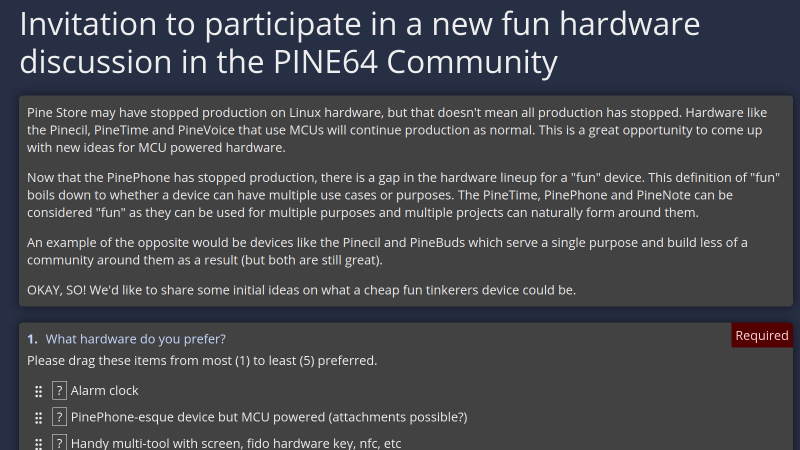
Pine64 is an open-source-community-centered project of mostly-open hardware, known for such hits as the PinePhone, the Pinecil soldering iron, and the PineTime. Now, the Pine64 project wants to know what kind of MCU-powered device you’d want to see built next, and there’s an online form you can fill out to let them know about any fun ideas they could bring to reality, as we all recover from the second round of Hardware Horrors Of 2020s.
In the age of RAM and storage shortage, it’s evident we’re not about to see a new Pine64 Linux SBC – but there’s plenty that can be done with regular microcontrollers, especially seeing how far modern microcontrollers have come in capabilities. On their Discord server and other linked platforms, you can see the announcement post giving you more details, as well as examples of devices that would fit the bill. An MP3 player? An alarm clock? Some sort of electronics multi-tool? PinePhone-esque device but based on an MCU? Digital camera? Whether you have full-on device ideas or specific feature requests for the aforementioned, check out the form and let them know.
Of course, any suggestions will ultimately have to be considered for viability by the Pine Store, the Pine64 hemisphere that actually decides on what to manufacture, so no promises can be made, but we consider this more than promising enough that you ought to have a say. Pine64 has come incredibly far in the 10 years it’s been around, and despite the troubles, we hope they’re here to stay, doing their thing releasing hardware that so often runs circles around the competition, and dropping by hacker cons all over the globe.












tricorder
yes, but offline
A tape drive for commercial multi-TB backup systems. I always felt like they are relatively simple systems with the most difficult part being the mechanical parts, which is the part that feels uncomfortable to most electronics hobbyists, but a company may have the engineering muscle, manpower and will to do it, especially one like Pine64
I would love to have 34TB of backup storage right about now. No matter how slow
Seconded! The cost of tape storage is all in the drives, so very few hobbyists can get their hands on modern enough tape that has the density to be cheaper than HDDs. But if Pine managed to make LT08/9 readers in a 5.25″ enclosure, ideally over SAS, then that would be a huge hit with homelabbers/archivists.
I do worry that’s probably too niche of a market for them though. Given the amount of mechanical components involved, they’d probably need a bigger order quantity at the injection molding shops.
Archiving/data hoarding was starting to become more and more popular just as the AI price surge on storage started. People want to own data instead of depending on moneyed interests to let them access it on a temporary basis. I could see affordable and fast drives leading to a boom of hobbyists building out their own robotic tape management systems and software stacks that take into account the lookup time of loading a tape.
Of course that could just lead to a dirth of tapes as demand rises…
SAS is great, but without SATA support too, it cuts out a large swath of the market, but then there’s two protocols to deal with.
I haven’t delved into the SAS/SATA thing much beyond flipping disks in a data centrr (which means ‘not at all’) ut it’sd need to support SATA at least for wide market adoption.
Not going to happen.
There’s a reason LTO tape drives cost so much. Hard drive heads are easier to make than tape drive heads, not to mention the track-following servo systems.
They should work with Jacqueline at Cool Tech Zone to mass produce the Tangara. https://www.crowdsupply.com/cool-tech-zone/tangara
Look for projects on kickstarter, present and past, that might be interesting.
Either projects that have completed, but the author isn’t interested in building a business, or failed projects that are interesting and technically feasible.
Building a product is wildly time intensive and difficult at first, lots of projects fail simply because the author isn’t prepared to put in the mountainous amount of effort needed.
Same with building a business (which I have done, a couple of times). It takes a lot of work and constant attention to detail to keep things running.
If they’ve already got the mechanics of production set up, kickstarter might be a fertile ground for finding new products.
Maybe with some better quality components and if a new SoC is a lot faster, a new PineTab. I bought the first one and it was the worst experience with a product I’ve had in a very long time. It was incredibly beautiful though. That flip cover with the keyboard, was so incredibly well made. It’s so beautiful. Sadly, the touch screen barely worked, YouTube streaming beyond 480p (and about 5fps) was impossible, the speaker sounded worse than a refurbished speaker from a Nokia 3210, WIFI was barely existing, support was just one man from the Netherlands on Discord trying to help everyone (not blaming him, he did an incredible job) and overall it was just a useless product, but it had potential. A properly made version would be amazing.
I’m not hating on them. I’m sad that I only have two PineCil’s and one PinePower. That should change in the near future. Those soldering irons are just amazing. We got several Weller stations at work, but for most soldering work I prefer to use my PineCil. When I know I have to solder a bunch of connectors, I take my iron from home and use it in the office. It’s super light and those red USB cables they sell are amazing. It’s so super light, making me less tired.
My Weller has been out of a job since I bought a Pinecil. I love it!
I’m still keeping my Weller though. It will work even after the apocalypse. Whereas with the Pinecil I’m not so sure. The Pinecil is great, but the Weller is KISS, whereas the Pinecil is just complex. A thousands things that could make it stop working, and zero ways to fix it after society collapses. ;)
As long as magnetism and the Curie Law keep working, I can fix my Weller with near stone-age materials.
My Weller is of the Magnastat type, which controls its temperature with a magnet in the tip.
I also had a temperature controlled weller with a ‘normal’ tip. But I hated that thing, it had no heat capacity and every time I wanted to desolder something large that would suck away the heat quickly, the tip’s temperature would crash and the tip would stick to anything that I was trying to solder. I very often had to wait for the tip to heat up again.
Not so with the Magnastat, that always worked great. And the Pinecil is the same. And if the tip temperature DOES sometimes drop too much, the Pinecil has a turbo mode that makes short work of the problem.
Buy a Pinecil. Seriously!
pinedio better than hacker pager
You would have to play catch-up with the current competition. However, I feel the ESP32-P4 space is going to blow up fast once third parties start using revision 3+ chips.
It would be cool to see a pager or a real cellular phone. Even camera projects could get really creative, as porting IMX-series chips is pretty easy now. I just ported the IMX462 and it’s pretty amazing for a low light camera build.
Other than that, could look into the tiny quantum sensors the US GOV is playing with for magnetic GPS nav.
I econ EP32-P4. It is quite good at things I’ve played with (mostly home automation, but video streaming, too).
Cellphone-wise I am researching so-called “hotspots”, which seem to be the cell phone modems – and most allow independent SIM cards, ie, NOT locked into one particular (usually US) provider. In a sense I am thinking “modular unit” with plugins, cell provider, etc. I’ve seen prototype done by others, so it is definitely doable.
A, more or less, capable and realtime translator, in the form of an earpiece. It can translate what is being said to you, and can translate what you are saying. Built-in microphone and speaker, enough battery life for 8 hours. No subscription. No vendor lock-in.
Also no data connection required, all translation happening on the device itself: edge AI. All the AI needs to do is translate between languages, so I expect that it doesn’t need millions of parameters.
It could actually be made to be configurable, so that you can load a model that only knows the two languages: yours and the one that you want translated. You configure it at home and go out with it. If the price is manageable, you could take more than one with you, one for every language that you’ll expect to need.
Maybe a ‘base’, which has the battery, power management, signal processing, amplification, and in which you can click different modules, each preconfigured with the language that you think you’ll need.
Call it the Babelfish64.
The idea is to have it in your ear like those old Bluetooth earpieces. No clue if technology has already advanced enough to make this all possible. ;) But Apple is getting close…
Translation language models aren’t small enough and microcontrollers aren’t beefy enough.
Maybe a wiring pen (for wiring protoboards) that can make nice angles in the wires, and can cut the wire at exactly the right length? Maybe even stripping it?
I was thinking of Kynar/Teflon wire in first instance. Bending the wire, and stripping it at the correct length would be the sh*t!
But I think the stripping is maybe not impossible, but probably not feasible.
But if the wiring pen is used with magnet wire, the stripping option wouldn’t be necessary. It’s already great if it could bend the wire in some nice angles, and cut them at exactly the right length. Stripping the coating can then be done with the Pinecil in turbo mode. ;)
It would still be an improvement to maybe combine the Pinecil and my vision of the wiring pen functionality in one, so that it dispenses the magnet wire, you can solder one end, then trace the wire around, making nice angles so that your board stays nice, then solder it to the other end and cut the wire, all with an all-in-one device.
This page is what inspired me to think up such a device.
https://elm-chan.org/docs/wire/wiring_e.html
A smarter logic probe. Basically a friendlier, quicker Bus Pirate.
Clip to ground, poke the tip around a circuit, and the little onboard screen might say things like “DC 4.95V”, “12MHz 3.3V clock”, “RS232 115.2K”, etc. Plug in to a computer with USB, and get a serial port with an interface like a Bus Pirate. Open a web page that can talk to it over Web Serial, and get more elaborate UIs and analysis.
Oh! That’s an interesting idea!
Please no, no more junk pine64 hardware collecting dust on makers shelves let’s just let this failed company die like how they leave all their users to hang when there’s any kind of hardware defect or firmware f up. My pine64 USB charger caught on fire during normal use. Pinebookpro useless paperweight was delivered with broken firmware, cables disconnected internally and a severed WiFi antenna. Pinecil died after a year of light use what garbage.
Yay! You’re back. Was wondering where the most excellent Arya articles had gone.
(Of all the reading I do, you’re in the scant few that I take notes on)
Thank you, glad to hear they’re to your taste!^^
Jenny convinced me to buy the Pinecil years ago and it’s working just fine.
Something I’d like: numerous timers with displays all able to sync, record, etc. Sort of like tracking your screen time on an Apple phone. “How much time did I actually spend in the bathroom this month” kind of thing….
Point-to-point radio modem as an alternative to the internet. User sets the frequency; caveat emptor.
I think they’ve been chipping at this with the Pinedio!
Looking at the capabilities of the Inmos Transputer would be a good start. Could the Helios kernel run on a modern microcontroller?