
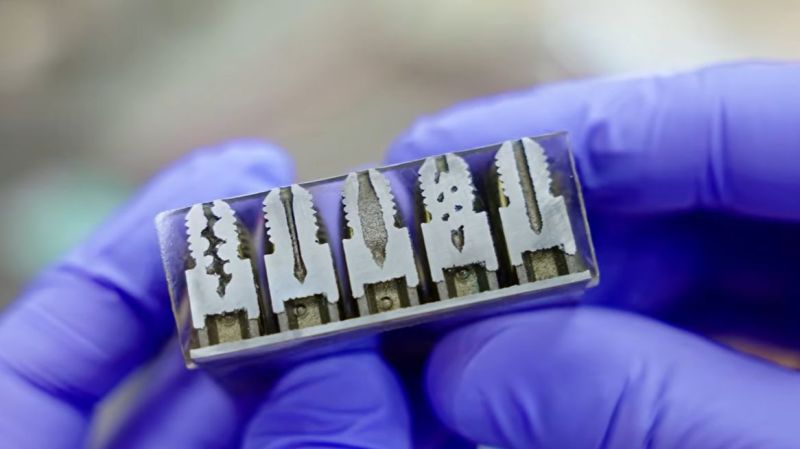
 As FDM printers keep getting faster, we are forced to deal with a range of bottlenecks, all of which conspire to hold us back from another Benchie world record. A major physical limitation is that of flowrate, as the hotend has to be able to melt the filament that enters the nozzle before it departs said nozzle. One attempt to make a high-flow nozzle involves splitting the material path into three winding sections, which theoretically should help said flowrate. Recently [Thomas Sanladerer] took a poke at this and other types of nozzle with SLS-printed nozzles.
These printed parts still needed some finishing on the lathe, including drilling the 0.4 mm nozzle hole. The finished nozzles feature a variety of internal geometries, including the aforementioned triple-path, as well as many with various intrusions that seek to maximize the contact area.
Using a Prusa Core One these nozzles were subsequently tested to see what print quality they produced at high flow rates. A special test rig to test the nozzle pressure was also used to further characterize them, as this indicates at which flowrate the nozzle begins to struggle. Among these the Fuge design did the best, though with the big asterisk that these nozzles were printed in MS1, which is in effect tool steel and thus not great for being nozzles.











Next he’ll be reviewing fleshlights
Hey, those are already about my size anyway.
Also a duck?
Honestly, pretty impressed by the “hah, that would be funny, why not” lets-stick-balls-in-the-flow-path nozzle. I mean, its not great, but I expected way way way worse.
Ball point. Calligraphy nibs next?
On coatings
https://phys.org/news/2026-09-silicon-nanosphere-coatings-glossy-nonfading.html
Using a 3D printer to print a 3D printer nozzle. Inching a little closer to fulfilling RepRap.
You wouldn’t print a 3D printer
I beg to differ.
Watched this while drowsing and did not realized he made them himself. Very impressive.
Well, he didn’t. That’s what happens if you watch videos while drowsing.
He used PCBWay to 3D-print the metal nozzles but designed and finished machining them himself. He did more to make the nozzles than AMD and ARM do to make their chips.
Now try to unclog or do a cold pull on those monstrosities. I only use normal flow nozzles, never saw any benefit of those high flow ones.
Well, theres the higher flow aspect.
I have a knockoff cht nozzle that’s hardened steel with a pressed in brass liner. Makes a lot of sense to me. Idea is to increase surface area and therefore heat transfer.
Cold pulls are old school, just make it out of tungsten carbide and throw it in the oven 😎 (oversimplifying of course, but entirely possible)
I can and will blowtorch my tungsten carbide nozzles. I love these things.
Couldn’t CFD simulations be used to test these nozzles instead of actually making them?
I’m the first to usually say “let’s build it instead of sims” but this seems like a perfect use case for “build first”
Before you simulate, we should do an RS analysis for design constraints, like “don’t make a twisty windy knobbly hole that becomes clogged with charred residue that’s impossible to clean.”
Might high flow nozzles work best if they stay still with the print surface sliding past?
If articulated, you might get curves laid down quickly.
I’m a little cautious of these high flow designs. I ran a CHA for a while and it was OK for regular filaments but tended to clog on “marble” filaments, never even attempted any CF or GF filaments. It was even a 0.6mm variant, normally stuff basically falls out ready to go at that size. My next stop is probably a Volcano setup with that extended melt zone.
Wouldn’t it just be simpler to use smaller diameter filament? 1mm anyone? Anyone? Bueler?