
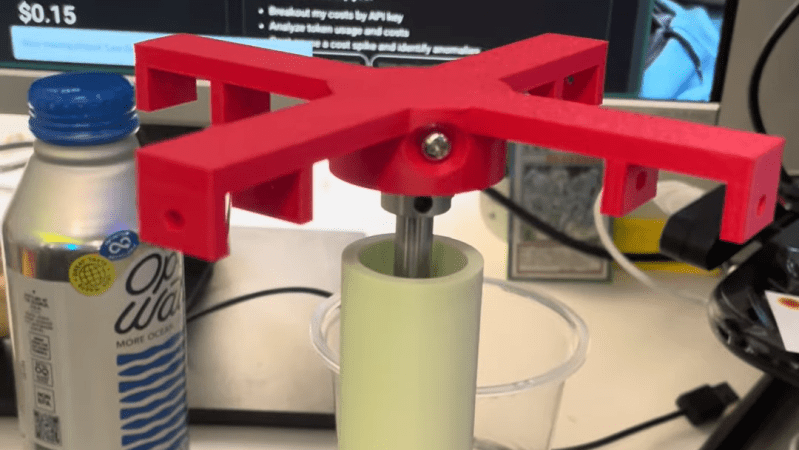
If you want to do certain types of lab work with blood, you’ll need a centrifuge. It’s often possible to find serviceable units on the used market, but they may not meet your requirements if you’re doing something quite specific. For that reason, [Thomas Nguyen] decided to build his own centrifuge from scratch.
His goal was to separate T cells from blood for further lab analysis, and he needed to be able to work with blood in 15 mL conical tubes. Capable centrifuges weren’t affordable, but he figured he could build his own quite easily. To that end, he enlisted a Raspberry Pi Pico, a 3D printer, and an A2212 brushless motor with a 30 amp electronic speed controller.
Soon enough, he had a design for a fixed-angle centrifuge design that could spin up blood products to the required speed for separation. It has useful safety features, like an MPU-6050 for vibration detection to shut down in case of dangerous imbalance, and an IR sensor for monitoring and controlling rotational speed. For now, the project is still in development, with the first version built and spinning. [Thomas] aims to check that the build operates safely and can separate fluids like dyed water and glycerol successfully before running it with real blood products.
We’ve seen other successful DIY centrifuge builds before, too. Sometimes, the lab hardware you need is the lab hardware you build yourself. If it works and does the job safely, it can be all that you need to get your science goals coming to fruition.












To that end, he enlisted a Raspberry Pi Pico, a 3D printer, and an A2212 brushless motor with a 30 amp electronic speed controller
Deep breaths kevin, …..deep breaths
Frak could have used a 555 and a cap instead of a dual core mcu for starters walking away
Could have used a hand crank instead of a 555.
Could have used a cardboard circle and some strings to make a whirligig instead of a hand crank.
This is the comment I was looking for.
No, he can’t do this stupidity. The blood separation process requires specific conditions in order to be repeatable scientific process. Which means the blood vial centrifuge needs to spin for specified amount of time and with controlled either RPM or RCF (g-force). Also, it’s basically mandatory to have carousel balance protection, both during start-up and during actual spin.
So he has an in with the FDA? Every time I’ve tried to get approval for one of my homebrew blood devices I’ve gotten shot down.
Anyone trying to isolate T-cells without budget for a basic piece of equipment is likely going to ping as a backyard garage secret underground room person-who-should-not-have-access-to-blood-or-electricity nutcase. I have some experience in this area although liquified bovine ovaries were my scene. If you don’t have funding you should not take deliveries of blood.
The real hack is the scrounge. There’s a “capable centrifuge” out there. Absent funding you’re just dandling your dingaling.
Hey it’s Thomas!
Getting blood for testing was something I had to solve for the next stages of the project. I will give more hints on how that’s done soon (;
?? No need for FDA approval here unless the device is getting sold for clinical use or the research gets to clinical trials phase. For the latter the tests would have to get redone on properly certified equipment or the auditors would throw a fit but no need for early research stages.
Same for all the other things OP would need like idk reagents- no need to spring for the pricey certified traceable stuff until you’re at the point you’re onto something and need the paperwork in order
As far as I know, the clinical center personnel needs to sign a document that “they have a suitable equipment for blood testing”, but there’s no paper trace of the actual equipment used during the trials (no model and serial number written anywhere).
I’m currently into watching the TV-series “Dexter” (on Netflix) and I must say that I’m looking different at blood now than I did before watching the show….
Basically a Marry-go-round for mosquitos.
I applaud the attempt, but I can’t determine how they want to mount the vials. From what I’ve seen, usually the vials are loaded from the inside out, which also makes the setup a lot more compact. One disk with vial sized holes at a slight angle, with a hub motor. Something like the OpenSCAD mockup below
difference(){ // disk
cylinder(35, d= 250, center = true);
for (i = [0: 45: 360]){

    rotate([0, 0, i])

    translate([-120, 0, -15])

    rotate([0, 65, 0])

    #hull(){ // vial

        translate([0, 0, 115-16-10]) sphere(d=16.2);

        sphere(d=16.2);

    }

}
}
I got a centrifuge through the Amazon Vine program, when I was at silver level, which is items under $100.
So you can get a decent centrifuge with a cover and balance feedback for relatively cheap.
A very important detail which is not seen in the video is how the vials are mounted on the carousel. There 2 basic types of mounting – fixed angle and swinging/adaptive. Both work.
Btw, there are standard sizes (diameter) for the vials, but these include several different lengths of the vials. The carousel is typically sold with rubber/foam adapters which are put at the bottom of the socket to support the vial during rotation and to prevent any mechanical load from tearing-off the plastic cap and ruining the sample.
And one last comment (I promise) – there should be a protective enclosure (even an ugly one) around the rotating carousel, that must be able to fully contain all possible damage at emergency – what could possibly go wrong when spinning someone else’s body fluids @ 3-5k RPMs for 15min?
Doesn’t matter whose body fluids they are. Even if they’re mine I don’t want them spread around accidentally :D
I concur; aluminum extrusion frame and acrylic or polycarb sheet walls, like you use for a desktop CNC.
Now I want to build one to sling all the condiments to the cap end of the bottle so I don’t waste any.
No biological substance should ever be centrifuged in anything other than a certified biological centrifuge to 1. Prevent aerosolization the material,. 2. Prevent serious injury from flying debris during a destructive failure 3. Prevent accidental contact with the spinning mechanism. That’s a dangerous device.