
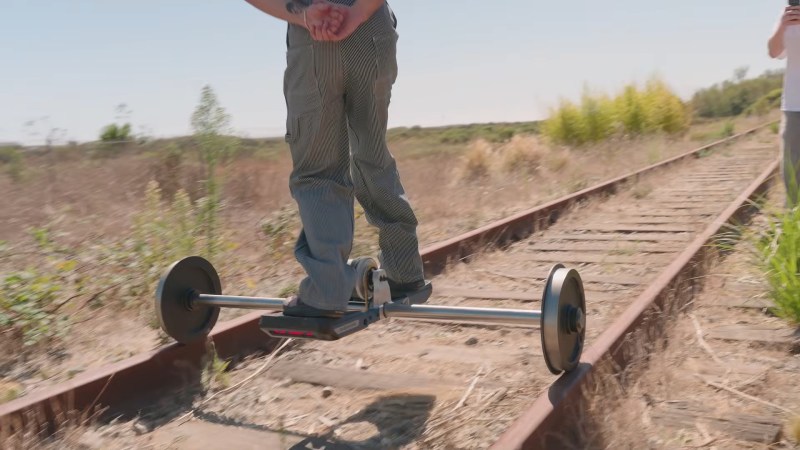
The US has tons of abandoned rail, especially in urban environments, so it seems a shame to let it go to waste. [OneWheel] decided to modify one of their boards to ride the rail behind their office.
The stock OneWheel frame was sectioned and CNC cut mounts were placed in the center to raise the motor above the deck. Steel rail wheels sourced from eBay were then attached to an axle run through where the original wheel was mounted in the center. The motor housing was turned down on a lathe for better clearance, and then a bike sprocket was attached to chain drive the train axle.
While not everyone has a hydraulic press and a CNC for that professional look, we don’t see any reason you couldn’t bodge something similar together at home. Be sure to watch [Bradley Gawthrop]’s Supercon talk on the Personal Electric Vehicle Revolution for some ideas on what you need to get started.
Dream of riding the rails yourself? You should checkout this tiny rail riding pod car or this more minimalist example. Definitely make sure you’re riding on a truly abandoned line or get a rail warrant though!










While railroad may seems abandoned, it is still technically trespassing if you don’t check first. Find out who owns the railroad and verify it is not in use, then get permission to travel on the track for recreational purpose.
Also, a steel axle will set off crossing gates if there are any active. This tends to really annoy railroads. Insulate the two wheels from each other.
Is it still a “onewheel” if it has more than one wheel?
That’s where my thoughts went. Wouldn’t it technically be a bicycle bow?
It’s technically a half-bogey
Of course Bodhi is the first to ride it. Only he could just jump on such an insane thing and have it work like magic.
Seems like it would be easy for it to rotate a little on the yaw axis and fall off the rails unless you get the tolerances between the two wheel rims just right, and falling would suck really bad. But that’s half the fun with boardsports
Indeed, it seems that this would happen if you went around a long enough curved section of track. It could use some kind of differential action that you could control to get the wheel that’s ahead slowed down a bit so the lagging one can catch up. Bonus points if this is done automatically.
I’m vaguely remembering how this works for actual trains. I believe the beveled shape of the wheel makes for a larger radius on the outside of a curve and a smaller radius on the inside, providing some differential action. So getting the geometry right is important.
Yes. The inertia of the train, on a curve, drives the wheel to the flange on the outside wheel where the diameter is largest .
Yep, trains don’t need differentials because they bank in the turn and the wheels are conical, so the circumference on the outside vs the inside increases proportional to the tightness of the turn. Very clever.
However, train cars have four wheels so they can’t just rotate 90 degrees and fall off the rails into the space between them
Unfortunately, this can also lead to a phenomenon called “hunting oscillations” which is a little uneasy for the traveller but greatly increases wear on wheels and rails. The conical profile of wheels needs to be just right and matched to rails and speeds.
The wheel flange, if tight to both rails, likely stops any rotation like that… So long as the tracks are parallel.
Seems like you have to get that tolerance right is what I’m saying. Too loose, you derail, too tight, lots of friction, especially in turns..
This actually will not happen if the two wheels are rigidly connected and both wheels have a taper. Its fundamental to how trains stay on the rails.
https://www.reddit.com/r/mechanical_gifs/comments/889ggu/why_train_wheels_have_conical_geometry/
Unless the wheels bounce and skid.
Look into the science behind rail wheels. It’s pretty amazing actually. They’re tapered so they self-center and take curves properly.
yeah that was my thought too but, just to expand on what the other replies are saying…the wheel/axle assembly looks heavy af, and gravity loves the rider too. so it’s the taper, combined with the weight. it will tend to stay centered. the flange doesn’t have to be snug in order for it to resist yawing. any yaw will require the whole heavy vehicle to rise a little bit. i believe it might work. :)
It’s two wheels and a railcart is by definition self-balancing because of running on rails. If you insist on riding standing up, how about One Rail Two Wheels?
How about One Man One Jar instead? Less chance of becoming uninstalled from this world, as long as you don’t panic and extract most of the glass quickly.
Absolutely not sustainable when it comes to curved rail sections.
So what remains is a Youtube stunt good enough to attract some attention.
I would have turned the eponymous wheel 90 degrees, and made it like a grooved pulley, so that one could perpetually grind one rail.
How does the single axle stay on the track? (i.e. axle perpendicular to the rail) Why doesn’t the whole thing twist and fall down in between the rails? Is it because of the flange on the wheel? What happens on a curve? I know the wheels are tapered to shift for corners. If the flange is riding right up against both rails will this prevent proper shifting around a curve?
While this could be a marvel from the techinical point of view, I consider it a quick way to get the Dawin Award, first class. When the thing gets jammed somehow or its driver loses balance, the user will fly, head first, towards a basically horizontal ladder, which is a place with many chances to grab parts of you (mainly the head), stop it and then let the rest of the body to continue its movement, thus breaking some part of your spine. If you are not lucky, you live. Sort of.
You also get bonus points when the contraption breaks while breaking the skull while reaching the victim from behind (as it is very close and there is not enough time to slow down and not enough clearence clearence).
Even more extra points and gold coins if you get into a tunnel riding this and get back out riding a locomotive.
Sorry, but this looks like a Coyotee project to me. And you know how this ends usually.
The tread on those wheels is too narrow for that rail. It looks like to contact is only on the outer edge of the wheel.
Hopefully, they’ll adjust the width if they take it much further. Looked like these particular wheels were bolted on and not welded.