
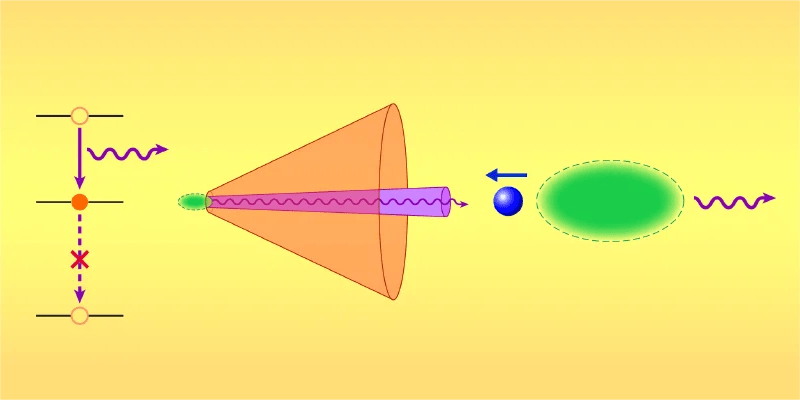
As cool as it would have been to wield lasers that produce a beam of neutrinos, recently two papers were published by MIT researchers that seem to dampen the likelihood of such lasers being at all possible. In a review paper by [Ana Maria Rey] et al. these two papers are investigated in more detail.
Although the concept behind a neutrino laser is rather simple, using the same superradiance effect involving a Bose-Einstein condensate (BEC) that allows for stimulation by photons to result in a synchronized direction of emitted photons, the idea of using a BEC of radioisotopes that naturally emit neutrinos in this fashion has now been effectively shot down.
The problem lies in taking the leap from photons with a BEC and applying this to a BEC of radioisotopes. Whereas photons are relatively low-energy at a mere 1 eV, a neutrino with 1+ MeV has a much greater kinetic effect on the particle that emitted it. Unlike a photon emitted by an atom, this leaves precious little time for the other particles in the BEC to be affected.
This first scenario is covered in the (paywalled) paper by [Yu-Kun Lu] et al. with their calculations showing that superradiance cannot occur with neutrinos in a BEC and thus a laser is impossible. In the (also paywalled) second paper by [Hanzhen Lin] et al. the question is asked whether the assumption that a BEC of a radioisotope will at all enhance radioactive decay, to which the answer is a curt ‘no’.
Although it’s impossible to prove a negative with the scientific method, these two studies have slammed close a couple of doors on the concept of a neutrino laser.











Photon BY DEFINITION can’t be any slower than anything else -it moves LITERALLY at speed of light. Neutrino, being a matter particle, CAN’T ever do that.
IOW, this explanation, as it is given here, is bullshit.
You’re not reading it right. It’s not the photon that matters, it’s the recoiling atom – that’s the “a much greater kinetic effect on the particle that emitted it” part. A 1 eV photon barely nudges the emitting atom, whereas a MeV scale neutrino kicks the emitting atom hard.
I’m just speculating, but based on this part: “…much greater kinetic effect on the particle that emitted it”, I’m guessing that it is the other particle that is moving more quickly away from the neutrino?
Wild
https://phys.org/news/2026-09-upstream-quantum-fluid-violating-newton.html
There go my dreams of one day looking deep inside planets with Niven’s Deep Radar.
Well receiving the neutrinos would also be a challenge wouldn’t it? I guess they had other unobtainium gadgets in those books like stasis fields, collapsed matter, etc. to explain that part.
Are there any other speculative uses for a neutrino laser out there? Other than having bragging rights for building a laser that can slice through anything (not that it alters the thing you’re slicing through in any way, but it does go through!)
Yeah, as an ultimate unshieldable SciFi weapon. Neutrinos rarely interact, but when they do they deposit their energy. When a very large number of neutrinos fly through matter, that can add up to the ultimate energy-beam superweapon.
And that’s not even hypothetical! Just … impractical.
In simulations of core collapse supernovas, the shockwave can’t push out against the infalling matter due to the high density and speed of the infalling matter – unless you account for neutrino heating. There is a MASSIVE amount of neutrinos flying out when a stellar mass of protons swallows the electrons around them to turn into neutrons all at once. The neutrinos interact so weakly that they are not affected by the large density of matter rushing in at relativistic speeds, and the total energy they carry is so humongous that the tiny fraction of it they deposit is large enough to heat up the inrushing matter and reduce the density juuust enough for the shockwave to win over and slowly eek outwards till the density is low enough that it goes big-badda-BOOM.
Anyway back to SciFi weapons.
If you create a beam of neutrinos as intense as that, the tiny fraction of its energy that is deposited by the beam per unit length traversed through the target’s matter will obliterate the target. And shielding against it is impossible, even by hiding behind a planet: The shielding half-thickness using eg lead is measured in lightyears, so even some hypothetical neutronium shielding material will be impossible. And force fields are out as long as you remain in the realm of physics-based hard SciFi.
Of course it’s somewhat impractical: you need stellar mass-energy equivalent levels of energy to power that beam ie not catch the output of a sun a la Dyson sphere, but annihilate the sun’s mass, turning it into energy… Even if you had the tech level for that, the mass of that energy is, well, a stellar mass. Unwieldy.
Plus anything in front of and behind your target for as long as the beam is focused to high energy density will be blown up as well, but who cares about details.
I don’t remember if I read about this weapon in a Niven or Baxter book, or I came up with it after reading about the neutrino radar and the core collapse supernova simulations.
If you have the tech to accelerate and bundle such a non-interacting particle beam, you also likely have the tech to shield against it.
Ok, maybe not the other faction.
Well, no! That’s my point!
We may not have the tech to utilise stellar-mass-equivalent levels of energy to create a focused neutrino beam. But neutrino interactions described above are established standard-model physics, and we do see the effects this kind of neutrino flux has from a combination of observations and computer models.
In contrast, force fields and shields like on Star Trek are simply not a thing in physics. Even if you don’t postulate “force field physics” but want to create a “force field effect” from standard model physics (like some call an optical tweezer a “tractor beam”), you run into the issue with neutrino interactions.
Neutrinos interact via weak gravitational force and gravity, that’s it. No electromagnetism (everything you know colloquially as force) or strong interaction (the thing binding nuclei together).
That’s the “magic” that makes them fly through the entire Earth like there’s nothing there: amongst other things, weak force interactions are, well, weak. Because of this, every individual neutrino has an extraordinarily small chance of interacting with a given atom it will encounter along its path.
So no force-field effects by clever EM field manipulation.
Furthermore, unlike electromagnetism (carried by massless photons), the weak force is carried by force carriers with mass (W+/- and Z bosons), so fundamentally you cannot shape it into large convenient field configurations easily by moving charge carriers in strategic ways.
So no force-field effects by weak interaction.
You could of course manipulate gravity. If you have the tech level to manipulate that level of energy, you effectively are manipulating also space-time due to the energy/mass involved…
But even with this, spacetime manipulation will deflect neutrinos just as anything else, but not change the neutrinos’ penetrating powers.
And who knows, maybe some form of entarted matter does interact with it? Any studies on how much of neutrinos pass through Neutron stars or Magnetars?
The “secret sauce” of this kind of dense matter is the strong interaction. The strong interaction has extremely short range, so distances larger than of order atomic nuclei, it’s irrelevant and electromagnetism dominates by far. But in this kind of “neutronium” dense matter, the distances between particles are not long compared to the weak interaction range, and the whole macroscopic object is dominated by strong interaction.
But: neutrinos don’t interact via strong force, so that doesn’t do much beyond just having a lot more matter in the way.
Neutronium density is of course so high that indeed, it would matter (see what I did there? Matter? Hahaha ha .. okok, I stop). At some 10^17kg/m3 it’s about 13 orders of magnitude above eg lead. A lightyear is of order 10^15 m, so the shielding half-density would be of order 100m.
But just to give you a sense of scale: neutron stars (famously consisting of neutronium) are of order 10km diameter. So you’d need to stack dozens of neutron stars behind each other to achieve appreciable shielding along the way.
And the stellar-mass levels of energy in our neutrino beam would be deposited in your neutron star shield, which would effectively make turn the neutron stars into supernova-size bombs..
I’m telling ya, a neutrino beam weapon would be unwieldy, but unstoppable!
BTW, if you like this sort of SciFi, check out Stephen Baxter. In particular his older Xeelee Sequence stuff.
“Neutrinos rarely interact, but when they do they deposit their energy. ”
I… don’t understand what you’re trying to say. I mean, neutrino interactions with matter primarily will just be with the electrons, which means you usually just get either charged or neutral current interactions (primarily charged) in which case you’re ending up with two new things flying off with energy and the imparted energy into the fixed object is overall pretty small, especially if the neutrino is high enough energy to actually be likely to interact.
(In high energy physics, one of the counterintuitive things is that particles deposit less energy as you increase the per-particle energy. Eventually the amount of energy you deposit reaches a minimum – hence the term ‘minimum ionizing particle’ – and does rise after that, but only very slowly.)
So it’s not like you’re shooting ghost bullets or something. There have been studies of high intensity neutrino beams (https://arxiv.org/pdf/hep-ph/0305062 and others) because physicists are weird and we do strange things when we’re bored. The main way you could actually do damage to something isn’t from the neutrinos themselves, it’s from the hadronic shower that gets initiated assuming the neutrino is absurdly high enough energy.
But even at that point it’s a really, really bad weapon: it’s like you’re using gigawatts of power to deliver watts to a target.
So yeah, it’s not a real thing.
Well, if Planet Nine is a Neptune mass black hole, might it handle neutrinos?
The XENONIT guys seem to think the solar tachocline may be a source of Dark Energy….so there may yet be hope.
X-rays and harmony
https://phys.org/news/2026-09-ray-guitar-music-frequencies-harmonics.html
For space-minded individuals, this is big news:
https://techxplore.com/news/2026-09-ultrathin-blocks-electromagnetic-masking-infrared.html
here are the arxiv preprint links to the two paywalled papers
https://arxiv.org/abs/2606.04761
https://arxiv.org/abs/2510.21705
I stopped reading where the article stated that neutrinos were faster than photons. And what has a BEC got to do with Lasers? Do you have a BEC in your laserpointer? You need help (to write better articles).
Oh, the “photons are relatively slow” bit slipped by me
The “faster” vs “slower” tripped me as well. I presume it’s the interaction time, not the particles’ speed, that they meant.
And while it’s not a Bose-Einstein Condensate in the sense of a number of free-floating particles happening to follow Bose statistics and coalescing into a singular macroscopic quantum state cloud of atoms, your laser pointer does indeed follow the same physics of Bosons collapsing into one quantum state. It’s just much much easier to achieve with photons rather than atoms, is all.
I presume someone read “Bose statistics” in the original paper and went “ah! I know that. BEC!”
The atoms recoiled by producing a high-energy neutrino are moving faster than those recoiled by producing a low-energy photon.
Emphasizing that these articles merely anti-suggest this particular METHOD of neutrino laser.
“Can Bose-Einstein Condensates Enhance Radioactive Decay?”
This seemed much more useful.
Slow photons?
Lasers or not, whoever invents neutrino-powered “solar panels” will do humanity quite a favor. Imagine that, panels that generate electricity even inside mines. 24hrs, non-stop, worldwide, pretty much free energy.
But I digress, since unimaginable R&D is spent improving what makes the largest profit, so the chances of someone finding the way are fairly slim – unless certain Dr. Emmett Brown invents us some kind of neutrino-powered 1.21 jigawatts flux reactor running on BEC.
Kidding of course, I am just mish-mashing this and that, but the point remains, whoever figures out how to safely (and affordably) harvest all the freebees (cosmic rays, etc) hitting Earth every second of the day WILL do humanity quite a favor.
Shhh, you’ll give all the perpetual motion fraudsters ideas. Next up they’ll claim it’s not perpetual motion because…
Naah, I like them both, perpetual motion researchers (met one in person) and fraudsters. First ones push the boundaries of knowledge, while the second ones keep us awake.
Mot perpetual motion mechanisms I’ve seen in the old illustrations were missing ball bearings (or any modern low-friction solutions), but the point remains, even when properly re-created, they’d still be mostly flywheels of sorts. I am also quite sure some of them were re-engineered into better flywheels deployed elsewhere, so not perpetual motion for sure, but at least aiding other solutions.
No mention that photons are bosons, and can naturally aggregate to the same quantum state (to allow a laser), whereas neutrinos are fermions and explicitly cannot do this because of the Pauli Exclusion Principle?
Yes this was also exactly my thought when I read the title, lasers need bosons according to my understanding. I was hoping they were using some neutrino Cooper pair like ideas I wasn’t aware of, but no sign of those in the article.
“lasers need bosons”
This is true for traditional lasers, where the “light amplification by stimulated emission of radiation” name is appropriate, but devices which output light via superradiance have been called “lasers” (inaccurately) by the general optics community, and superradiance doesn’t rely on boson statistics.
The “simple toy model” is that in a traditional laser, the phase coherence is maintained by the light in the cavity all being in the same mode, whereas in a superradiant laser the phase coherence is maintained by the atoms in the medium itself coherently seeing the emitted field – essentially, in stimulated emission, the photons are all in one “mode” whereas in superradiance the medium is all in one “mode” as far as the field is concerned. If you’re talking about light, and the light is low enough energy (= long wavelength), you’re essentially saying “pack all the molecules so close the light emitted is coherent because there’s not enough space for phase differences.” (n.b. all of the language here is sloppy for visualization, don’t take it too literally)
Yeah, this is the fault of the optics community: the effect here isn’t technically lasing, since the “SE” stands for stimulated emission, and you can’t have stimulated emission with fermions.
But you can have superradiance, and SR devices have been called lasers for years.
As soon as the experts say something is impossible in science, some non-expert will come along and prove them wrong.
Who are the experts here?
It’s beside the point that there’s no known or even posited technique for collimating such a particle that is so weakly-interacting that it is statistically probable for it to pass through light years of solid baryonic matter without an interaction.
Our detectors for such things only see a minuscule fraction of a minuscule fraction of the total particles of this species that passes through the detection volume.
Superradiance is effectively collimated by the geometry of the condensate. It doesn’t matter that you can’t focus the beam, the beam can only be produced coherently in a certain direction.