
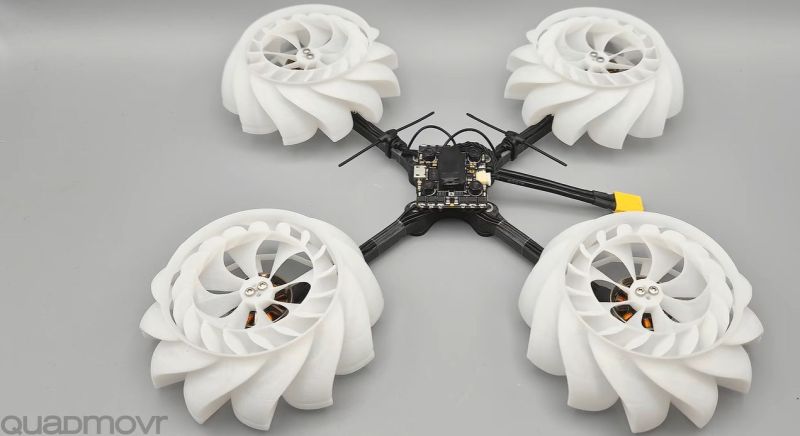
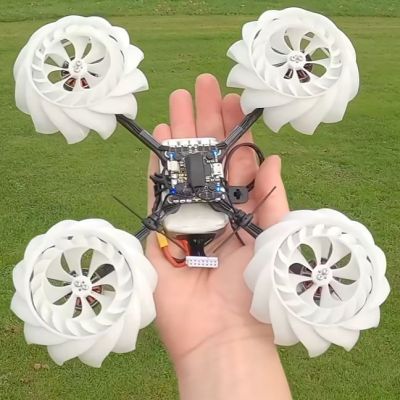
 Even if the world has already settled on plain old propellers as the way to make quadcopter drones fly, this doesn’t mean that you cannot give other designs a shake to see what kind of flying performance they result in. For example impeller designs that depart radically from standard propellers – themselves a sub-category of axial impellers – and go radically radial instead as in this design by [quadmovr] with accompanying demonstration video.
This is itself a remix of a design by [Baba] to make it fit the target 1750KV T-mount motor. As for whether this is a design that you want to slap on your own quadcopter, the obvious disadvantage is that it’s much heavier than regular propellers.
Weighing [quadmovr]’s drone without battery pack and with these 3D-printed PETG impellers shows them to weigh 189 grams. This compares to 141 grams with the standard three-bladed propellers, or a hefty 12.8 gram weight penalty per impeller. Naturally this translates into less flying time, so what are the advantages?
The noise profile of the impeller design is definitely more pleasant, and much like novice quadcopters with the protective ring around the propellers these impellers should be more robust. On the other hand increased mass adds to inertia, and there is a lot more surface area with the air to add drag, so despite the absolutely sick moves that [quadmovr] pulls off with both impeller configurations in the video one has to admit that regular three-blade propellers do have the edge here.












Finally somebody from the oldschool X-Ufo X-BL days :D
I missed this kind of flying so much.
Still sounds pretty loud to me (safety better), but I imagine some things are hard to make very quiet.
Could double as wheels too?
They move on their wheels folded up like a car and then unfold as a drone – a great idea worth trying
Lift capabilities?
Looking at the comparison in speed and agility at the end of the video, I surmise they are much less effective than stock
Is there some regime where there is an advantage in battery usage vs. distance, or vs. flight time, such as straight-line at a speed where the design provides lift, or in hover?
We know kits use the wind….might wind powered drones be a thing with lighter weight materials?
Gonna need you to elaborate on that, do you mean like a drone that has a wind turbine on top? That would definitely not work, the whole thing would just be carried away by the wind if it were not spending much more energy station-keeping and holding the turbine in the correct orientation.
Generally the same reason you don’t see any sail-powered blimps; there’s no denser medium to anchor the sail (like a keel, or the ground for a wind turbine) so the whole thing just goes straight downwind no matter what shape you make it
This is right it would be just like a water propelled boat, it could only go where the current takes it
so… a balloon?
The geometry is completely wrong – but man, that guy is a Sir Pilot!
This guy is my #1 favorite line of sight drone pilot he is absolutely amazing and a genius.
“The noise profile of the impeller design is definitely more pleasant,”
Uhm, no, I disagree, it sounded so nasty.
Makes me wonder what kind of music you are into :) because really ‘definitely more pleasant’.. OK then.
But so far I’m the only one commenting it is not better, and IMHO worse. So perhaps I’m a minority here.
And perhaps I’m more accustomed to regular drones? I see them in videos on a regular basis. But on the other hand I never had this bad a reaction when I first heard a regular drone, where my hair stands on end.
I think the trick here is it’s turning a single frequency hum into a wider band of noise. It doesn’t sound “good” but it would likely disappear into ambient noise much more readily than the props.
its louder and the noise is covering inverter squeaks of the traditional 3 bladed design. Imo fail.
If it really was an optimized solution, it wouldn’t be flat on the top and the bottom. 🫤
Cyclocopters are cooler than impellers.
The sound isn’t any better, but it makes the drone much easier to see.