
The Whole Computer Is Vim

Love it or hate it, Vim, the vi-compatible minimalist editor, is a common denominator between a huge array of operating systems. If you need to edit a file, it’s usually safe to expect it there if your normal editor is absent. Now thanks to [Omwah] it’s moved onto the most meager of platforms, where it becomes the firmware itself rather than a program running on an OS.

ESP-Vim is, as its name suggests, Vim, for some of the ESP32 series of microcontrollers. It boots straight into the familiar editor on an attached screen, and it has filesystem and git access, along with MicroPython. It’s a small computer for working with text files and some basic scripting, and we like the idea.

It needs a board with an ESP32-S3 or P4, with 16 MB of Flash and at least 8 MB of PSRAM. There’s a list of boards that meet this spec, and we can’t help noticing that one of them is the version of the Cheap Yellow Display that comes with an S3. Hook up a Bluetooth keyboard and you’re in.

How easy it will be to use remains to be seen, but bearing in mind that the vi interface followed by Vim was designed for very slow terminals in a much earlier decade, and it could be just right for these platforms. Would you use one?


Vim logo: The Vim project, VIM License.
SDR– Lets You Patch Together Your Setup

It is often helpful to think of a radio as a series of interconnected functional blocks—hence the use of block diagrams to convey how a given radio operates. [Julian Haag] has brought this ethos to SDR–, a software-defined radio program where you can patch together your setup.

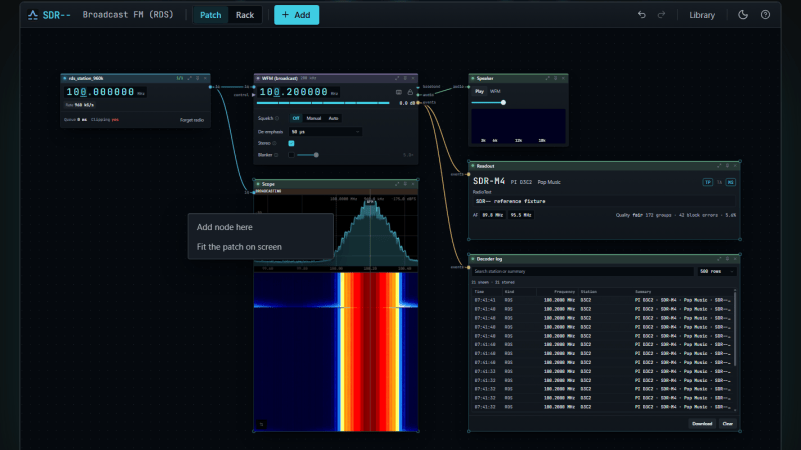
There are many software defined radio tools out there, with various interfaces and methods of configuration. [Julian] wanted to keep things intuitive and simple, and so built SDR– with an interface similar to that of a modular synth. You drop in blocks, like a radio, a demodulator, or a speaker, and then you link them together with patch cables to route the signals where they need to go.

[Julian] has populated the tool with plenty of useful decoders, too, so you can have lots of fun from the get go. You can play with things like ADS-B, POCSAG, SSTV, DAB, and RDS right out of the box. There’s also some fun passive radar and direction finding tools there too if you want to dive in. Files are on GitHub for the curious.

We’ve featured lots of neat SDR hacks over the years, like this neat real-time beamforming setup. Meanwhile, if you’re cooking up your own radio experiments in the homelab, don’t hesitate to let us know on the tipsline.









