
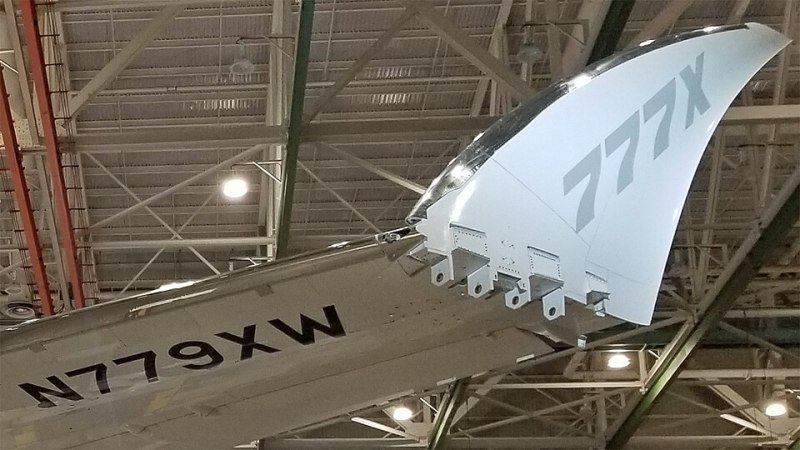
Folding wings have a long history in aviation. Particularly in the military world, where the ability to fit more fighting planes on a boat made a very real difference to the outcomes of a combat situation. In civil aviation, though, particularly at commercial scales, the idea has been less popular.
As unattractive as complexity can be, the push for ever greater efficiency and performance may be changing things in this space. In coming years, you might find yourself boarding an airliner and watching the wings fold out prior to take off, in a way that once unthinkable for a conventional commercial aircraft.
Know When To Fold ‘Em
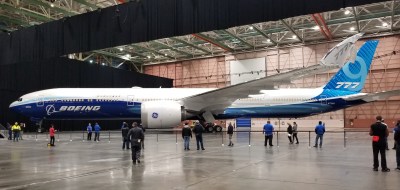
Longer thinner wings, subject to the laws of physics, are more efficient. But commercial air travel, and the planes we all fly on, are subject to an endless list of strict human rules. There are regulations for safety’s sake, mostly written in blood, but also a whole bunch of details that are locked in due to simple practical considerations. Airliners can’t be too heavy, because they’d destroy the runway, and they can’t be too large, or they wouldn’t fit at the gate. As engineers work to make each generation of aircraft better than the last, they have to stick within these limits, lest they accidentally build a plane that physically can’t access real-world airports.
A great example of this issue is the Boeing 777X. The cutting-edge widebody airliner has the widest wingspan of any model Boeing has introduced, at 71.75 meters. Engineers chose to design a larger wing for the sake of its ability to generate lift with less induced drag, along with other related factors to efficiency and performance. Fuel savings and increased range are on the table with a larger, longer, more efficient wing, but it comes with a tradeoff—size. At that wingspan, the plane would fall into ICAO aerodrome size F, putting it in the same category as heavy aircraft like the Airbus A380 and Boeing 747-8. This would restrict the 777X to operating only at select airports that had facilities suitable for such large aircraft. However, Boeing made the design choice to give the 777X folding wingtips. In the retracted state, the 777X’s wingspan becomes just 64.85 meters, allowing it to remain in the size E category along with existing 777 models.
Boeing didn’t need to equip the 777X with an extreme folding wing to get by. Whereas classic military aircraft like the Voight F4U Corsair had wings that folded right near the root to save the maximum amount of space on a crowded carrier deck, such measures aren’t necessary when it comes to the airliner market. Instead, just folding the tips away is enough to get the plane back into a more convenient size category. The wingtips are retracted and extended via hydraulic actuators, with the process taking roughly 20 seconds to complete. Once in place, the wingtips are locked in position prior to takeoff, to ensure the wing operates as one complete unit in flight.
Flapping In The Breeze
Boeing isn’t the only one playing in this arena, either. Airbus has been working on its own aircraft concept with folding wingtips, with even more interesting possibilities. The AlbatrossONE demonstrator is a small-scale, remote controlled aircraft that is being used to test an altogether different type of folding wing. Specifically, it is fitted with a set of semi-aeroelastic wingtips that are hinged such that they can freely flap to and fro during flight. The idea is that these wingtips can reduce the effects of turbulence by allowing the tips to freely move rather than transmitting the disruption to the rest of the aircraft. There’s also the hope that they could avoid wingtip stalls during landing, and even increase roll rate for improved handling.
The AlbatrossONE was reportedly inspired by the way the albatross can “unlock” its shoulder during flight to better manage different wind speeds.
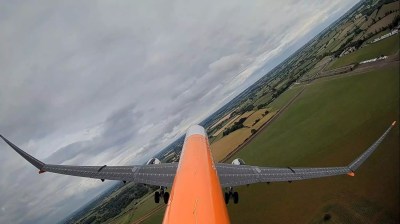
The wingtips are not allowed to flap freely at all times. They can be locked flat for climbing and cruising regimes where it is desirable to minimize drag. In conditions where greater maneuverability is key, or when it’s desirable to limit the impact of turbulence, the wingtips can be allowed to flap freely upwards in response to prevailing conditions. The wingtips can also be locked into a 10-degree raised position to minimize the risk of tip stalls during landing. Much like the Boeing design, the wingtips can also be stowed in a fully upright position to minimize the space the aircraft takes up at the gate.
The AlbatrossONE concept showed potential aerodynamic benefits of folding wingtips on a commercial aircraft. However, thus far, Airbus hasn’t pursued the concept to quite the same level of commercial availability as the Boeing 777X. Nevertheless, the work has fed into further projects, such as the eXtra Performance Wing demonstrator of more recent years. It could be that a future Airbus offers folding wingtips, either simply to boast a longer wing or to add better control and turbulence management in flight. But for now, it’s not something that is ready to hit the company’s mainstream offerings.
Bending The Rules
Ultimately, folding wings on commercial airliners are only going to become a thing for one reason—there’s an engineering benefit to be had. If there were other, cheaper ways to get the same efficiency gains without introducing additional mechanical complexity, they’d be the low hanging fruit that engineers attacked first. The fact that the Boeing 777X is heading in this direction suggests that the easy wins have been had, and that dodging around typical wingspan limits with a fancy folding mechanism is the way to go. If the technology proves fruitful and reliable in practice, expect it to spread in time to other aircraft in time—because if there’s fuel costs to be saved and profit margins to be padded out, you can bet the airlines will be champing at the bit for it.
Featured image: “777X” by Dan Nevill, CC BY 2.0












Please be kind and respectful to help make the comments section excellent. (Comment Policy)