
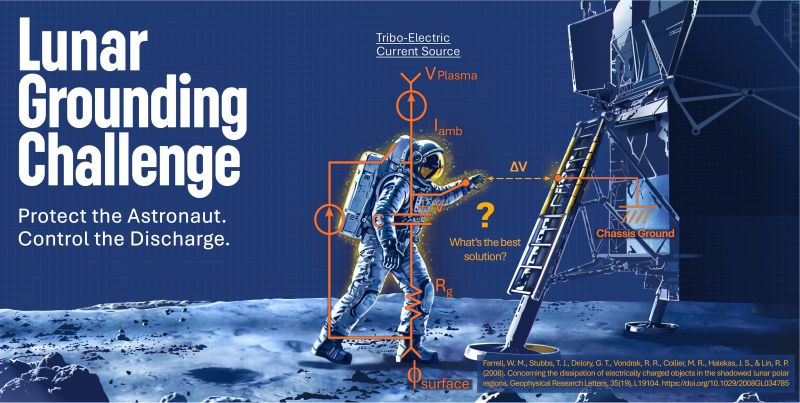
One could make a joke about how an astronaut walking on the lunar surface is rather akin to a cat walking on the carpet in the living room, but out in space the resulting triboelectric discharge can do a lot more damage than just some stinging fingers and a bemused looking cat.
The problem that NASA and other space agencies are dealing with is that the charge that builds up on a lunar-walking astronaut is very hard to equalize with something like a lunar lander. For this reason they have now set up the Lunar Grounding Challenge to consult the public whilst dangling $150,000 of rewards in front of anyone ready to pounce with a good idea.
Here on Earth we have many ways in which we can get rid of unwanted charge: dry winter weather, for instance, demonstrates effectively that humidity is a crucial factor here. With no real atmosphere on the Moon, each astronaut becomes a walking capacitor, which is worsened when said astronaut ventures outside of the sunlit areas and then returns to the slightly positively charged lander.
The challenge here is to equalize the astronaut and lander, with a design specification of a -100 kV or higher astronaut and about 100 V lander. A resulting current should not exceed 1 mA, ideally less than 0.2 mA to remain below human perception levels. If an arc exists it should not contact the suit or astronaut.
Of course, the most low-tech solution would be to use a resistor to limit the current, but at those voltage ranges it would take an awful long time to bleed off, in an environment that’s basically a perfect insulator. It definitely seems like a fun challenge to sink one’s fangs into.











Not all cats. My old cat Tiger always loved to kiss my nose while I slept but during drier months, she often shocked me. She often hissed at me because her nose got zapped. She didn’t learn to stop trying to kiss my nose for 13 years. I miss Tiger.
Pouring one out for ol’ Tiger over here
Limiting it to 0.2 mA pretty much defines the time it will take to discharge. I suppose you could use a constant current limiter instead of a resistor to speed things up for lower voltages, but they have defined the problem in a way that pretty much defines the solution.
Did they define the distance where the discharge may start? No?
IMO with 0.2mA they only defined the time – nothing else.
Not how, where, etc.
Did they define the number of discharge paths?
That 20 microcoulombs of charge at 0.2 mA will take a tenth of a second to discharge.
Going through the arithmetic, it looks like one gram of Polonium 210 will discharge it at about 20 uA, so would do the trick in about one second: Plate it onto the inside of an arch, and just stroll through.
Heck, they left more than 7 kg of Plutonium-238 on the moon in the ALSEP generators. A gram of Po-210 shouldn’t be an issue.
Or just go fetch the ALSEP generators and use the old Pu-238 instead. You’d need something like 300 g of it, but there’s probably more than 4 kg left. You’d have some challenge grinding it into a fine enough powder, but that’s the prize.
Unfortunately the closest ALSEP site to the proposed Artemis landing zones is around 2300 kilometers. Bit of a walk, I’m sure they’ll build up a nice healthy static charge by the time they get back!
Many megabucks worth of Pu-238 sitting there waiting to be plucked. It’s gonna happen.
Environmentalists are outraged across the world! …are they?
Does it say in here if there’s a range requirement for how far the astronaut needs to be able to wander away from the lander? Or is that presumed to be rangeless? Line of sight?
I skimmed it but didn’t see any requirements like that.
Can someone explain why a simple solution like a meter long “resistor stick” with 500Mohms of resistance at the tip wouldn’t work?
Enter and explain it to them. I think the idea is to generate a simple solution with low mass that works in space. Why not? They aren’t trying to tell you what not to do except for don’t arc through a space suit.
Why don’t use the solution used at last visit on Moon?
That’s when they discovered the problem. I don’t think they had a solution then
Also they say the problem is far more severe in permanently-shaded parts of the moon. No other missions were on the south pole (the reason they are stuck on the south pole is itself kind of concerning…)
Why wasn’t this necessary with the previous moon missions, what did they do about it then, what does the literature of the time say, and was it percieved by the astronauts (was it written in any of their accounts)?
Found my answer via nasa and sciencedirect..
This however raises more questions as the article states “when the astronaut ventures into shadow regions” but the surface temperature of permanently shaded regions is below -200*C so I think they have bigger problems than static electricity.
Vacuum is a good thermal insulator. The problem my still be needing to cool the suit.
Huh, the polar region sounds like it has a lot of severe hazards. I wonder why they are landing there?
That question has been a large concern with the entire mission. The answer is that their spacecraft don’t have the delta-v to enter a proper orbit, they’re stuck with the bizarre halo orbit.
A quick look at the NTRS reveals no mention of static discharge issues on Apollo missions.
Conductive doormat and ground through the boot soles came to mind immediately. Just like an ESD workstation.
Since the vacuum is already taken care of couldn’t you basically do a CRT without the tube part. When the phosphors stop glowing as you approach then you know the voltage has come down to safe levels, a resistor could then finish the job.
A long wire in the suit, touching the body, connected to the suite’s glove via a fine mesh?
Or did i misunderstand the problem?
Since the AI filter doesn’t like the ohm symbol, I’m not sure what offend it. I’ll attempt to remember the jist of my ramblings.
Perhaps something as simple as a neon indicator lamp or even a couple of resistors to equalize the charge in stages.
Maybe even make use of the charge for moving charged particles or low level lighting.
1956, Hal Clement — Dust Rag …
A large ESD mat carpet strapped to the lander -> done.
Walking on the mat while approaching the lander will discharge the suit gradually.
The areal resistance of the mat material can be adjusted to match the expected voltage.
DARPA just had a drone lift challenge with $6.5m in prizes. It’s incentive for people go innovate and maybe give them a return on their investment of their time, energy and money. Generally these things work because we’re all capable of having ingenious ways to solve a problem, sometimes though they’re not the problem we’re trying to solve.
… so I pay taxes, NASA takes from $150,000 my taxes paid and offers me as a reward …
Sorry, couldn’t resist the oddity of the offer.
Ionic hair dryers because they’re worth it! Well maybe not hair dryers but ionization like they do with cleanrooms?
In a vacuum? You’ll have to provide your own ionized gas.
Bring my own gas? Tin of beans and some bran flakes, no problem!