
To quote commenter [douyarou], “It’s like our little version of a Precambrian explosion”. A bunch of hackers have discovered, independently and building on each other’s work, software-defined radio (SDR) capabilities in more places than you can shake a stick at.
It all started with [Espargos] and [h0m3us3r] apparently independently discovering that the ESP32 family of chips had a “secret” debug mode that allowed direct access to the radio that’s normally used for WiFi. While the 2.4 GHz radio signal is almost always immediately converted into data by the MAC hardware, here they found a way to listen in upstream, to the raw IQ data.
Seeing this, folks were immediately inspired to find out if they could transmit as well. [marble] not only got transmit functionality working, but integrated the part in with the standard osmosdr data flow, which meant that a whole bunch of existing tools were ready to go. We didn’t know about it at the time, but apparently [jochenhammes] and [z1000biker] concurrently had their TX-capable hacks up and running: here and here.
At this point, folks have already started to use the capabilities for broadcasting digital TV signals, voice signals, FM Hell, and other hijinks. This reminds us of the early days of the RTL-SDR project, when a competent, if receive-only, SDR functionality was found in a bunch of USB TV-tuner dongles. Once the hardware capabilities were sussed out, people started writing all sorts of useful software, and it gave rise to all manner of radio projects, from simply poking at domestic wireless devices to tracking all the airplanes in the world as they fly by.
[Tom] and I were discussing this on the podcast, and he remarked that of course there are SDRs hidden everywhere there is a radio unit these days, and the question is just whether or not we could hack them into usability. And before the podcast was even finally edited, [Samson1te] told us about his find in the LR2021 LoRa chip. This is a radio that’s designed to be a radio, with 16-bit resolution, and covering lower frequencies from 150 MHz to 960 MHz.
Compared to the RTL-SDR revolution, this is all happening at incredible speed. Each of these hacks will enable us to use different slices of radio spectrum with different degrees of ease, but it’s clear that the cost of entry into playing around with digital radio has just dropped precipitously. We will see hundreds of new signals hacks in the next few months – the floodgates have been opened.












We need down/upconverters for the esp32!
I can’t believe the next wave of SDRs are going to be cheap 2$ chips instead of harmonic oscillators + mixers + a dozen band specific filter paths + PA
He who buys cheap, buys twice.
I’d rather want to see more higher quality solutions again.
Something around 30 to 50€ would be totally fine.
I need to make a plaque that says this and hang it on my wall
3d print it, for the irony factor
Still makes me wonder why no one designed a goatse picture frame. Bummer.
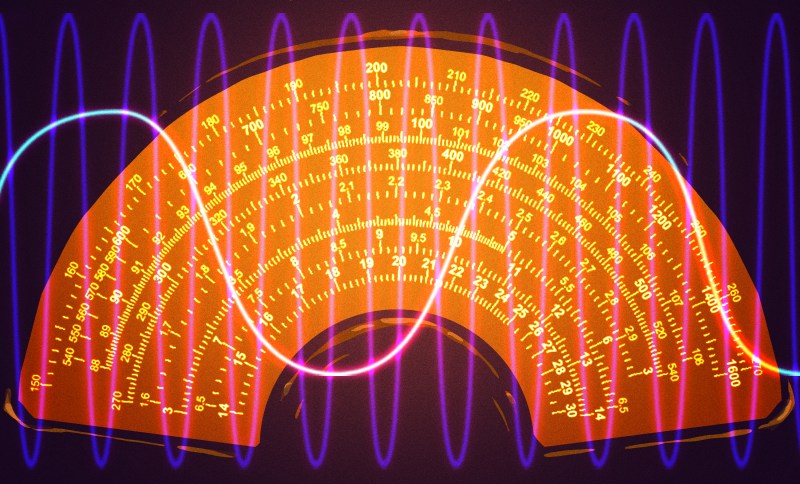
Interesting receiver behind the dial of that header image. Can we learn its provenance? Originally seen on https://hackaday.com/2020/07/10/how-early-radio-receivers-worked/ and the tags imply it’s original to HaD. So, what receiver did this belong to? It’s got the modern FM broadcast band, so it can’t be ancient, but it also has the longwave bands, so I’m curious.
I think it’s the dial on a signal generator. A while back, it was common for radio repair shops to have one with a continuous frequency range from 150 kHz to 30 MHz, in addition to the 88-108 MHz band.
The image is a depiction of a imaginary (non-existent) radio receiver, made from the image located here (scroll down and you’ll see a BW dial):
http://www.quadibloc.com/science/freqint.htm
It is an image of a hypothetical receiver:
http://www.quadibloc.com/science/freqint.htm
It is an image of a hypothetical receiver (scroll down):
http://www.quadibloc.com/science/freqint.htm
PS: Add http:// to the url, as HaD doesn’t allow me to post the link.
It is an image of a hypothetical receiver (scroll down):
www . quadibloc . com/science/freqint.htm
PS: Add also http:// to the url, as HaD doesn’t allow me to post the link.
It is a hypothetical receiver, not generator, just scroll down (look at the BW scale):
https://shorturl.at/xGzHR
That’s fascinating. Good find!
Thanks!
*
+ good DACs, PLL/DDS, fast low noise ADCs, VCOs etc etc
Seems like we really hit the jackpot
you can add my OFFgrid-SDR to that list of recent SDR software as well. lol
https://hackaday.io/project/206845-offgrid-sdr
that project is not related at all. There are plenty of better solutions that are mature, reliable, and not hobbyist ai slop.
Not sure why your sh*ting on his project, where’s yours?
It has absolutely nothing to do with enabling unkown sdr functionality in microcontrollers, so his desire to be included in this article is silly.
It’s also clearly 100% llm-generated without any disclosure or attribution.
This guy clearly just wants people to tell him he’s awesome for software he didn’t even write, which is gross. I don’t publish my software because I don’t need praise online.
Not any SDR contained within a single html web page there isnt.
However, I do agree there are a lot of SDR options out there that are Mature and reliable.
as for AI slop, this is actually quite good with some novel ideas for the trusty RTL card.
That is a nice project! I have been messing with and it is a great introduction to Wefax and CW decoding. The seek function is cool and the way you can just toggle through the bands is very handy. Don’t take any noise about it. Its awesome.
Just imagining what would happen if there were malicious devices floating around quietly grabbing the rf spectrum and sending it home or some sort of virus that could hop between all manner of technology more or less unhindered due to a wireless backdoor. Maybe a war time situation where the devices ping back and essentially illuminate all the populated areas.
This has been discussed as a theoretical threat to the power grid. Using smart meters to simultaneously begin charging EV, heating water, and pool filter pumps at times of peak usage in order to cause cascade failures.
I’ve ordered a couple of boards with LR2021.
Pipe all the binary radio drivers into an LLM for analysis :-)
Maybe we can finally liberate the wrt54g?
I love this comment way too much. :)
Erm…Went a lil crazy there with that GIGANTIC blockquote. Need to brush up on the appropriate use of html in the comments section.
Yet somehow it makes it even funnier (to me).
Aww, thanks for the quote!
Interesting that the debug mode was sitting in the ESP32 silicon all along. Having cheap raw IQ access on a chip that is already in so many projects opens up a lot of experimentation, and it is great to see people building on each other’s work so quickly.