
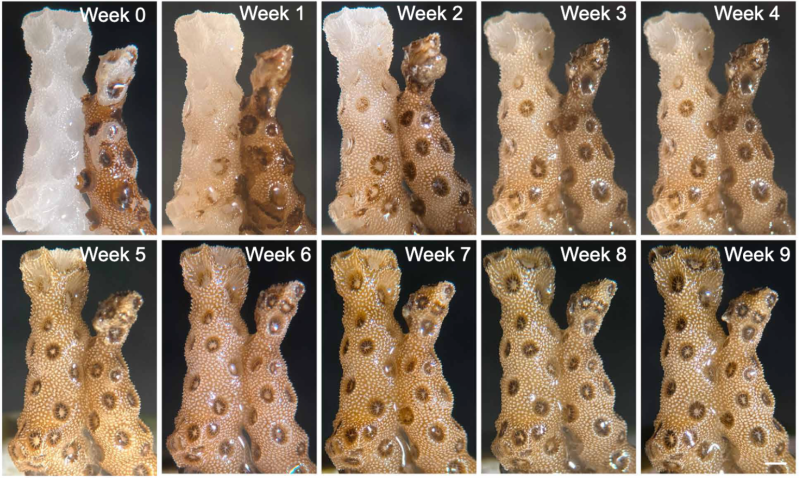
Coral bleaching is a major problem for ocean ecosystems as the ocean gets warmer. Researchers at Stanford have found a new method for regenerating bleached corals.
Scientists working on coral found that when they had a bleached and healthy example accidentally touching in the lab, the symbionts from the healthy coral that make its food were able to spread to the bleached coral, reviving it in a matter of weeks. Contact was only required for one week, although three days was sufficient in a few cases. The effect only seems to work with corals of the same genet as the healthy corals of other genets just take over the bleached coral antagonistically.
This is particularly exciting, as areas where not all coral has bleached may indicate the presence of symbionts that are more heat tolerant, and being able to spread these symbionts to their neighbors quickly can greatly speed up the process of coral regeneration and save the reef. Coral reefs are some of the most vibrant ecosystems in the ocean, so if you save the coral, you can save many other species as well that rely on them.
If you’d like to explore how the coral is doing near you, perhaps you should try an open ROV or a bionic jellyfish?












There was also interesting research that showed that playing the sounds of a healthy reef (*) helped coral larvae settle at a damaged reef.
https://www.bbc.co.uk/newsround/68553058
(*) People who do not dive tend to think of it as a silent world. Scuba divers know better. A healthy reef crackles, pops, clicks, grunts. Some fishes make noises with their swim bladders or otherwise and whales and dolphins can be heard from miles away.
And some fish communicate with farts.
I know! But (unfortunately,) it does not sound like above water farts.
https://www.science.org/content/article/farting-fish-keep-touch
FRT? Really?
…and yet when I do it people get upset.
Because you do not use propper Tursurun! Check Mr. Bean as dr. Who video for details. Also tun captions on.
So, “bleached” is “not healthy”? We keep hearing that, but why?
The linked article implies the white coral is not dead. But it needs its brown symbionts to make its food and clean the place.
If the brown gets expelled, the white won’t live long or reproduce without the browns preparing meals and taking care of the trash.
Re-introducing the brown symbionts to the environment restores health.
Interesting.
Bleached coral are the skeletal remains of the formerly living polyps who built them. Apparently, when the same species of coral are living nearby, the living polyps can repopulate the calcium carbonate “shell” and literally “regrow” the reef. This is exciting biological news!
What an odd thing to say.
Odd? It’s just a short paraphrasing of the linked article.
Now this is a story all about how
My reef got bleached and the currents shifted somehow
I lived in a lagoon, where the polyps were bright
Until the water warmed up and turned everything white
In west coast oceans born and raised
In the shallow tide pools is where I spent most of my days
Chillin’ out, maxin’, relaxin’ all cool
And the fish were just swimmin’ in a tropical poo
When a couple of heatwaves who were up to no good
Started warming the water just like we knew they would
I got in one little drift and the temp hit a peak
And my symbiotic algae left me feeling weak
I whistled for a current and when it came near
The ocean was warming, the danger was clear
If anything I could say that this reef was rare
But the rising temperatures were more than it could bear
The white portion was never really alive. It’s like a big apartment complex for the symbionts to live on that they built themselves to live on and inside of. When it’s “bleached”, all of those inhabitants have died. What has been discovered is that if you place an apartment complex with living inhabitants next to the empty apartment complex, it provides new places for the symbionts to live that they don’t have to build themselves.
The problem I imagine with this is that it seems that it requires the same “type” of coral (which makes sense since the apartments were custom built to each symbiont’s specifications), so whatever stressed the original coral will likely stress the new coral.
I have been tangentially involved in coral research in the past. One project as studying temperature-related-stress resistant coral that thrive in a particularly warm area of micronesia, and another one of those projects was trying to transfer coral from one set of conditions to another (for example from the warm bay being studied by said first project to a cooler channel or reef in open ocean). Admittedly, I was little more than an underwater mule to carry tools, search for sponge-obscured sensors, and exchange the air tanks that ran our tools with the full tanks on the boat. As such, the findings are far beyond my understanding, but from what I gathered from talking with my overlords, coral doesn’t particularly care to be relocated. They become acclimated to their surroundings and moving them to another location with different conditions is a stressor.
My understanding is they’re hoping to use coral from as nearby as possible to reseed the bleached stuff as it will be more adapted to the given environment, but I can’t remember if they explicitly stated that in the paper.
You likely have far more experience than anyone else here in the comments, but I also seem to remember reading that coral is highly adapted for its own little spec of ocean, so it can be difficult to revive.
Warming does not cause coral bleaching (they evolved through far warmer and colder eras), oddly enough it is things like the sunscreen worn by tourists visiting the reefs, that and other modern chemicals that are harmful to the organism or it’s algae symbiote. Please leave the politics out of what is a biochemical phenomena.
The researchers specifically say, “Thermal stress can induce coral
bleaching by disrupting the symbiotic relationship between corals and
their dinoflagellate symbionts (Symbiodiniaceae), triggering symbiont
expulsion from coral tissues,” citing this paper: https://archive.org/details/biostor-10486/mode/2up
I thought you mindless global warming bots weren’t getting used anymore given other political astroturfing that’s going on. Sad to see you’re still around.
Now we just need to reverse global warming to make the oceans alive again.
Reversal is a ship that’s sailed at this point, but we can help species adapt more quickly to try to keep up with the changes. We can certainly slow things down if we stopped pumping so much CO2, methane, and other warming gases into the atmosphere though.
This Onion article is over a decade old and still seems only a hair away from “real” news: https://theonion.com/scientists-politely-remind-world-that-clean-energy-tech-1819576507/