
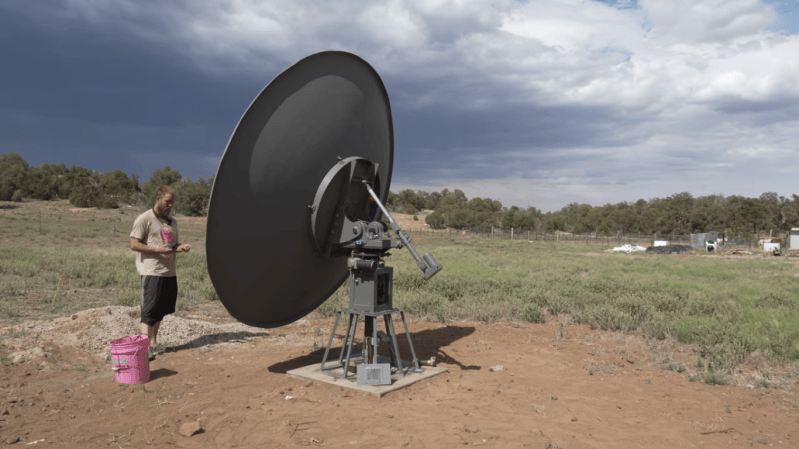
When most radio enthusiasts start trying to pick up signals from satellites, they might put together a quick-and-dirty Yagi antenna and try to catch a repeater as is passes overhead, or they might grab a small unused dish from a satellite TV service and point it up at a weather satellite by hand to try to decode some of the data coming down. But [Cranktown City] had a different approach. He found an eight-foot dish online and built a massive articulating base station out of it as his first exploration into the world of satellites.
The first problem that needs to be solved with a dish of this size is its mounting location. This installation uses a large post and concrete foundation with a custom-fabricated metal base at the bottom. The metal base houses all of the electronics not just for receiving signals from the dish, but also for orienting it properly. That includes a large metal gear driven by a wheelchair motor to control its azimuth and a linear actuator to take care of its elevation. Getting the large dish onto the frame was its own ordeal, complicated by the fact that it’s not uniform in its shape and has to be mounted in a specific orientation.
With everything assembled, the circularly-polarized antenna installed, and the computers up and running, the dish is able to track satellites across the sky and download data from things like GOES weather satellites. [Cranktown City] also built in a system that detects wind and points the dish vertically when it goes above a certain speed. This level of effort is impressive, and absolutely not required to listen in on plenty of sattelite activity out in the sky, but this installation will certainly give [Cranktown City] a lot of mileage and possibly even work for some radio astronomy.












I keep thinking this guy is a character. His shtick, and those rough hands. He’s quite resourceful while playing the meth-hobo.
This build was impressive no matter what.
I love his videos. Been a fan for a long time, it’s good to see him get some love here.
I could not miss one. Absolutely stellar.
Pretty Cool, Man – Making stuff from parts you’ve saved!
In two side views of the dish it looks warped enough to effect focusing, probably had a fall from it’s original mounting higher up.
I’ve walked away from several used/scrapped dishes because of that. Dismantlers typically throw them off the side of buildings when they take them down.
I once took a bent mesh dish thinking I could hammer it out, but couldn’t figure out an accurate way to do it and ended up scrapping it later.
why do old millennials make zoomer-oriented videos? why waste so much time and effort to make your video 30% memes and loud SFX? gen z is not even the target audience for this.
How aboug Xennials and Zillennials then? 🙂
I wonder if it can cope with the weight of the water if it’s raining when it’s windy.perhaps a radome or a way to sense the water and tip it out periodically? No doubt water droplets on the dish will cause reception issues at certain frequencies anyway.
Good question. And I think that at this size,
a wire mesh type of parabolic mirror would be more managable perhaps.
The wind and the rain would put less stress on the structural integrity.
Not sure about the differences in maximum frequency and efficiency, though.
Very cool pulling all those scraps together to decode weather images. Also, he is a riot!