
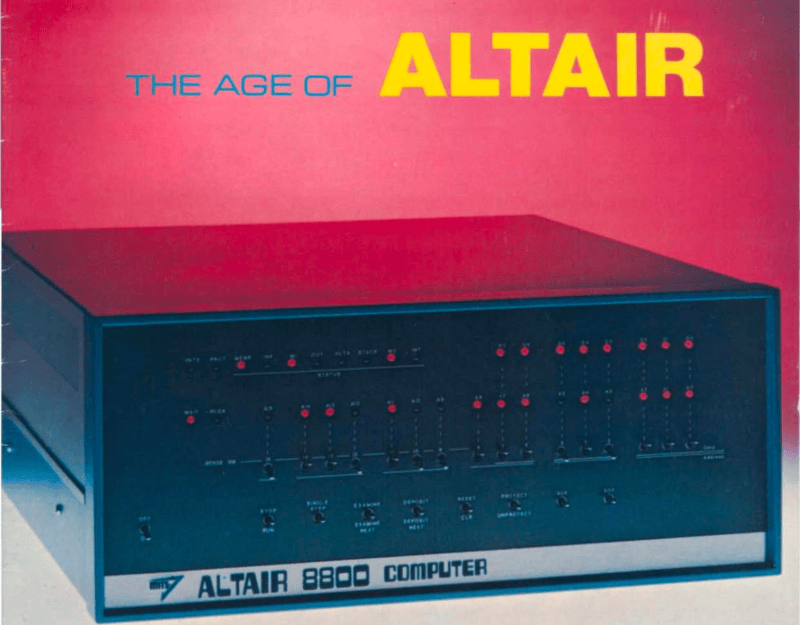
I recently got the Amazon Christmas toy book in the mail, and it is definitely the modern version of the Sears Christmas Wish Book for last century’s youth. Or at least the majority of last century’s youth. For the true hacker, we had a different set of wishes. Recently, I found something I’ve clung to for over 50 years: the 1975 “The Age of Altair” catalog from MITS. Now that was a wish book!
The poor thing has been dragged around for decades and, I’m sad to say, it looks it. It isn’t totally trash, but I decided I should scan it. Then I realized that Bitsavers has already done it for me and with a much nicer copy, too. The images in this post are from their scan instead.
About the Altair
If your first computer ran Windows, you might not get the significance of the Altair. Back in 1974, the idea of having your own computer was practically ludicrous. Sure, Radio Electronics had published plans for the Mark 8 in July of that year. But it used an anemic 8008 CPU, and it wasn’t easy to get all the parts you’d need to build one. Other limited computers, like the Kenbak-1 or the occasional surplus minicomputer, ended up in personal hands. But you couldn’t just decide you wanted a real computer, plunk down some money, and have one delivered unless you had extremely deep pockets.
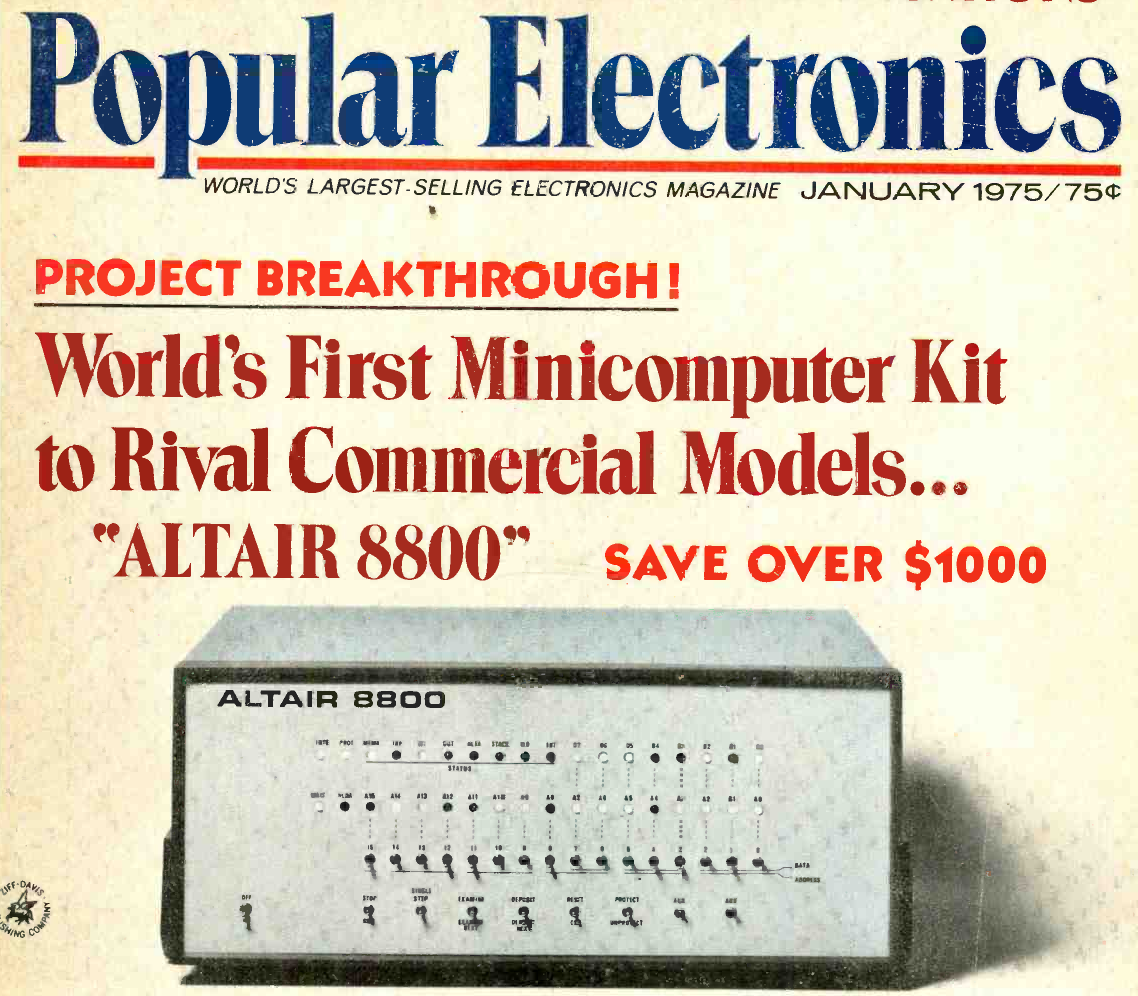
To stay on magazine stands longer, old print mags would come out earlier than their cover date suggested. The January 1975 Popular Electronics arrived, actually, in December of 1974 — just in time for the holidays. It showed a computer you could buy as a kit or assembled: the Altair 8800. Many of us were mesmerized by the idea of owning an actual useful computer.
Reality Check
Of course, the problem is, it wasn’t actually a useful computer. All by itself, it was a bunch of switches and LEDs with a CPU. You’d need memory, and even a little was super expensive. But it was still cheaper than anything else. Want a terminal and enough memory to run BASIC? That’s going to be even more.
In those days, magazines had “bingo cards.” Each ad had a number, and if you wanted more information, you circled that number on the card and mailed it to the magazine. A while later, you’d be rewarded with mail from the company in question. I have no idea how many of the “Age of Altair” catalogs were sent, but I know I got one.
The machine on the cover didn’t look much like the machine in the magazine. The story is that the original machine was sent to the magazine for photography and was lost in the return shipping. But either way, it looked like a small minicomputer of the era.
Micro
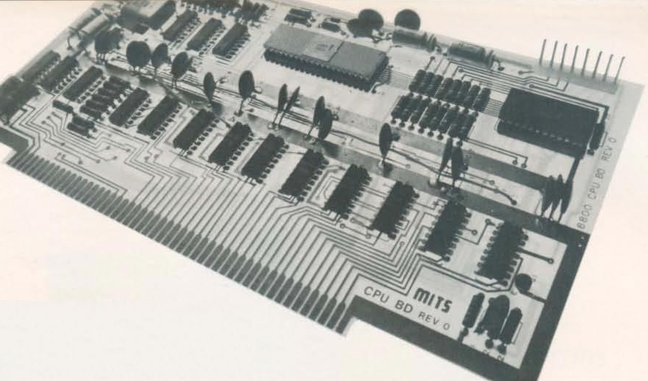
The catalog notes a cycle time of two microseconds, or about 500 kHz. That’s a little misleading. The CPU actually ran at 2 MHz, but each instruction took multiple clock periods, and some instructions required several machine cycles. Even a simple NOP took two microseconds, while more complex instructions could take considerably longer. It wasn’t a speed demon.
One nice thing about the Altair is that it had a card cage, and you could plug in whatever you wanted with what would later be called the S-100 bus. Of course, to save money, you might not get all the card guides and connectors.
If you had deep pockets, you could get fast static memory. This would cost more and provide less memory, but the chips stored bits in flip-flops, and it was fast. Or you could opt for more dynamic memory, which stored data in tiny capacitors on its memory chips. The downside is that the memory had to periodically refresh itself, stealing cycles away from the already slow CPU.
Down with Switches
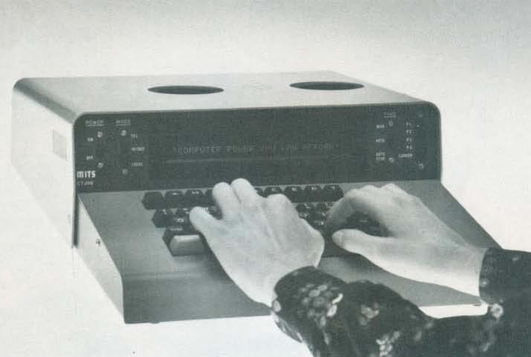
Naturally, you didn’t want to flip switches all the time. MITS offered the Comter 256 terminal. It had 256 bytes of its own storage and a whopping 32-character display. It even had holes to stick your phone in, if you wanted to talk to a remote computer.
This was, of course, not very practical. Your best bet was a TeleType. The TeleType Model 33 had a printer and a keyboard. The ASR variant had a paper tape reader and punch, too. Mass storage and a printer that operated at 10 characters per second. No screen, though. Everything you did was on paper. And it was pricey, too.
Software
The catalog offered a 4K and 8K BASIC along with “Extended” BASIC, which needed 12K but got you double precision math, PRINT USING, and disk I/O. There was also a single page of 8080 instructions in binary. I remember fixating on that page, trying to understand how you’d program this machine. There was a lot of missing detail.
Pricing
For as cheap as these were compared to the alternatives, they were still out of reach for many people, especially a kid. The computer itself was just a bit over $600 unless you wanted to build it yourself. Then you could save just under $200.
You couldn’t do anything without memory, though. A board that could hold 1 kB of static RAM (but only came with 256 bytes) was $134 assembled, plus $61 for every 256 bytes after that. If you wanted the board fully loaded, they discounted that to $209. The slower 4 kB dynamic RAM board was a cool $338. If you didn’t have paper tape, you probably wanted the interface to load and save programs from cassette. That was another $174.
Wanted something with a keyboard? The Comter terminal was $885, but for $35 more, you could get one that would also work with your cassette recorder to save and load things. Or opt for the TeleType for $1,500. You might be tempted by the 88-VLCT (the “low cost terminal”) at only $169. But if you saw it, it only had seven numeric keys (for octal) and two other buttons.
That’s not all. Those terminals had to plug into something. That board would run you around $140, depending on which variant you wanted. Even something like a real-time clock was an extra purchase.
The base computer price had four available slots, one of which held the CPU. So if you had a CPU, two memory cards, and a serial I/O card, you were full unless you bought more slots. To make it easier, you could buy a bundle. The cheapest was just shy of $3,000.
Perspective
I know. It is easy enough to spend $3,000 on a state-of-the-art computer today and, at the time, this was pretty state-of-the-art. But in today’s dollars, that’s about $19,000. A new car was about $5,000, and $3,000 would get you a very nice used car. An average home ran about $42,000, and $3,000 would be a hefty part of a down payment. The median income in 1975? Under $14,000.
Still, these were the first real computers you could at least imagine buying. It wouldn’t be long before the prices of even better machines dropped considerably.
I wasn’t the only one who wanted one of these machines. I conspired with friends to pool money to get one, but we never managed it. I pored over machine code listings in later magazines and the instruction reference in the catalog, trying to puzzle it out. I finally did. In those days, you couldn’t just download the manuals or watch a video about it.
Then again, the value of an original working Altair 8800 today makes it, again, out of reach for most of us. There are always faithful recreations. Or even less-than-faithful ones. I have plenty of these recreations and simulations now, but I still have kept the catalog I pored over so many years ago.












The day I saw the PE article on the alternator was the day I started looking for a job. I was too young to be a bus boy, but I asked anyway.
Ended up building a tv typewriter in high school, and building a quest super elf.
I had a Quest super elf. I never got the hang of programming it – 1802 was like a 4 bit instruction set in an 8 bit package. Spent many hours trying at the kitchen table in the evenings.
I was so happy to discover that the 8080, 8085, 6811 were all conceptually so much easier to develop for.
My dad bought me an IMSI in ’77. I built it and a video terminal. Got the casset tape but still had to enter the bootstrap to get to the tape drive.
Later added a Micon floppy (still had to enter bootstrap to get to the tape to get the hard drive.
It was an exciting time. I enjoyed the soldering, learning octal. Then I got serious. I wrote a BASIC program to run the bookkeeping for our family business. Swapping disks as I went.
It provided me a love of computers and layer a career in software development!
The highschool computer lab in 1981 was wild. There were a lot of very different machines in there:
An Altair with two 8 inch floppy drive and a CRT terminal with keyboard. It ran CPM.
An IMSAI, much like the Altair but missing some drivers in CPM.
Two Apple II computers
An RCA Elf, naked in a metal frame with a CRT display and an octal keypad. That thing always made me nervous – a piece of bubble gum wrapper could have killed it with a short circuit.
Two TRS-80 Model 1, Level 2 machines. Both with cassette drives.
An Atari 400
An Atari 800 – most popular because you could play SCRAM on it. https://www.atarimania.com/games/atari-400-800-xl-xe-games-scram-4543
A true Frankenstein monster that the teacher had built back in the 1970s. Wire wrapped, sitting in a metal tray, with a huge green teletype for input/output. Two guys made a project out of cleaning up the teletype and getting the whole thing running again. They made the computer lab smell like WD-40 most days. I have no idea what microprocessor it used.
I wanted to use the Altair, so I trekked around town (on foot) to one of the two computer stores in town and bought a couple of 8 inch floppies. The other shop was more into Apple stuff and didn’t have any 8 inch floppies.
I was sitting there, writing some program on the Altair, and a couple of guys in the physics lab next door decided to fire up a Van de Graaf generator. I saved my stuff, and got a write error. We all assumed it was due to the discharges from the Van de Graaf generator. The teacher came over and looked, and told me I’d gotten ripped off by the computer shop – they’d sold me a couple disks from a type known to be really crummy. The sparks weren’t the cause, it was the crummy disks.
Sounds like a cool school
Big school. It was in a town of over 150000 population, but only two high schools. Both big. Each grade level had something like 1000 students at each school.
Physics lab, chemistry lab, biology lab. Metal shop, car shop, wood shop. Electronics lab.
Actually used the front panel switches to enter and run a (small) assembly language program on the Altair. All it did was send the letters of my name through the serial port to be displayed on the terminal using a BDOS system call. Wrote out the code by hand, converted to binary by hand, entered into memory using the switches. Great fun. Wheee!
Aww man, those physics guys always thought they were so cool with their Tesla coils and Van deGraafs and giant TEM0 Q switched LASERs and turbo molecular vacuum systems, spilling cryogenic liquids and and diffusion pump oil all over the place. No respect for any computer that couldn’t run FORTRAN. Sheeeeeesh, they’d never appreciate cramming an entire hex monitor into half a K of RAM!
these would turn up in estate sales in the 80s; family had no idea what all Grandpa’s old stuff was and put it out with insanely high (its computer junk!) or insanely low prices. i was more into radio at the time and passed them by.
I still have all my Popular Electronics and Radio Electronics magazines from that era in a box in the garage, including that pictured issue. It was the heyday of hobby electronics magazines and we couldn’t wait for each issue to arrive.
I wish I still had my Dad’s
As a high school senior in 1975, I wanted one of these SOOO bad. But like Al Williams recounts, it wasn’t enough to just have the computer, you needed all kinds of other luxury stuff… like RAM. I saw the price of the computer and thought at first I might be able to swing it (somehow). But when I realized what else I’d need, the price slipped waaaayyyyy out of my reach [sigh].
Like lots of things, if only…. but we didn’t have the resources. You could invest half a million today and make a fortune! Have you got half a million to take a chance on?! And you could invest it in ‘Sodium Battery technology’ or something equally new. In 3 years, it would be almost worthless, and out of date too! I love history, but I think thats part of getting past the middle of the seesaw! Thankfully, the end of this life is only a gateway to the next life!
Loved this story and the comments too. Thank you Al!
Don’t forget the SCELBI-8H!
“Holes to stick your phone in”? The phrase you’re looking for is “acoustic coupler”.
Well, yeah, but I am not sure the youngsters would know exactly how you use that. My first modem was homebrew and used drink coozies as the couplers. I did some side work for a company back then that had plans to make a modem that used a coil pickup instead of a microphone to reduce noise pickup. They advertised and pre-sold them then discovered that some phones are shielded and a pickup won’t work on them. Uh oh…
I recall this was the ROM factor – Requires Only Money
I was born in ’87, but it’s still wild to me how fast things moved for several decades. I still use a Thinkpad I bought in 2012, it’s fine as long as you don’t want to do anything too strenuous. The Altair released in ’75, and the ZX Spectrum in ’83, several orders of magnitude more powerful for several orders of magnitude fewer dollars. Another 10 years later, Doom came out. 10 years after that, we’re expected to hand in longer school projects typed out, with pictures and diagrams. That’s where it started to really slow down, I think. Using a PC that shipped with Windows XP these days is kind of painful, but anything younger than that can work in a pinch. It’s weird to think that my parents are older than the transistor, and now have computers of today.
LULZ yes , same here , my “main machine” , i.e my terminal is also a HP elitebook a year older then my oldest daughter who’s now in university 😁😁😂🤣😂🤣😂
Hi, I can relate to this except for Doom.
Compared to the Super NES launch titles (StarFox, F-Zero, Pilot Wings) that I.d. title wasn’t very spectacular, I think.
On PC, I’ve found Commander Keen series, Jazz Jackrabbit or Skunny Kart/Wacky Wheels to be much more outstanding.
But maybe Doom also wasn’t about technological progress so much,
as it had been about attracting teenage boys and young men.
Doom was all about violence, gore, blood and manly stereotypes.
No wonder it attracted a certain group.
It was manlyness condensed into one thing, to many a means of compensation.
It was like football and drinking beer, maybe.
Not great things as such, either, but being hyped by the masses.
A social event, something that thrills.
Like playing Doom in the cellar or in forbidden places (say family PC, school PC, workplace PC).
I mean, Windows 95 had been a big symbol of pop culture, too, despite it being technologically, um, questionable.
OS/2’s loss against Win95 proved that not the best technology will always win.
wow , I’m a ’80 geek kid , yes I plugged my first computer to my parents CRT TV , first was a Timex Sinclair , then commodore , trx80 , but I remember the Altair , can’t say I saw one but read a lot about it , a thing of legend .
yeah I was born 3 months before the integrated transistor , the little 3 legged guy and I almost share our bdays , spent a lifetime in IT industry , just retired 4 years ago , just wicked everytime I think about it
I am currently restoring an original Altair 8800 my friend built while in college in 1975 – he recently passed and left it to me. I was 4 years old when he built it. I am documenting the restore process and info here https://www.nerdnet.com/altair8800/ and the blog linked there is https://www.nerdnet.com/altair8800/blog/ – barely started the project but it’s going.. (website still needs work)
1979, newly minted M.S., teaching chemistry at a small backwoods college. Backwoods…but they had bought the previous year an Altair 8800b, Lear Siegler ADM-3A display/keyboard, and cassette interface. The latter was pretty sketchy and wasn’t much used. And they had just bought a 32k (!! not G nor M) memory board. Second semester of my first year, one of the other three faculty brought in a friend who knew a little about computers. He flipped a few switches, did this n that, and BASIC appeared! Apparently a BASIC interpreter was on the board they’d purchased, and they didn’t know about it.
I spent the next year or so playing a very primitive Star Trek game in my spare time, and an equally primitive lunar lander; input the thrust, angle, and duration of the burn, and repeat until you landed or crashed. Eventually I was able to input the three variables and land immediately.
I lost interest in the game, but became interested in a young woman who kept coming into the small room to watch me…we celebrated our 45th anniversary in August. :-) (To be clear she will tell you that she chased me. As a stupid male I did not realize this for quite some time…)
In my college days I bought the Altair 8800 PCBs from MITS (for something like $100, if I’m remembering correctly) and populated them with parts from various sources. Bought a metal box of similar size and made a functionally-identical but very DIY-looking copy of the front panel from a thick sheet of aluminum that I very laboriously drilled all the holes in with a very cheap, crummy electric drill. The project was a ridiculous amount of work, and probably cost me as much if not more than the complete kit would have, but in the end it actually functioned correctly. I several times played Kill the Bit on it, then the thing sat unused on a table for several years until I gave it to my little brother (who, truth be told, made better use of it than I had). However, the fact that I had constructed this thing impressed the young owner of a nascent computer store enough that he gave me a job as the store’s technician. That store didn’t survive very long because a ComputerLand came to our small town and blew it away, but that new store hired me as its tech and my lifelong career in computers took off from there. Thank you, MITS—I couldn’t have done it without you. Well, probably I could have, but MITS certainly gave me a jumpstart.
So, an Altair 8800 led to (different forms of) life success for both me and for [prfesser], the comment above mine. Those were the days, my friend.
Oh, and since I was now working for a computer store, my next machine was a real IMSAI 8080 which I fleshed out into a useful machine that I kept using (alongside newer, more powerful ones like an Apple ][ that I built from store service parts) until, thanks to the ComputerLand job, I was able to buy an IBM PC at a price that I could vaguely afford.
My 14 year old self saw this PE issue at my grandfather’s (he was an electrical engineer at the time). I asked my father if we could purchase the Altair kit. Unfortunately he chose to beat Ken Olsen to the punch and ask “why would anyone need a computer in their home?”