
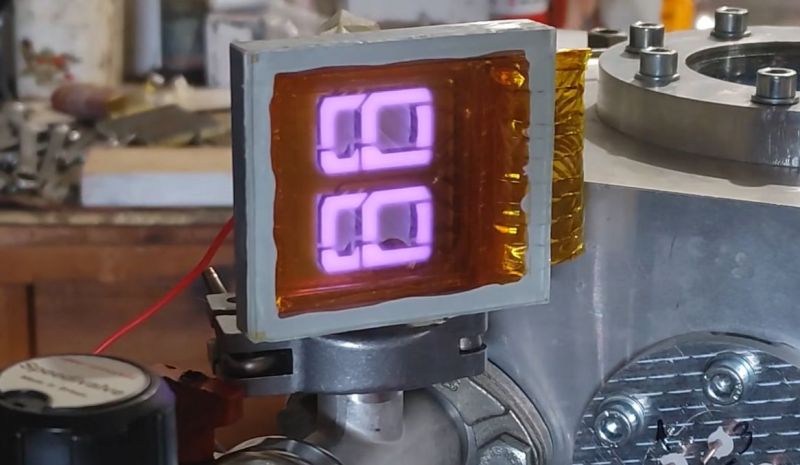
Before the advent of effective semiconductor LEDs many display types existed to display things like numbers and other characters. The Nixie tube is a well-known one, along with VFDs and there are also lesser known ones such as Burrough’s Panaplex, which all saw plentiful use in everything from calculators to audio equipment. The design that [Witchcraft and Alchemy] made appears to lean heavily on this Panaplex design.
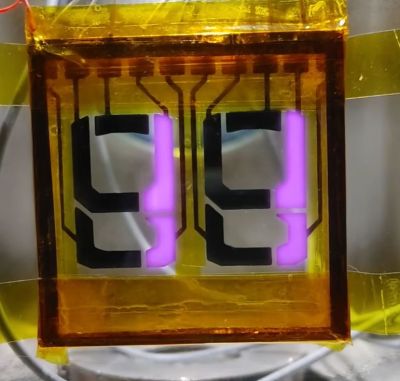 Rather than neon, this uses argon as the gas. The anode is formed by the indium-tin oxide layer on a piece of glass, with the cathode sputtered onto the other side in the form of first a titanium layer followed by platinum. This combination helps to prevent the latter from flaking off due to incompatibilities between the molecular matrices of the glass and platinum.
Since this is an early prototype, only five segments were sputtered onto the glass and driven with a 74141 Nixie driver IC, creating the expected purple glow in a vacuum chamber. Following this a self-contained prototype was created, but this proved to be less successful, with the prototype quickly failing to light up as expected.
For a next attempt no tape or epoxy for sealing the device will be used, but rather a gasket instead of gluing the front glass onto the device. The use of conductive vias should make the device’s vacuum more permanent, and enable those last two segments to make it a seven-segment display. The final change should be to use a Penning mixture instead of pure argon.












That’s slick
When I was much younger, I read Venus Equilateral by George O Smith, and I was sad because designing vacuum tubes out of bits and pieces in outer space where it was possible to do cut and try would never be important in a world with transistors and microchips.
And now this. What an amazing project,
I mean if you’re lost in space you probably don’t have a silicon fab… Seems like it would still be a viable MacGuyver solution if you desperately need a logic component. It just becomes even more interesting because it requires a character who is an audiophile, guitar amp enthusiast, ham, or retro-computing guy to explain why he has the expertise needed to design tube equipment.
Or just be a insane polymath prodigy like Dr. Stone
Although the show’s strength was on chemistry and Earth science.
Yeah. Building a minimum-viable tube circuit in space out of scrap would be an interesting design exercise. You wouldn’t really need envelopes around the tubes, would you? Just keep it in shadow so the sun doesn’t blast them, and probably put some shields or extra charged plates here and there to keep electrons from flying between valves where you don’t want them to. I wonder what it would look like? How crude could you make it? Without the problem of atmosphere, what other issues would crop up?
Soldering and bonding plates/grids made much easier by vacuum-welding. Don’t even need your iron, just something abrasive. Hm.
I had similar idea but with ceramic (or just regular might be good enough for prototype) pcbs. The vias as feed trough, the simple machines box with glass and silicone seals on top. For a nixie dot display.
The thing that impressed me most was the platinum sputter target he was fiddling with. That looked like $1000+ worth of platinum.
Nah, a small wedding band is only about $1200. (Mine was about $2800 in 2010’s currency). And you don’t actually deposit a lot in sputtering. Certainly an economic hurdle if you wanted to mass produce them, but indium isn’t cheap either (about 1/50th of Pt) and in most LCDs panels.
I wonder about sputtering the entire surface and then using the laser cutter to etch out the pattern?
Wet chemical etch is be nice too, because you can recover the platinum very easily.
Unless the etching uses very different chemicals than making a platinum solution for alternate photographic printing, I don’t really want to be around them. Hot aqua-regia anyone?
I thought that the 74141 Nixie driver IC ‘s where unobtainable nowadays.
Some people have good junk boxes.
A brief search shows several thousand in stock worldwide, at prices in the $5 to $14 range. The price implies that they’re no longer being manufactured. The outputs can withstand 60 V, which the functionally compatible 74145 can’t do.
The 74141 is a one-of-ten decoder, not really useful with segmented displays. And there are better drivers that are easier to obtain, like SN75468 or a couple of MPSA42. Another option is to salvage EL panel drivers like the µPD16302 (a 40-bit shift register with 250V outputs), often found in industrial displays from the 1990s.