
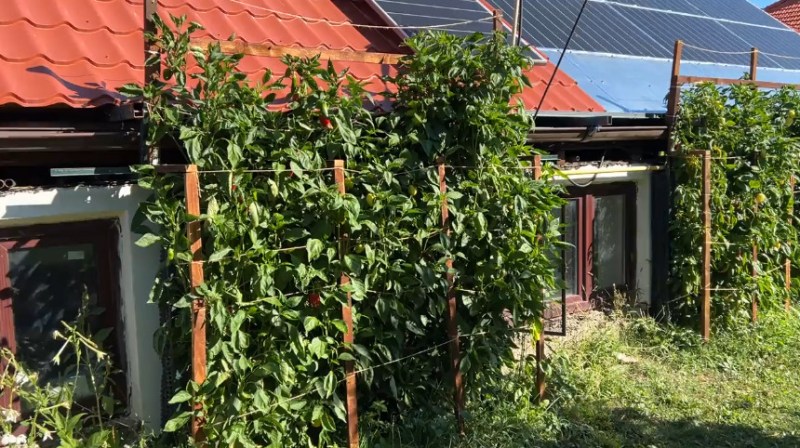
Unless it’s automated or using some other form of high-tech trickery, a vegetable garden isn’t exactly the sort of thing you’d expect to see on Hackaday. Be that as it may, the bountiful crop of peppers [Mihai Oltean] grew on the side of his house was done the old fashioned way, with nary a transistor in sight. So what’s the catch?
Well, in this case, it’s more about the journey than the end result. The produce sprouting in [Mihai]’s garden may be common enough, but the method in which he designed the garden itself is worth a closer look. To our knowledge, it’s the first time somebody sat down and wrote out all the code to generate a 3D model of a vertical garden in OpenSCAD.
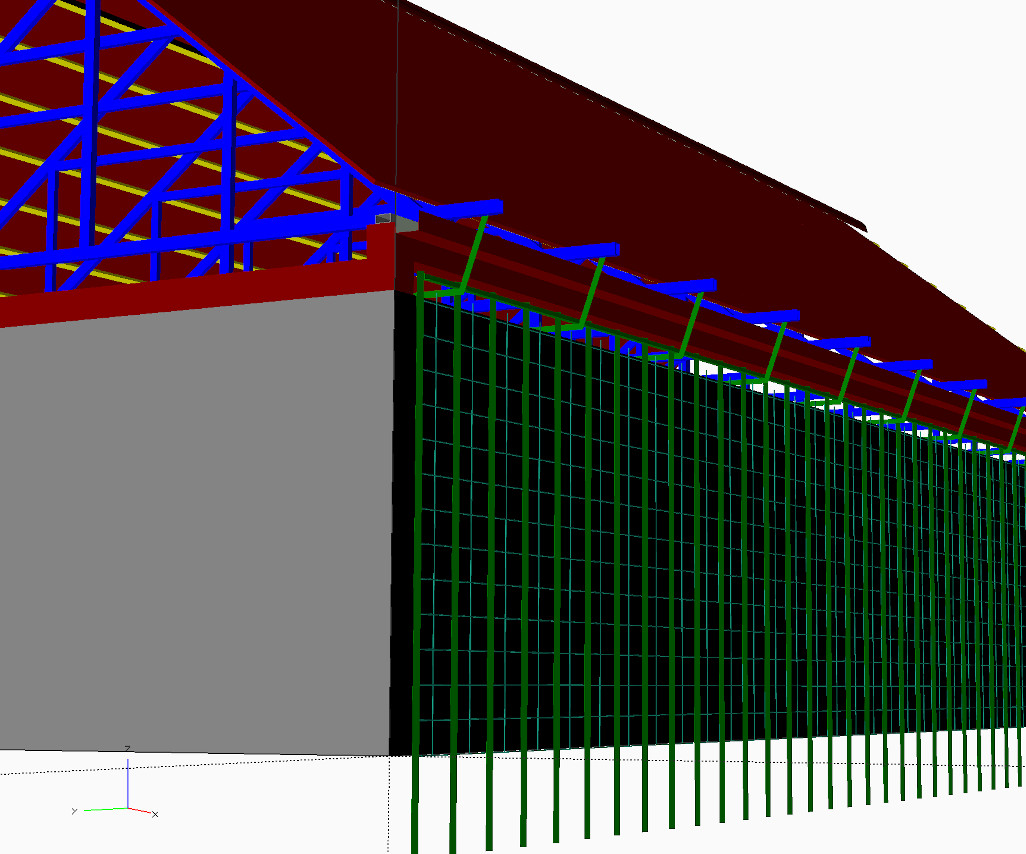 Usually, we see OpenSCAD used to produce design files for 3D printing or occasionally 2D CNC operations. But that’s not what’s happening here. The goal was to simply plan out how all the parts of the system would come together, and [Mihai] felt comfortable tackling it in the code-centric workflow offered by OpenSCAD. We know the feeling well.
Though the code isn’t necessarily being used to produce parts for manufacture, [Mihai] does bring in a bunch of virtual components to stand in for their corporeal counterparts. We’re partial to using a parts library such as NopSCADlib for this kind of thing, but from the looks of the GitHub repo, [Mihai] decided to implement his own versions of the screws, nuts, washers, and sections of metal extrusion used to construct the garden wall.
We recently covered the advantages of “building” a complex multi-part project like a CNC control cabinet virtually in your CAD tool of choice before bending metal on the real thing. This project is a fantastic example of that concept, as it shows that the technique isn’t limited to electronic components.












OpenSCAD is a veritable boon for folks with aphantasia (like me). Having no visual imagination makes it really easy to screw up even the simplest mechanical tasks so I very often build a mockup of anything I’m going to want to visualize before making the first cut. I find having a programmatic surrogate visual imagination to be one of those killer apps that I have a hard time imagining what I’d ever do without it (especially since modern GUIs are a challenge due to having no visual memory).
that is so interesting and cool that OpenSCAD has been a lifesaver to you in this way, thank you for sharing your experience!
Interesting, I have aphantasia and I am a programmer, but Openscad never clicked for me. I need chamfer here, cutout there and they need to be this distance from something else. I’m good with constraints, figuring out the required properties without knowing/visualizing the the results. I’m thinking more in the parametric edit history tree instead of images, so parametric cads are usable but Blender haunts me.
If you want to stick with plain OpenSCAD then the BOSL2 library is a lifesaver. I hear you about chamfers though. I’m about to check out build123d for that reason
Very pleased with Build123d! It works surprisingly well with ‘intelligence’ like claude (smallish quick hand-holding steps for me), this is now my go-to for technical parts.
I’m yet to play with integrating SVG’s for more artsy shapes, which I do in inkscape.
build132d feels like OpenScad but with a proper language. Last time I used it, setting up the environment was a challenge (editor, build env, visualizer) but once I got the workflow going it was fantastic.
I have aphantasia and love openscad. The mind is weird, and everyone’s cognitive experience is different, so notes on what works for me might not help you. Maybe try imagining how it would feel instead of how it will look. Other CAD tools are great too!
Huh…. Interesting…! i am a mechanical Engineer with aphantesia and i can’t stand openscad because of my inability to visualize in my mind, i 100% need sketches and visualizations to cad 3d models. And when using openscad i need to have a sketchbook next to me and draw it out first before i can even begin the coding part.
I have aphantasia and love openscad. The mind is weird, and everyone’s cognitive experience is different, so notes on what works for me might not help you. Maybe try imagining how it would feel instead of how it will look. Other CAD tools are great too!
about a decade ago, i built a bunk bed (2x4s, 1x4s, plywood, screws, washers) using basically this methodology. the process went smoothly and i don’t think it was really any more time or effort than drawing up plans on paper. it was just barely over that threshhold where i needed to plan the length of cuts and so on instead of just winging it. but i still feel it’s kind of silly :)
OpenSCAD is cool and all, but what the heck?!? six-foot pepper plants in a cool temperate climate? That’s the hack I really want to learn about!
Add me to the list of people who want to know more about glorious peppers in cool climates. My pepper garden barely got past knee high. Don’t get me started about lack of yield.
The peep pep talked the pepper plants, pumping them with enough pizzazz to sprout to palacious size
Nice greenhouse. OpenSCAD seems like a good tool for that job to me… design the part once and then for statement it down the Y Axis!
I felt BOSL2 deserves a second shout out as a swiss knife library for OpenSCAD. I use a bolt specific library for bolts but usually BOSL2 for integrating threads, anchoring chamfers to corners, and such like. Things that OpenSCAD can do but that you need to write glue logic for. It’s at https://github.com/BelfrySCAD/BOSL2
honest opinion, i freaking hate cities, i hated having lived in one, and it baffles me that in my country, everyone is turning everything into cities, the fields are abandoned, there are large plots of land, that need people and animals (sheep, goats, cows) to take care of them, and then there are people in cities making vertical gardens, why? this is just stupid, just leave cities, it was an aweful idea, cities have more crime anyway, what’s the point of cities? everyone is depressed, always running everywhere, there are no appropriate green spaces, i hate it