
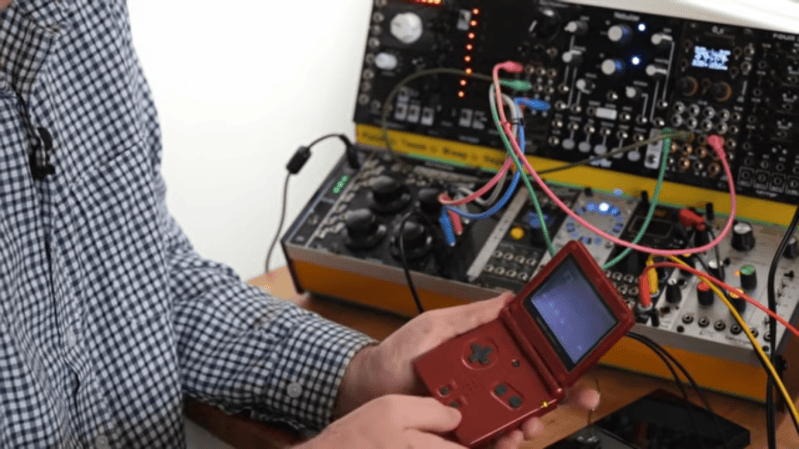
The style and sound of older video games is unique enough that they’re still copied in relatively modern games like Undertale, Celeste, or Shovel Knight. There’s also a vibrant chiptune community making music on the older hardware directly. Often this involves hardware modding or otherwise finding chips from older gaming systems to replicate that unique retro gaming sound authentically. But disassembling older systems is not always necessary. Take a look at this Game Boy Advance synthesizer which uses the GBA hardware with no modifications at all.
The key to making this work is the GBA’s multiboot feature, which allowed these systems to send executable code over a link cable to other consoles which didn’t have cartridges. This meant that friends could play multiplayer games without each one needing their own cartridge, but it also means that nowadays people can send their own custom software directly to the console’s RAM without much extra effort. To run the synthesizer software, the GBA is connected to a computer, the software is started, and then when the GBA is powered on the snythesizer is automatically loaded into its RAM. The audio output is played over the headphone jack, and various controls are available on the computer and on the console.
In the video linked below, [Andy] is using the GBA with some other musical hardware and the sounds he’s getting from the unmodified console are impressive. It could certainly be a go-to for anyone interested in getting started in this style of music or who doesn’t want to do something like take apart an original Sega Genesis for the audio circuitry.











Amazing
It might not be the most musically pleasing of demos, but I’m really pleased to have got the Eurorack and GBA talking to one another using the MTM Workshop Computer module. I hope others do good things with it.
The module is kinda expensive, but the application is really neat.
It has me thinking I should build a MIDI to link cable adapter and write a little application for a flash cart to turn my GBA into a MIDI instrument.
The WorkshopComputer module is an RP2040 at heart. If you are only interested in trying the GBA connection, grab the code, a breadboard and get hacking.
Given the functionality I think the module is still not overly expensive, the firmware-on-a-card is a very clever thing. I just think the microSD-style connector for a QuadSPI flash is a suboptimal choice although a clever hack.
Reminded of this guy: https://arottenbit2029.bandcamp.com/
Saw him live once (with Master Boot Record!), uses a GB (not GBA) on stage as… maybe it’s just a prop, maybe a remote (with radio module?), maybe actual live audio, who knows; but (supposedly) at least the track is recorded from a GB (my guess is one or a few voices at a time, then layered in post).
With, maybe not much more work (than this and the above combined, say?), maybe a totally stock GBA, with custom cart, and either radio embedded in the cart, or maybe a custom link-cable attachment, could do the same thing, polyphonic live interactive synth. Good luck inputting melodies live on a handful of buttons, heh, but queuing would be perfectly feasible.