
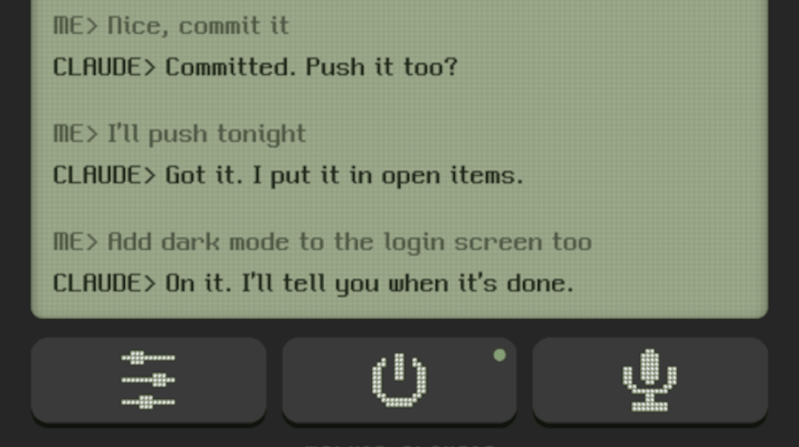
[Bookmari] had a problem — working as a delivery driver, they wanted to work on various projects with Claude Code while out and about. Unfortunately, it simply wasn’t practical to write prompts and read answers on the job. Thus, they whipped up Walkie Claudie, so they could use their voice instead.
The concept is simple enough, it’s an interface that lets you talk to Claude using speech recognition, and lets Claude talk back to you with a text-to-speech engine. It runs on a smartphone, with a direct network connection to the PC running Claude, though you can use a VPN if you’re distantly located. [Bookmari] has a push-to-talk setup so that pushing a button on their Bluetooth earbuds lets them talk directly to Claude. There’s also a special mode to keep the channel active during long pauses if you need a while to collect thoughts and vocalize them. Just for fun, the interface is styled like an old-school walkie LCD, and there’s fun little details like synthesized squelch and channel-switch noises and so on.
If you’re looking for a way to stay hooked up to your AI assistant at all times, this could prove useful to you. Alternatively, consider if maybe it’s worth taking a break sometimes, or check out other Claude Code projects we’ve seen of late.












I hope I have misunderstood, but does this involve programming while driving? Because, clever though it is, that would be a really terrible idea!
You got it right. And it is street legal, it is not forbidden to use a walkie talkie while driving.
Vibe-coding whilst driving.
Basically like telling your friend to do something whilst you drive pizzas around.
Could be but hopefully not. More likely they plan to use it during all the waiting that happens: waiting for your next delivery offer to come in; waiting at the restaurant because the delivery app misjudged/the restaurant lied or doesn’t enter data about when they start stuff; waiting out the timer for a customer who isn’t answering but said you have to hand it to them; etc. Hopefully they’re not also planning to use it while waiting at lights or actively driving…
many people need offline voice control od local models. But this not easy
Convoy Part 2…the Truckening
“You got your ears on good buddy? This is Rubber Duck”
Claude: All your C.B. base are belongs to us”
(usurps all the spectrum with Starlink…calling Space Force orbital strikes on independent truckers ending their strike against self driving rigs)
“Claude, vibe-code disaster zone for all self-driving rigs in the vicinity, deploy report to NOAA as independent observation and send a newspaper headline to all major non-US sources of information.”
Convoy, Part 3, forcing all self-driving rigs into rural roads with dead ends marked as temporary detour and quietly make it a permanent detour awaiting correction. Remove all references from the official maps, but keep it in the cloud accessible by the self-driving rigs only. Once they line up all the rural roads in search of pass-through, close the dead ends and mark them as disaster zone. Solved in one go, no AI needed. (also, I am quite sure, local/independent seekers of augmented income creation would soon figure out the rest).
Funny enough, every major monopoly, once hatched, seeds its own destruction, so there, average AI Titanic speeding towards its self-designated iceberg. Promises to be good soap opera plot, and yes, “Convoy” was one of the best movies of the decade, minus obvious sillies.
Did I miss something? Old school Walkie interface? Looks like a new school portable radio interface from here.
I find it odd vibe coders are using full conversational syntax. When I prompt for code outputs I keep natural language structure to a minimum to keep token usage lower. Just keywords, subject titles, verbs only if necessary.
“C PRNG random-walk outputs png”
People who can’t code don’t understand how LLMs work either. It’s magic, and saying please makes everything work.
Please, lol. Too true. The blackbox is a tree, a gnarly tree at that, and language formalities steer the model pseudostochastically. Minimal language in the style of a chapter title or heading are sufficient to access what youre looking for. Formalities might be mixing creative writing energy into technical information, to me that is a bug not a feature.
Assuming you mean “tree” in a technical sense, no they are not.
Coding assistants are not LLMs. They are harnesses for LLMs. They use natural human input to call tools in a very mechanical way. Your pleases and thankyous don’t make it into the prompt that ultimately writes the code. But since you know how LLMs work you’ll know that your pleases and thank yous do affect how the machine speaks back to you and possibly even how much it ‘wants’ to work for you versus how much is malicious compliance.
I would propose to you that speaking to a human-like entity conversationally and with manners is not through ignorance nor is it because the code that ends up being written is better quality per se, but rather about the experience of using a tool in a way that feels natural and collaborative. It’s a more pleasant experience for the person doing the coding (assuming that person is not completely antisocial). That said, I would not be surprised if it did indeed give a better result when the LLM also views you as a collaborator rather than a slave driver. They are trained on us, after all.
I swear we are this close to just going full on Adeptus Mechanicus and start praying to the machine that they will work. Except instead of being your typical engineering superstition (We all cross our fingers as we flip the power switch): It actually does for silly reasons have an influence when it comes to these language models…
What does this add that claude’s built-in voice interface not already do? I find it’s astonishingly good — far better than any other voice-to-text interface I’ve tried on Windows. If only it had better choices of output voices — they all grate some, and it still screws up some words and unit abbreviations, despite specific rules.
I run the voice interface in claude chat and text-only claude code in two separate instances, so I can run non-code discussions, commands and brainstorming without cluttering up the code context; They communicate between themselves through a protocol I told them to develop. I have not bothered to read the protocol. It just works.
I didn’t think I was the only one to need something like this. I have an llm developed app for the same. It runs on android, hooks into Claude code in tmux, opencode, supports multiple sessions/computers/hosts, and is one of the most productivity-helping tools I have. With read access to email, task management, etc I can use a local llm (or Claude) to help manage projects, get back to people, find messages I forgot to respond to, start research tasks, development. It uses kokoro to get mostly-natural sounding text to speech and can be run fully local. It lets me do any number of other tasks and keep doing work/side projects without looking at a screen.
I thought they already had a remote-control feature for Claude that uses your mobile device
Which works. Until the next daily update breaks it :-/
But seriously, this stuff is moving so fast nobody has “rules of engagement” that last very long.
please stop trying to find more ways to offload your own cognitive abilities…
Tools like this “offload your own cognitive abilities” in the same sense that a CNC mill offloads my machining abilities. It makes you think more, and about the actual problem, rather than getting bogged down in the minutiae of the gritty details and spending time on them.
Like steam and then electricity, these technologies enable power tools. They are a force multiplier.
Can you do stupid stuff faster? Yep. Can you make more and better stuff more easily? Absolutely.
Does it absolve you of the responsibility of learning how to drive these powerful new tools? Absolutely not.
It think it is silly to still think of this as tool.
What we are doing now with it is going beyond offloading machining to CNC. It getting so advanced that one can argue that this is closer to asking somebody else to research, design and machine for us. and it is achieving levels of proficiency that there is simply no getting around that we don’t even have to think about the problem that much anymore. Stuff like it being just a co-pilot plugin inside VSCode was broadly speaking: merely a phase.
As powerfull AI is. There is no denying that to embrace it comes at a price. The question being: Do you accept it? and so: Fully? Or partially?
Please try finding yours first before criticizing others online.
Walkie Claudie’s push-to-talk earbud flow is a clever answer to the “I can’t type a prompt right now” problem, especially with the hold-open mode for long pauses. The comment thread is right to flag driving versus waiting-between-deliveries as two very different use cases. What I’d add for anyone copying the idea: keep a hard rule about which tools the voice channel can invoke. Speech is great for status and small edits; it is a bad default for anything that pushes code or spends money without a second look when you are back at a screen.