
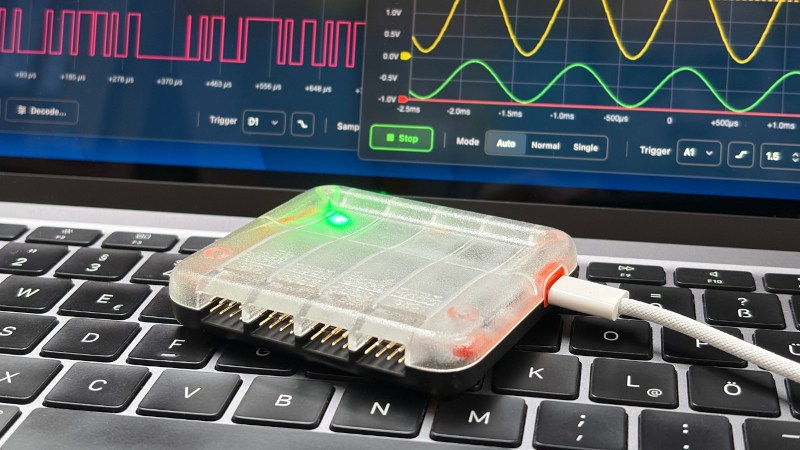
When working on an electronic project it’s likely you will find yourself working with a variety of different instruments, be they logic analysers, oscilloscopes, or whatever. These can take up a lot of space, not to mention cost a bundle of cash. [Max.K] came up with PicoLab as a solution, it’s an all-in-one box containing a four-channel oscilloscope, eight-channel logic analyser, GPIOs, a data logger, and serial, SPI, and i2C interfaces. There’s even an adjustable power supply!
Behind it all is an RP2350, in its larger package with more pins, coupled to some custom interface and protection circuitry. Perhaps the cleverest part is its interface, which it serves as a web site on the network card it exposes through the USB port. Any OS that supports a web browser and USB networking can thus use this thing. You can find all the code in a GitHub repository, should you wish to have a go at building one yourself. We like this idea.











Unfortunately I keep banging my head into the need for far more than 8 channels. If only it wasn’t far more expensive to ship an old HP unit to me than to actually buy it!
You can get 27 channels with a RP2350/Pico2 board including RLE-compression with this project: https://github.com/rabbitholecomputing/RP2350_Logic_Sniffer
I need even more than that :D The trick is to use that other pico-based project which supports ganging up multiple boards. Which requires me to go pay for that pcbway order that’s been sitting at the quote stage for over a month, whoops…
Hey pelrun, if you’re in a mood to cobble some modules together, please take a look at Olimex’s rp2350-pico2-bb48 and pico2-xxl. They both expose 48 GPIO pins, and I think the price is at hobbyist-level.
Regards.
My other frustration is that they didn’t add USB 2.0 so you can’t do realtime capture at full speed and are limited by the RAM available on the pico.
I really would like to be able to make long, faster captures on tons of pins without breaking the bank. I have a device that uses a semi-unique video output signal and want to be able to simulate an FPGA working with it but a full frame needs much more than what the pico can do.
Gotta leave something for the more expensive microcontrollers to implement!
As it stands, very little out there actually supports USB 2.0 high speed or faster without an external PHY. We wouldn’t have suffered with Cypress parts if there was a more convenient option! :D
And USB 2.0 full speed is the same speed as USB 1.1. Why pay for the more complex IP core if it doesn’t perform any faster by itself?
“very little out there actually supports USB 2.0 high speed or faster without an external PHY.”
Yes. And? This is one of my great frustrations with the RP2350 – it’s got a nice, beautiful high speed programmable I/O pins and they didn’t think to make it capable of doing ULPI to implement USB 2.0 in software. External PHYs are fine.
“And USB 2.0 full speed is the same speed as USB 1.1”
USB 2.0 full speed is USB 1.1. The 2.0 spec just named it. The “full speed” didn’t mean USB full speed, it meant at capture rate.
I can’t say these devices are that rare anymore, but i can appreciate the simplicity of the hardware. It is an army of bi-directional transceivers along with a I2C voltage regulator, some current measuring amps and the RP2350B hardware. It is simple, yet effective and i am definitely checking out that MP28167-A I2C Regulator.
Firmware is a bit of a mess though as everything is crammed into a single C file of ~2900 lines. It definitely could benefit from getting split up by functionality so that it is easier to maintain or for others to re-use. I guess messy code is just going to be a recurring theme in this AI-powered era.
The faster people produce code, the messier it is. LLMs allow people to produce code hundreds of times faster. A skilled developer will use some of that saved time to ask the agent to refactor the codebase before making it public.
A skilled developer doesn’t require an LLM to write code for them.
Firmware and Ui entirely Ai generated ….. yeah i man … thats just how it is today. I have a very very similar project. And while it took me several weeks to programm an older version, Claude did it in 20 minutes and all it got was the hackaday.io page of the old stuff and the new netlist.
I really dont know where this will eventually lead to…… scary times
At this point it is not about about it being made by the AI, but about the control you have as a human. The level of use gets no credit for me, and mostly as it also looks like slop. It can still be useful in rare cases, but why wouldn’t anyone already into LLM build their own version?
I’m more afraid for when the Piper shows up to collect their dues. These AI are incredibly powerful, but also incredibly expensive and we are essentially getting access at an incredibly low teaser rate.
It is the biggest reason why i haven’t “gotten with the program” yet. That whole profitability thing is ever present like a sword of Damocles and i don’t want to be around should it drop.
PLUS i know that i still have much to learn about coding, refactoring and how to make it so it is feasible to maintain or re-use parts of it and that can only be done by suffering through it. I also do not want to end up like one of those obnoxious vibe coders on social media that boast about their projects only for a real expert to dunk on them from orbit. I want to be the expert!
Frontier cloud agents are incredibly wasteful (proof by comparison – your brain is smarter and yet only needs 20W to do it) so there is huge scope for efficiency gains even if the hardware platform is inferior to our wetware. So the hope is that the smaller open-weight agents will improve until those agents can run fast enough on tiny hardware and still be very useful.
The open-weight models are only about a year or so behind the frontier models in capability, and while that doesn’t mean they’re guaranteed to reach the current state of the art any time soon you can still potentially throw away your cloud subscription and get useful results from them if you can get your hands on enough VRAM.
In my defense, the hardware, the art, concepts, testing and optimization are “handmade”. I intentionally wanted to test out how far AI can help me with the web design and firmware but I would not call this “entirely ai-generated”, as in some AI model can just built this if you feed it enough tokens. At some point, all (software) products will be created with some amount of AI help. And there is sadly no going back. We can just try to ensure the same quality standards as for human-made designs. Or everything is going down the drain like Windows.
“At some point, all (software) products will be created with some amount of AI help. And there is sadly no going back.”
You assert this as if it were some cosmic inevitability or natural law. The use of AI is neither – it is a CHOICE. A choice made by someone who is either too lazy or doesn’t care enough to actually learn what is needed and put in the effort to create what they’ve envisioned. Effectively, “Hey, Machine, I have this great idea. You should make it for me !”
In the end, I have to ask – who actually made the thing, and do you really understand how it works ?
But hey, I’m just some almost-grey-beard who has realized that the projects I’ve created – the most satisfying, fun, and successful ones, were undertakings where I had to learn some new skill or technique or method.
Well from an economic perspective ….. who cares. I see it in my company. Most Programmers from firmware to cloud all use Ai excessively. Who cares if the price doubles? Last week my boss even told a firmware colleague “oh you blew 300€ on tokens in 2 days? well it would cost more to pay you doing it over a week, and be honest you dont fully understand most libraries you use anyways do you?” So its really not a choice anymore. Use it or be discarded.
And seeing how Claude threw out firmware for my version of OPs project and the quality, also how it even started improving itself once i gave it access to my scope ….. really made me regret not becoming a chicken farmer instead when i had the chance.
I see very very dark times ahead for us people who really care about this stuff. I really feel how the old scribes must have felt once the printing press got invented.
“…the most satisfying, fun, and successful ones, were undertakings where I had to learn some new skill or technique or method”
I believe that in a way this is a skill and I learned a lot during this project. Partially because I need these skills for my job. Don’t get me wrong – I am not a fan of the whole AI development. It’s sad to see the environmental impact, the even faster spreading of misinformation, how this will make future generations dumber and how this is ruining jobs. The biggest software manufacturers are shoving AI feature into their products with seemingly no direction or no quality control. Even without AI, many software and hardware products were becoming continually worse, but this process is speeding up. Things might get better but I don’t think AI will ever go away.
Also, AI usage is not completely black and white. Sure, a car manufacturer won’t just say “Siri, build me a car”. But they are already using AI to speed up things like documentation and parts of their software. There is a difference between a skillfull programmer using AI tools to work faster and a vibe-coder making an app he knows nothing about. Even Linus Torvalds recently started using AI to write code. Is Linux AI-generated because of that?
I think when it time to tooling web-gui is a limitation. When you look at similar commercial offerings like Analog Discovery 3 or Saleae Logic you get a desktop application. If one is gonna ship messy code with an LLM, well it knows C++ and Qt as well!
Can we get a few analog channels and power measurement capabilities too?
My ideal device would be logic analyzer + oscilloscope + blackmagicprobe + something like nrf ppk2 + analog discovery
Sorry but not sorry for being greedy
This uses the available analog channels on the Rasbperry Pi Pico for an oscilloscope and for current measurement. So you get a logic analyzer + oscilloscope + PPK2. The only thing missing is JTAG.
Analog discovery features are missing as well
But then again, this is more than enough for all the digital IoT/low power BLE gizmo development.
Didn’t realise you were the creator! Amazing work. This device will serve you well
Thank you! What features of the Analog Discovery do you find most useful? The waveform generator seems cool.
I think the arbitrary waveform generator is the most useful, but I really like the network analyzer and VI curve tracer. VI curve tracer is pretty simple for you to implement in software I think, since you do have an adjustable power supply and also a current shunt. I mostly use the VI curve tracer to characterise LEDs.
If anyone wants a simpler version of this (only 2 channels) which is probably cheaper and not AI generated, I highly recommend the espotek labrador. That board got me started with electronics and I still carry it around as my first line of troubleshooting small things.
Hi Max, thanks for your efforts!
I have the following comment regarding the design:
The project page mentions multiple ADCs, which is basically not true. The rp2350 has only a single ADC with several multiplexed inputs and can perform a single ADC conversion at a time. Sampling several inputs means that ADC conversions are not happening at the same time, so displaying the channels’ waveforms aligned as if they were sampled at the same time is basically misleading.
Maybe the waveform viewer can be updated to properly display that each consecutive channel is offset by 1 ADC conversion period, which would be a little bit strange when looking at, but would be at least technically correct.
I completely agree that this behavior is not project author’s fault and only due to technical limitations of the rp2350, but still wanted to outline it for the sake of completeness.
Putting several rp2350’s on the same board and synchronizing their ADC acquisition will definitely solve this issue of parallel sampling, but it’s more complex in terms of design and implementation efforts. I’m just sharing thoughts on the fly.
Kind regards.
Hi Nik, thanks a lot for the feedback! You are right, I should have written ADC channels instead of just ADCs. With the test that I have done so far I never noticed the offset between channels, but it’s technically there. It should not be too difficult to just shift the channels in the scope waveform.
Hi Max. It’s interesting that you haven’t seed an issue there, as it should be observable. Let me give some examples.
Let’s choose 500 ksps Fs for a single channel. For sequential sampling of 2 inputs that’s 250 ksps effective Fs. Let’s tie the 2 ADC inputs in parallel and feed them with a sine-wave with frequency between 1/20 and 1/10 of Fs (12.5 – 25 khz). You should be able to observe a phase shift in the recorded waveform if the scope inputs are sequentially sampled, and on parallel-sampled inputs the sine-waves should be always aligned (+/- the adc s/h circuitry and trigger uncertainty).
Another test is to have 2 square-waves with phase delay of ~0.5-1 ADC sample time (1-2us) to each other. On the sequentially sampled scope they’ll look either aligned or with doubled delay, depending on the scanning direction.
Regards.
When I have multiple instruments on my bench, one of my biggest annoyances is all the wires lying around. I couldn’t find any pictures of the PicoLab actually connected to a device-under-test, so I don’t know what kind of cables I would need with one.
Or did I just miss it?