
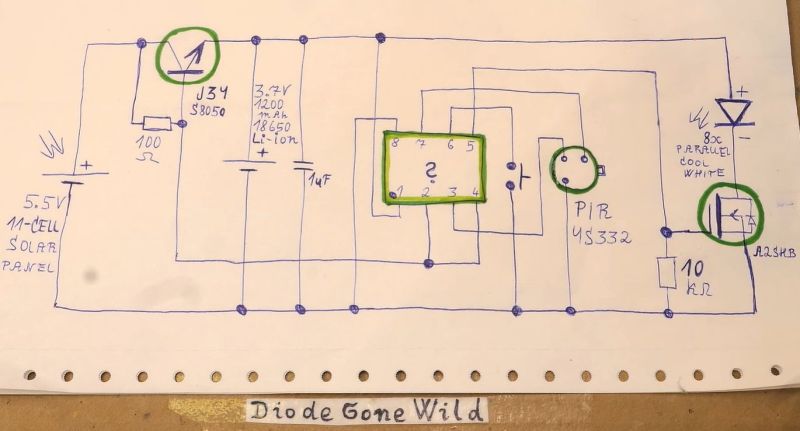
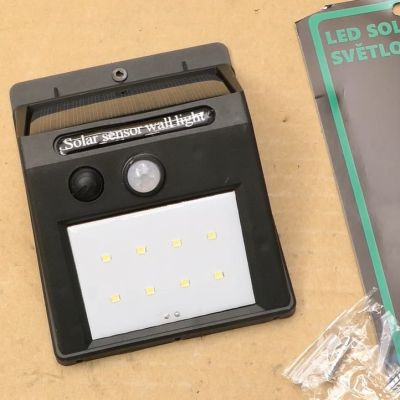
 Recently [DiodeGoneWild] got his paws on a purportedly IP44-rated outdoor solar light with PIR motion sensor that also contains an 18650 Li-ion cell. Since it’s being sold in Czechia in a supermarket by a Czech company you’d expect it to meet at least some quality standards, but once he got inside the device a true horror show unfolded.
The best guess here is that someone took an originally cheap NiMH cell-based solar light circuit and simply replaced said NiMH cell with an – unprotected – Li-ion 18650 cell, as there is absolutely no charging management or cell protection. This is important as while NiMH will throttle charging current by rejecting it as heat the more it is in a charged state, Li-ion is not as tolerant.
Even ignoring that the ‘IP44’ enclosure has more gaps and holes in it than the average slice of Swiss cheese, the 5.5 V-rated PV solar panel happily tried charging the Li-ion cell at around 6 V. This raises the potential that on a particularly sunny day with an already charged Li-ion cell sitting at 4.2+ V, it’ll effectively grenade this cell.
During an outdoors test the 18650 cell was charged to 4.8 V before the sun vanished behind the building, which probably isn’t an amazing sign if you are expecting for this light to keep working for more than a few weeks. Or not violently explode/catch on fire on the side of your house for that matter.
Of course, treating a NiMH cell better than in this particular circuit will extend its lifespan as well, but the failure mode of that battery chemistry tends to be a bit less aggressive. Hence why people keep getting away with dodgy circuit designs like this.












I’m surprised. Not by the degree to which it is cheap and nasty; but by li-ion getting the nod for a product being cost optimized straight into dangerous dishonesty.
Maybe I’m just old and out of touch; but I still think of this as an application where a vendor who doesn’t really care about the fact that they are probably also lying about how long the light will run from a day’s charge will just shove a nickel cadmium cell in there and call it good: tepid energy density and the cadmium issue; but cheap and takes abuse pretty well. NiMH if they care slightly more, since the self discharge won’t be a huge deal on a 12-24 hour timescale and the energy density is better.
Has Li-ion just come down that much across the board; or is it a case where proper Li-ion would still be more expensive; but the volume manufactured for more demanding applications with actual QA means that irregular lots turn up for a pittance in quantities large enough to bodge in but not necessarily large enough to re-engineer around?
I’d guess rejects/recycled/reclaimed vape cells, which makes this doubly dangerous.
China may have run out of cadmium to dispose of in cheap yard lights and now has dodgy Li cells to dispose of.
I just hope that someday they decide to “dispose of” their cheap electric cars and trucks as well, because I want one.
Come to the EU, where they’re selling their crap EVs as “used vehicles” to dodge the import bans. New cars that are nominally sold to some “private individual” according to the made-up paperwork, and then shipped over and sold on discount at a loss – simply to dump more of their cars on the market to displace European domestic competitors.
“Crap EVs”, sounds like an angry customer. EU should have better lemon laws.
That sounds like a good plan, except for the fact that I’d have to live in the EU.
It’s hard to apply such laws against companies that are liable to dump and run, not even trying to establish a lasting brand. Hence why the import bans and limits. These cars are like bad light bulbs: by the time you need to claim warranty, the seller and the manufacturer have disappeared.
I’m pretty sure nicad is banned in the EU now, so they can’t sell devices with it in regular EU based shops.
Perhaps it is that regulation that made the manufacturer when he got an order say “Oh banned? No worry, we put in Lion” and there we have it, no protection.
It’s silly though for DGW to call it house burner because 99% of the houses in the EU are stone surely, and it would merely be a mess rather than a house fire when attached to a wall outside.
Mind you it is possible that someone would attach it to a garden shed of a burnable material like wood or plastic. Or even to a tree, so that might go south fast. And then there is the areas in the EU where they have that extreme heat and drought in the summer and some sparks falling down could set the bushes and then a whole area on fire.
But I think that if you tell the vendor to put in protection when ordering them they have no problem doing so, it’s the importer that failed really, didn’t do due diligence.
They use second-hand cells salvaged from old laptop packs etc., hence capacity is somewhat random.
Adding protection isn’t that hard, those little 1-cell BMS circuits are cheap. They won’t regulate current (a little solar cell can’t cause too much havoc), but at least it’ll shut off at 4.2v and again at 3v-ish.
I once bought a knock-off laptop pack to salvage the cells, I wasn’t expecting much and the pack certainly delivered. I think the cells were supposed to be 2200mah based on the pack label, when opened they said 1800mah, peeling off the wrapper showed 1300mah, and they tested at about 1000mah. That was fine but the cascade of lies was amusing.
LOL nope. Any “entrepreneur” can import crap from China, slap a “CE” sticker on it (which is just “declaration of conformity”, not “tested for conformity”) and call it a day.
Sometimes consumer protection agency (like our Office of Competition and Consumer Protection, UOKiK) will take action and declare something as “dangerous good” which must be recalled (and in some cases existing stocks must be destroyed). They may also issue fines, but those are so insignificant that one may factor it as part of doing business costs. In the end it’s like using a flyswatter to destroy a single wasp on the wall when there’s multiple nests inside your house anyway.
Take for example those really small chinese “300A inverter stick welders” flooding the market. They (UOKiK) may issue a recall on one specific model because it: uses too thin welding cables which would catch on fire with current of less than 100 amps; crocodile clamp is the same one as in cheapest jumpstart cables; declared welding current is bullshit; inverter board has insufficient insulation between primary and secondary creating risk of electric shock, PE connection to the case doesn’t use locknut and ~may~ will fail, and finally, despite being rated at 3600W of power, the device is using 3×0.5mm² mains cable.
That’s fine but it takes time and money to test it, write a report and issue a proper, legal recall. Meanwhile, the same crap inverter welder will be sold under yet another “MAX MASTER 300XZ-PRO SOMETHING SOMETHING” brand within 6 months and the whole cat-and-mouse game starts again.
Only EU-wide bans are working really. There was a time when weedwacker heads with chainsaw flail chain were commonly available and became popular among DIY homeowners. Their (mis-)use led to some pretty horrific injuries. I mean this stuff: https://www.amazon.com/Universal-Weed-Eater-Head-Accessories/dp/B0D6N4BSQJ
They were banned a few years ago under some “flail mower” EU-wide regulation and they’re gone from regular stores. Nowdays you may sometimes find one only on a bazaar, imported directly from China in small batch, but that’s a niche and not worth the fight.
Honestly, I have no idea how to effectively prevent such bad products from entering EU-wide markets without also creating a massive shortage economy reminiscent of the 1980s.
Maybe making marketplaces responsible for the crap they “totally don’t sell because they’re just a marketplace” would be a start? How the U.K. is making them responsible for collecting VAT.
The current economy operates on the premise of customer making a conscious decisions whether he wants a product or imitation of a product.
But does that really work when people are not really educated while conmen are everywhere?
When it comes to money, businesses have to fill reports to explain where they got it. Otherwise they’ll be targets for an audit.
With physical products, it’s possible to do the old switcheroo and pretend to be selling A while actually delivering B. That’s how the same substandard crap ends up on the store shelves everywhere, and the seller has the plausible deniability of “not knowing”.
Ugh. I am imagining what such a weed wacker head would do to my wooden fence.
The flame graphic doesn’t do justice to the situation, nuclear bomb mushroom cloud would be better.
IED!
i agree it’s dangerous but this story — “i found something sketchy. and i didn’t use it. and it didn’t start a fire. and it did not fail prematurely” — is specifically not telling ‘why’ unregulated lithium chargers are dangerous. it’s just asserting that they are, which, well, yes.
just sayin…headlines etc.
What about a solar light with anything less than ip66 rating. Crazy, if you need to put it under cover then how can the solar be effective?
Something seemingly well sealed but in fact permeable to moisture will tend to collect moisture. Something full of holes will collect moisture but will also vent out the moisture.
This.
When designing a junction box for my solar panels I used a double shadowline with an extra deep grove so I could put a rubber windowscreen spline cord coated in white grease to act as a gasket in there.
That’s on top.
On bottom I have open holes where any condensation can run out.
If one didn’t understand condensation they would probably look at that and think it was nuts. So much attention to waterproofing here, open holes there. But it’s lasted a couple years already and everything inside is bright, shiny new!
I intend to design some mesh node boxes the same way as soon as I can get caught up on chores and return to fun projects.
Keep your drain holes very small though… otherwise you just built a yellowjacket nest. At least in my area
There are vent hole plugs with a mesh for this exact purpose: let the air and humidity through, keep liquid water and dust/insects out.
If your enclosure is completely sealed, changes in temperature causes changes in pressure and the box “breathes” through any tiny gap or seam. Hot day pushes air out, then comes rain and water gets into the gaskets, the temperature and internal pressure drops and the box sucks the water in.
That’s groove, sir.
https://www.youtube.com/watch?v=uInyIuNmqEo&t=31s
Rappin’ Ron:
Presidential aid:
The IP rating isn’t anything to go by, because it’s so easy to follow the rules and cheat to claim that your stuff is “waterproof” when it just isn’t.
If you have an IP66 rated device and you leave it outside in the rain, water will find its way in – usually by wicking in through a seam or a crack, which takes longer than the 3 minute test. I’ve had IP67 rated devices destroyed by water in conditions where the water didn’t immediately drip or evaporate away from the gaskets and seams. In other words, outdoors in the weather. I no longer trust the IP rating at all.
Even IP68 doesn’t guarantee anything, since the manufacturer can specify how the device is dunked in water and for how long, This means that e.g. a cellphone can get an IP68 rating because the manufacturer says that it must be submerged with the screen side up, so the case traps an air bubble inside that keeps the water from leaking in through the back cover seals. The same trick they use for cheap “waterproof” watches.
my experience with cheap lights is that the ones that don’t put any effort towards water management last much much longer than the ones that put a token effort towards it. turns out, the ability to drain is better than keeping 99.99% of water out but retaining the water that does make it in.
Link to some video of fire of lion 18650 overcharged (by such small pv cell)? Nevermind, i will try to find one for me:)
I have three similar for 2 years. Functionality intermittent but in expectations accordingly to cheap price.
So, hackaday is like my playlist from YouTube. But late…
I saw the video yesterday…
The NiCd cells in those cheap solar lights are a worry. How many tonnes of heavy metals have well-meaning gardeners added to the places food is grown?
NiCad in solar lights hasn’t been a thing forever, they all went to landfill to contaminate the water table for everyone a couple of decades ago.
NiCad is actually a bit hard to find (esp in AA or AAA), and generally only needed if you need high amps. And it’s often just NiMh relabelled anyway.
These garden solar garden lights imported by the millions all end up in the garbage after one season. Water infiltration and poor quality circuitry and sub-par batteries. Designed to appeal to the local ignorant shopper.
People throwing away cheap products with built-in lithium batteries has a habit of starting garbage trucks and waste handling facilities on fire.
https://www.theguardian.com/environment/2026/aug/22/lithium-battery-fires-waste-recycling-centres-vapes-uk
Truly, Youtube is a horrendous mess on anything non-Chrome.
Not if you use Firefox and uBlock Origin.
Altho then Google will delay your video starting by up to a few seconds.