
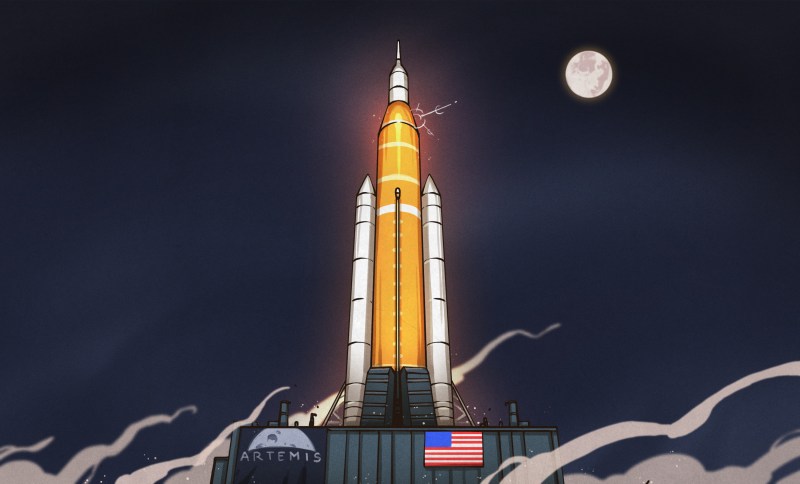
NASA is going back to the Moon! We’ll follow the crew of Artemis II every step of the way.
It’s not everyday that humans make a trip around the Moon — in fact, most of us weren’t alive the last time it happened. In recognition of the occasion and the incredible engineering that made it possible, we’ve decided to do something a little different: this post will remain on the front page for the entirety of the Artemis II mission, and will be regularly updated with new information and images.
Use the comment section below to share your thoughts and hang out with other Hackaday readers as we experience this historic event together in real-time.
Day 1 – Liftoff!
After resolving a last-minute communications issue with the Flight Termination System (FTS), the Artemis II Space Launch System (SLS) rocket lifted off from Launch Complex 39B at NASA’s Kennedy Space Center in Florida at 6:35 PM EDT.
Main engine cutoff (MECO) for the SLS rocket occurred at 6:43 PM, placing the Orion spacecraft and crew members Reid Wiseman, Victor Glover, Christina Koch, and Jeremy Hansen safely into orbit around the Earth. Just before 7:00 PM, all four solar array “wings” were successfully deployed from the European Service Module.
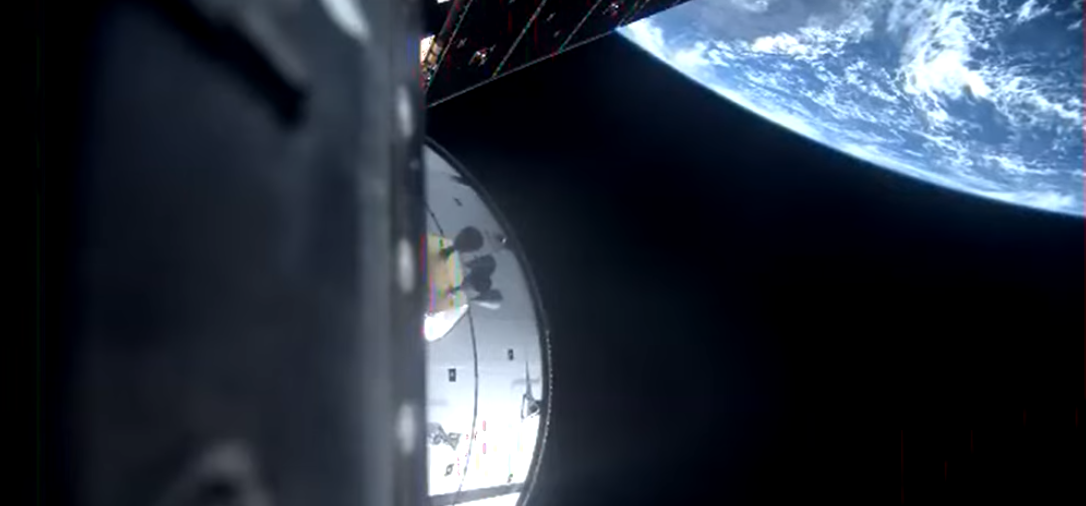
The perigee and apogee raise maneuvers were completed as scheduled — two burns by the RL10 engine on the interim cryogenic propulsion stage (ICPS) lifted the Orion spacecraft to a higher orbit, and put it in position for the eventual trans-lunar injection (TLI) burn which will put the vehicle on course for the Moon.
Between the execution of these two maneuvers, audio and video communication with the Orion spacecraft was briefly lost. Mission Control was still able to receive the telemetry downlink from the vehicle during this period, and was able to determine the spacecraft was operating normally. The cause of the communication glitch is still being investigated, but according to statements from NASA Administrator Jared Isaacman during the post-launch press conference, engineers do not believe it to be a critical issue.
Day 1 – Proximity Operations Demo
Following the separation of the ICPS, the Artemis II crew performed the Proximity Operations Demonstration.
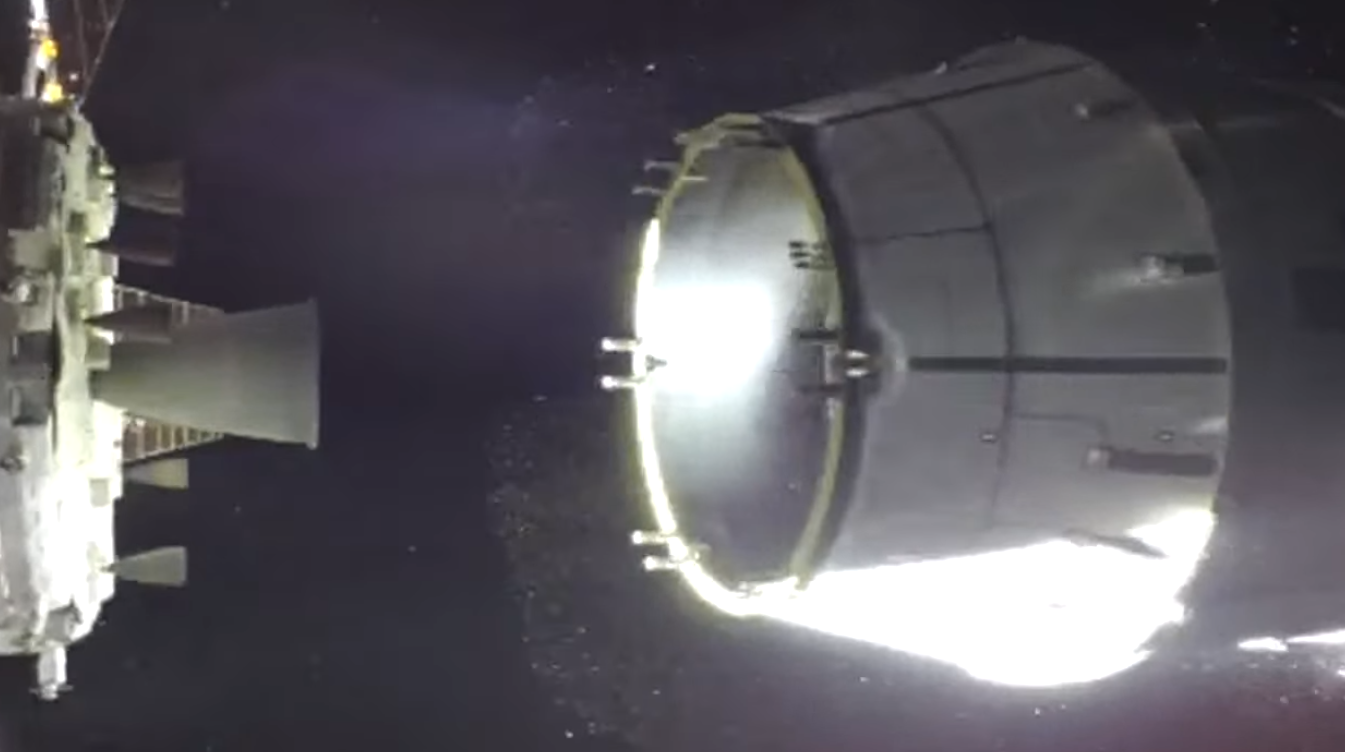
Pilot Victor Glover took manual control of the Orion spacecraft, and performed a 180 degree turn to face the discarded ICPS. While flying the Orion, he told Mission Control that the vehicle’s real-world performance was better than in the simulator, and specifically commented on the accuracy of the controls and the clarity of the camera system.
The crew reported a rumbling sensation coming from the Service Module, and were advised by Mission Control that they were feeling expected thruster firings. They noted that crews on both the Soyuz and Dragon spacecraft have reported similar experiences.
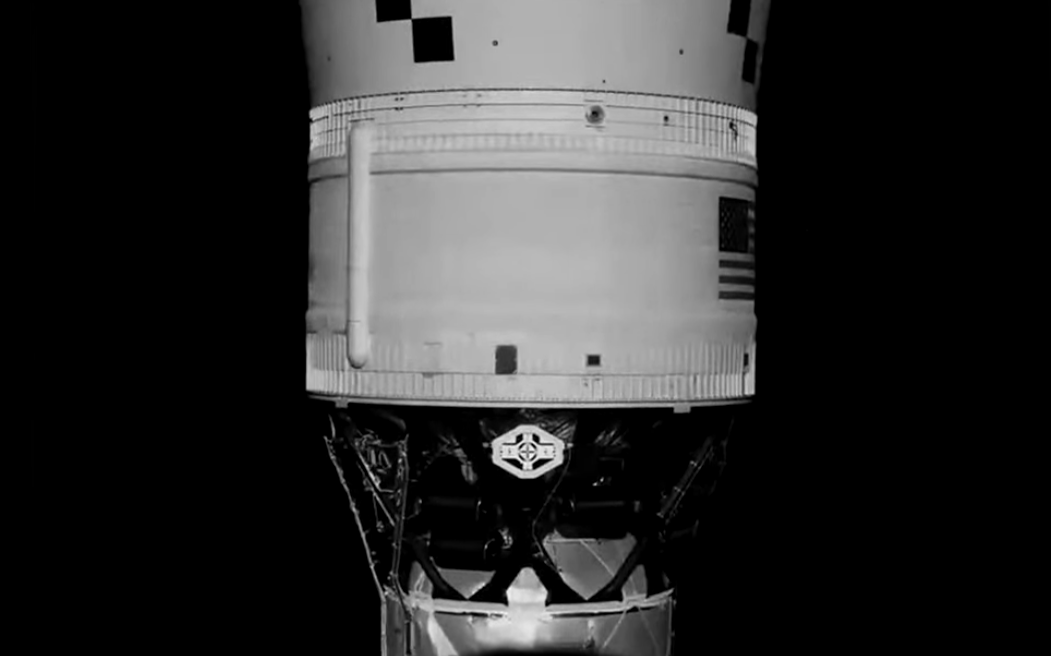
Glover spent slightly more than an hour at the controls of the Orion spacecraft, before finally backing away from the spent ICPS and returning the vehicle to automatic control. Once the Orion was a safe distance away, the ICPS performed its own disposal burn which put it on target to reenter the Earth’s atmosphere over the Pacific Ocean.
Day 2 – Trans-Lunar Injection
Approximately 25 hours after launch, at 7:49 PM EDT, the Orion spacecraft completed the trans-lunar injection burn that put it on course for a rendezvous with the Moon. As Artemis II is utilizing what’s known as a free return trajectory, the maneuver also put the spacecraft on target for its eventual return to Earth in nine days.
Although the final figures may change slightly as the spacecraft’s course is refined over the coming days, it’s currently calculated that its closest approach to the Moon will put it 6,617 kilometers (4111 miles) over the lunar surface. The craft will achieve a maximum distance from the Earth of 406,840 km (252,798 miles), which will set a new record for the farthest crewed spaceflight — a record previously held by Apollo 13.
Day 3 – En Route
While a brief course correction burn was scheduled for today, Mission Control decided that yesterday’s TLI maneuver was so accurate that it was not needed. At the same time, the Moon is still too distant to perform any of the planned observations. This left the crew with a relatively light agenda to get through.
Most of the day was spent settling in to life aboard Orion, which included performing exercises and unpacking equipment that will be used in the coming days. The crew will spend only a relatively short amount of time in the vicinity of the Moon, so they also rehearsed the various activities that are scheduled to take place during their closest approach on Monday. While they have trained extensively for this moment on the ground, being in space literally adds a new dimension to everything they do within the capsule. Rehearsing their movements now can help save precious seconds later on.
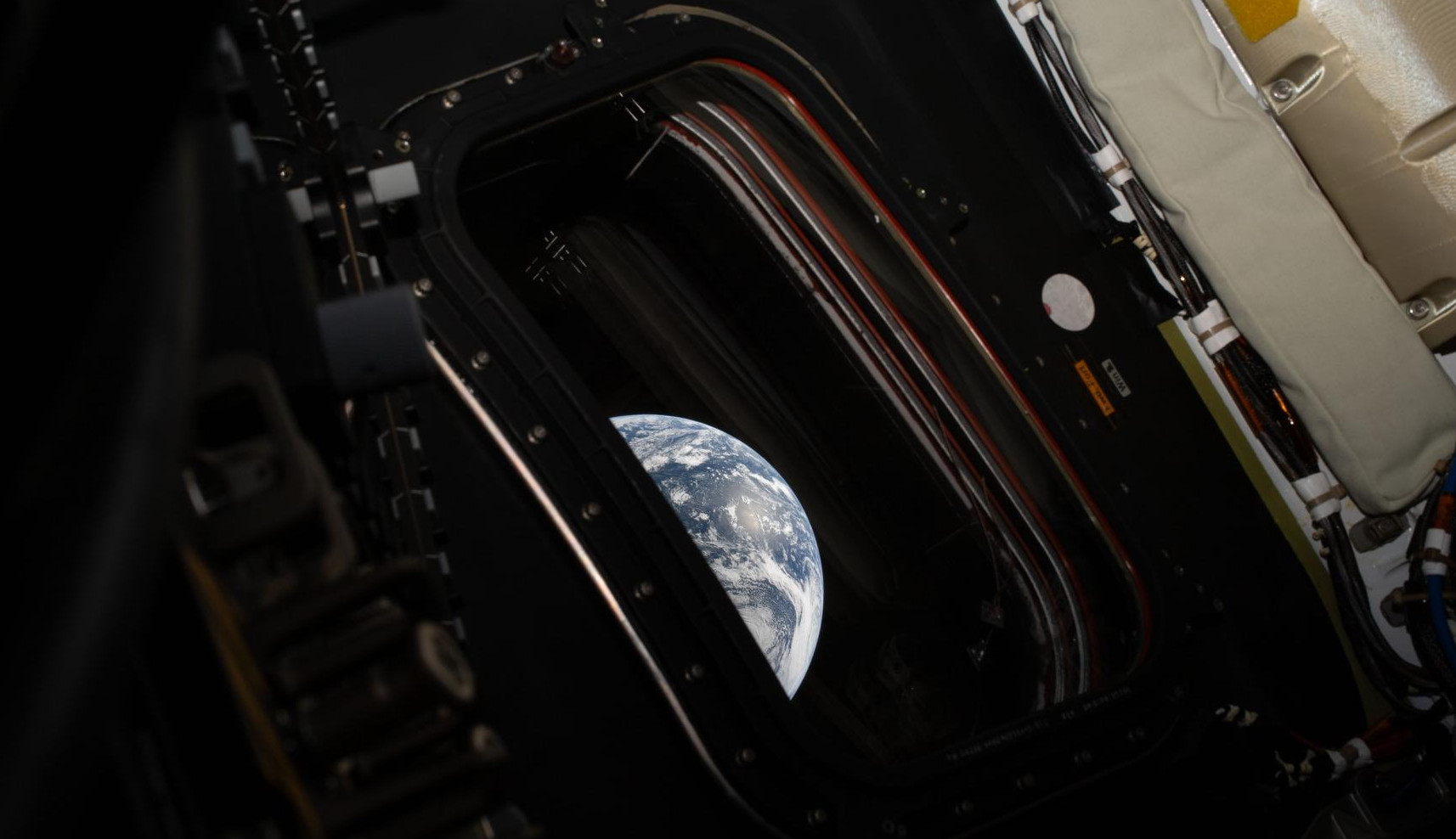
The crew also ran through several emergency response demonstrations, focusing specifically on what to do if an individual was choking or required cardiopulmonary resuscitation (CPR). As humanity ventures farther into space and for longer periods of time, these sort of scenarios will only become more likely.
Arguably the most important task on today’s agenda is still to come — a demonstration of using NASA’s Deep Space Network (DSN) for backup communications. While the high-speed Optical Communications System (O2O) offers enough bandwidth to transmit live HD video from lunar distances, the nature of laser communications means that poor weather back on Earth could degrade or completely block reception. The “old school” DSN link might not be able to handle 4K video, but it can still provide a secondary channel for communicating with Mission Control if necessary.












Artemis II Timeline tracker: https://www.sunnywingsvirtual.com/artemis2/timeline.html
An excellent comment – thanks! Super-detailed status.
That’s a good resource, though a legend of what all the acronyms mean would be useful
That’s against HaD policy.
What doe HaD stand for?
Our actual style guide, FWIW, is to spell out acronyms when we think they are not commonly used. So not PCB, or even CVE in the context of the Week in Security article, but absolutely for the kind of things that NASA is pulling off in that link.
Feynman made the same complaint about NASA in the write up of his investigation of the Challenger disaster.
Thank you.
A wonderful perspective from the Carl Sagan of our day
https://m.youtube.com/watch?v=vo3Dy6Zd30g
I am still fascinated by all the space stuff but the ISS and the Mars missions have shown how unrealistic human space travel is in any substantial form for hundreds of years to come.
All these missions can’t do anything without ground control babysitting every little detail. The autonomy is a Potemkin village. So if you need that anyway, just send robots: they are way more robust than us bags of water and nobody cares if you blow one up or leave them stranded. Get the basics down first, then worry about adding humans.
Actually, robots are not very robust. For the simple reason that they badly adept to unforeseen situations. Humans can asses and adept to a lot more situations.
I’m curious how you think humans will adapt to deep space radiation, the lack of oxygen and extreme temperatures. we can adapt to situations on earth, but not in space
Radiation shielding,
Mining oxygen from silicon dioxide, aluminum oxide, iron oxide, calcium oxide, magnesium oxide, etc
and finally proper spacesuit/vehicle/habitation design.
Radiation shielding can be done in various ways.
Forms of water (ice, liquid, gel etc), lead, electrostaticity etc.
People just have to get a bit creative here.
OP meant unforeseen situations. Humans are great at thinking on the fly, adapting to failure modes not previously considered.
The things you mention are problems to be solved ahead of time.
Survivor bias.
Most people put in positions requiring that, fail, die and are forgotten.
Some get lucky and spend the rest of their lives telling the world that playing the lottery is a good financial plan and to ‘keep dreaming’.
well yea survivor bias. Thats how we grow.. by people doing dangerous things and then learning from those experiences. Not all of those experiences will be good ones.
How would humans react if their urine-to-water system failed on a Mars mission? In case of abort return flight takes about 2 years. That’s not an issue when it’s a bunch of electric motors powered by a piece of red-hot plutonium instead of a human.
And how would a robot execute a nonstandard, non-documented repair process invented on the fly by ground control to fix an issue (which is apparently what was done to solve the urine-to-water issue)? Humans are flexible and adaptable, with onboard AI (Actual Intelligence) that can grasp concepts and infer data much quicker than a machine.
When the human mission goes wrong, the objective changes from science to bringing the humans back alive. The science is lost while the costs keeps racking.
When a robot mission goes wrong, the loss is a tiny fraction of the cost of the human mission, so it can just be abandoned without further loss.
“When a robot mission goes wrong, the loss is a tiny fraction of the cost of the human mission, so it can just be abandoned without further loss.”
Exactly.
And because human spaceflight missions are inherently VASTLY more expensive than unmanned ones, the question SHOULD be “What science REQUIRES a highly fragile biological unit which requires food, water, a room temperature pressurized oxygen/nitrogen atmosphere with CO2 scrubbing, massive shielding and exercise machines for long flights, low G loading, and functional Zero-G toilets, all in an otherwise empty, large volume that can’t be done with a unit in a much smaller space that only requires sunlight (or Pu-238) in a vacuum?”
NASA, in my opinion WASTES 50% of its budget on human spaceflight thanks to lobbies, their politicians, and NASA administrators selected because they love Spam in a can spaceflight as Chuck Yeager called the Mercury capsule. That’s why the, according to NASA’s OIG, $4.1 BILLION per launch SLS is also called the Senate Launch System. Science via lobbyists and politicians. Brilliant.
I’d rather see MORE surfaces of planets and moons through HD robotic eyes than send people on what are mostly just taxpayer funded joy rides that millionaires/billionaires pay millions to experience.
And on the myth that it requires human payloads to hold public interest, the public quickly bored of the Apollo missions until Apollo 13 temporarily renewed interest while record web site hits have been seen for some of NASA’s robotic missions.
Book: The End of Astronauts: Why Robots are the Future of Exploration (2022)
In the USA, maybe. People on other places on earth with a longer attention span and less sensationalism might beg to differ!
Alas, it probably doesn’t matter to you guys.
To you guys, “to all mankind” wasn’t more than a PR stunt, right?
While the rest of us saw human beings landing on the moon, your kind saw nothing than a flag and some tax money spent on a rock. So sad! I pitty you. 😮💨
Have you seen how far Perseverance has traveled on Mars in five years? 25 miles. The lunar rover on Apollo 17: 22 miles. In 4 hours, with 1970’s battery and motor technology. And with dudes and movie cameras running.
The moon isn’t Mars, and the science missions were different, so I’m not saying one mode should be favored exclusively over the other. But watching people tooling around on the moon…
https://www.youtube.com/watch?v=QJW2Za9sg0c
Although now that I think about it, the first two lunar rover missions were purposefully limited to a radius that the astronauts could plausibly walk back from if things broke. But the third, they had enough confidence to push out the boundary even further.
Risks are higher with people in the seats. But so are the rewards.
I think the reason no one has been to the moon in half a decade is because all the possible rewards were reapt. They did an incredible proof of concept but discovered so many pitfalls along the way that they simply could not reason or justify to push that concept any further at the time.
Since then it seems all that institutional knowledge has been lost and we are bound to discover again that not having a million-million ton-cubic-kilometers big life support system will make things really really hard for us. Given the amount of humans that will actually travel there: for the rest of us it does not make a difference if we send a robot who does the exploration.
Maybe slower now, but until humans can actually set foot on the Moon again the artificial agents will easily be good enough to do the same job much better much faster. We can even send some crates with backup units if failure occurs.
Personally I have no problem with the Moon inhabited by Boston Dynamics Bots running on OpenClaw agentics – let them roam the Moon wild and free and see what happens.
I don’t think the possible rewards were realized, I think the politicians lost their will. There was no motivation to beat the other guys to whip people up to justify the budget which was a significant part of the Federal budget, now it’s not even a 10th of that. There wasn’t the memory of murdered young(ish) visionary to drive pride and to also distract from a very unpopular war and multiple missteps in socio-political fronts. NASAS’s engineers wanted to do a lot more, but the reality of budget restrictions caused them to re-evaluate where to put effort.
There’s a lot more to discover on the Moon. We’ve barely scratched the surface, literally and figuratively. However, I’d rather see them spend effort on capturing an asteroid and mining it, but maybe a private company should be doing that work?
What would you do up there that can’t be done on the ISS or on earth?
That would be mainly studying the geology of the moon, which might be interesting from an academic point of view, but not very useful in any other. To sell it to the public, you’d need to use the old rhetoric about developing new technology as a side effect, which is begging the question that we couldn’t develop the same without actually going to the moon.
The “new technologies” argument about the original moonshot was also a bit fake, since the major technologies that did come out of it existed prior and were adopted into the program. They scoured the market for things that they needed and put a NASA spin on top for marketing.
@Dude China doesn’t seem to care about that.
If the US doesn’t want to participate in manned moon missions, it doesn’t have to. That’s fine.
The US had its heyday and relevance in the 20th century, anyway.
Now follows the inadvertible decay, as you and your sameminded fellows had wished by the virtue of your mindsets.
Other nations would be happy, even, if Coca Cola and Starbucks wouldn’t set a foot on the moon, eventually. ;)
So far, China has been sending robots.
Like everyone else, so far? Artemis II hasn’t even left orbit “so far”.
And it’s not even sure that the expertise for a moon landing is still there.
The flyby is an historic event for sure, but it’s less ambitious than Apollo 8 (real orbit) and it’s not sure if 50+ years of standstill can be overcome so easily.
US space program has fallen behind a lot since the late 20th century.
While China by comparison has done a lot since it had been excluded by the US from an ISS partnership.
China has its own space station right now, which other nations haven’t attempt so far.
It’s a nation that rises, unlike the US, which looks like an old empire on a descent.
Please don’t get me wrong, I’m not looking forward to that, it’s worrying.
But the very obsession with money and profits now shows its consequences.
You over there have shaped a culture that values human life very little.
And it shows on all levels. Health, food production, quality of appliances.. Profits about everything.
If people have no ideals and dreams anymore they become mere consumers and producers, rather than human beings.
In the end, they might be become or replaced by robots, too, maybe?
They’re further up the far than China. Your point?
So far it’s been catching up to what the Soviet Union did in the 1980’s. Launching orbital stations is not new, it’s just a matter of how much other people’s money you’re willing to spend on it.
Ah, I see. Money. The k*ller argument again.
Maybe, just maybe, there’s more in life than money.
It could maybe cross someone’s mind that some nations care about the future and the development of their society?
Last time I’ve checked space programs were also peace projects and a matter of international co-operation.
They allowed certain acts of diplomacy that were not possible here on earth.
Which are priceless in times of war and international conflicts.
The co-operation of space programs between US and US/SR maybe prevented WW3 in the height of cold war.
– I know sounds sentimental and naive. But really, this co-operation built a certain level trust and mutual respect. At least among adults.
It allowed both opponents to de-escalate without loosing face.
This is something that robot missions alone can’t do.
Astronauts are heros or do represent humanities, best, at least.
Like philosophers or priests. And right now, the US needs some heros the most.
Not Superman or Captain America, but real people they can look up to.
People who remind them that everything is possible, even reaching for the stars.
And this is priceless. Because people don’t just seek power and wealth but also purpose in life.
People want to be useful, want to be needed. Even the rich.
That’s why they do these crazy projects when money becomes irrelevant to them.
They want that their live has a meaning, a purpose, want to be truely loved for something done right.
Dude, I see that your knowledge is very profound in terms of business and various forms of goverment (capitalism, socialism, marxism etc). Kudos.
But what I’m encouraging you to do is you try to learn more about human psyche, how people feel inside.
Money is important to pay safety and to provide comfortable living, but it alone doesn’t bring people an inner fulfillment.
China is a high-tech nation, though, which the UdSSR wasn’t exactly.
And it already has surpassed the US and Europe in certain fields.
Solar panels, for example. Or engineering, mechanical high-precission, e-car production, microchips etc.
Unlike the US it also has clean streets, trams and subways and health care.
With their average citizen being well educated, disciplined, not obese and good mannered in public.
By direct comparison, the US looks like a slum most of time.
The cities, not the breathtaking North American nature, I mean.
The subways are dirty and are running on 80s era technology (the one part I find fascinating),
most cars run on conventional petrol.
Public transportation (trams) is barely existing, because of cars. Buses lines are next best thing.
Bikecyclists and pedestrians are people second class.
Kids have no place to go to nowadays (few playgrounds, malls, etc).
Playing on street is dangerous, again because of car centric planning.
In political sense both have more in common than what sets them apart, I’m afraid.
Both are lead by authorian regimes that spy on their people and want to dominate the rest of the world.
And they’re both into ice cold capitalism, too. Business comes first, diplomacy second.
The interviews of their leaders make it seem like that, at very least.
The lunar rovers had a limited range of 57 miles with single-use batteries, while the Mars rovers are built to move indefinitely using solar power. They’re power-limited to move very slowly.
And they generate more data faster than scientists can write papers about, because the Mars rovers actually stop and take photos and measurements along the way.
Or an RTG, but that’s the same point: it only has 110 Watts to run everything, with a margin to account for the RTG fading over the years.
The popular Voyager RTGs are no reference, though.
They were designed for a small lifespan of a few years.
The radioactive material itself isn’t even the problem here, but the decay of the Voyager RTGs themselves.
In simple words, it’s like with a carbon battery that dissolves before the material itself has lost its value as an energy source.
I’m not talking about Voyager’s RTGs, but the one in the Perseverance rover.
https://en.wikipedia.org/wiki/Multi-mission_radioisotope_thermoelectric_generator
A great deal of the power will be consumed on the computers running the communications, data collection and path planning. Relatively little is used for actually moving the rover because it does not need to travel very fast.
It’s more fun to drive a slow rover fast then a fast rover slow.
American rovers should have capacitors for bursts of extra power.
Roosting gravel as the probe starts moving or makes a turn is America marking territory.
The lunar rovers had 1 HP of power in total, and an effective weight of 73 kg fully loaded under lunar gravity, so in terms of sticking to the ground they were driving around like a kid on a minibike.
Of course, weighing 73 kg while having a mass of 440 kg meant that you were going around like a curling stone on ice. Lots of inertia, no traction.
The Martian atmosphere is as useless as the lunar atmosphere for human purposes. Mining oxygen? Pull the other one.
Young whipper snapper !!! Heresy against the church !!! If man were meant to fly, he’d have wings !!
And this thing called, eeellektrissity… it is demonic !!! work of the Devil !!!
We must get horses !!! God is angry at these abominations called – aautowmobeels ! (why do you think so many people are taken to the firey pit every year ?)
Heathens !!! all o ya ! Repent ye sinners !! tek-na-la-gee is evil !!!
Muahaha! Best answer around, even if it misses the point of my post. ;-)
Did you see too much Catweazle?
Science fiction novels have some interesting ideas here.
Traveling inside solar system isn’t too unrealistic, also, I think.
Colonies on moons and asteroids are possible even with our primitive technology of today – and the more sophisticated one from 50 years ago. ;)
It has the “fiction” part in its name for a reason. ;-)
Take a look around you unless you are in downtown somewhere: even the tiniest garden on a balcony is a bigger and more extensive life support system than even the whole of ISS can provide. 100m² are the rough requirement for sustainable self sufficient food supply for a single person on Planet Earth. And that does not cover oxygen supply, medicine requirements, and other little things.
An algae bioreactor capable of supplying oxygen for one person typically requires a volume of up to 100 liters of dense, highly illuminated Chlorella culture, To maintain this, a surface area of approximately 8 square meters (86 sq ft) of illuminated area is generally required. If using artificial light and spiralized tank design you can pack the that surface area and a greater than needed volume into a 1 meter diameter cylinder that is 1.25 meters tall.
Food production would naturally reduce the total algal requirement as well but its a reasonable size on its own.
As to your 100m2 calculation for food production is a very earthbound notion where space is not at a premium. Most plants have performed poorly in low grav so it will likely be necessary to use simulated gravity to efficiently grow in space. A 6 meter diameter cylinder that is only 3 meters in height exceeds your 100m2 requirement. That would require ~17.25rpm to approximate 1G.
Scaling for multiple spacepersons could be accomplished either by increasing these cylinders heights or by nesting multiple units together.
Another option would be to surround the first growth cylinder with a larger diameter, slower rotating cylinder for additional growth/simgrav environment.
There was a guy on Youtube that actually tried to make enough oxygen for one person from algae, and with several 100 liter barrels full of it he still failed. Turns out the algae is a bit picky on how it likes to live.
Yes a guy on youtube certainly represents the potential for the greatest minds on earth to construct an algal bioreactor capable of the task. /s
Sure. Because without actual testing things do remain a mind experiment only.
But many of the ideas are scientifically being backed rather than being based on, say, magic.
A lot of science fiction authors do spend some deep thinking into their imaginary worlds and their physics.
That problem is being covered by sci-fi novels, too.
There are various ideas that try to solve it.
From genetically modified plants and humans over alternative types of food (protein bars etc) to food synthesizers..
Star Trek picked up the latter, before replicators were introduced.
One notable reason as to why space exploration is so delayed is the conservative thinking, maybe.
It’s been over 50 years since the first moon landing and best that space agencies have to offer are flying cigars.
If, for example, other types of propulsion had been tried out in the past 70 years, then the situation would be different now.
Ion drives are one of them which materialized and they are useful for longer travels.
Ion drives are limited by the amount of electricity you can generate, so they’re not powerful enough to push you off the ground.
Generating electricity up in space is another matter entirely. If you want high thrust, you need hundreds of megawatts of electricity. That’s one mighty solar array. Batteries simply don’t have the energy density to drive the system, and other types of generators run into trouble with thermal exhaust into the vacuum, because there’s no convection to carry the heat away.
Not in human time scales, because the thrust is so low that it takes years to accelerate and stop.
Ion drives provide a steady acceleration over a long period of time that can build up, which is already used for space probes.
Putting humans in winter sleep might be one way to make a 10 years journay happen, maybe.
I’m just a layman here, of course, so I don’t know the exact numbers.
Another, more radical concept was using atomic power directly for propulsion.
“100m² are the rough requirement for sustainable self sufficient food supply for a single person on Planet Earth.” Without hunting or fishing? Not buying it. Challenge.
It’s a “spherical cow” approximation, or “first principles” as Elon Musk would call it.
You can grow X calories of food on a square meter of land, a person needs Y calories to live…
Still not buying it. Metaphorically is this the 100m² you want to die on? Again challenge. Double jinx super challenge.
https://www.google.com/search?q=how+much+land+is+needed+to+sustain+one+person
https://www.google.com/search?q=how+many+square+meters+in+an+acre
And because I’m fair-minded, https://www.reddit.com/r/Permaculture/comments/ayiz0t/400kg_800lb_of_home_grown_produce_over_12_months/
Elon Musk? Hmm, that’s the Hypertubelink guy, the guy who got government subsidies, innit?
https://www.congress.gov/119/meeting/house/117956/documents/HMKP-119-JU00-20250226-SD003.pdf
Why yes it is.
Health and safety culture.
Kill it.
Look at mega projects on earth in the 21st century.
In the so called first world we spend a fortune on site safety which is very over the top. It’s a huge amount of the budget in any project.
Look at HS2 in the UK for an example and whilst corruption is rife, the H&S culture is a massive part of it.
Now lets just do away with it.
Hire people with common sense. but tell them hey, this is dangerous but we’re going to pay you a ton of money and if you get injured these are the agreed payouts.
No one is forcing them to sign up, but you’ll have a queue round the block.
Many competent people just hate the H&S culture which stops them from doing the actual job because some moron with a clipboard whose never done the job or any physical labour let alone anything remotely dangerous in their life has “risk assessed it” and they have decided as the dictator in charge that it’s too dangerous.
Climbing a ladder….
That doesn’t mean that corners would get cut. No, have peer review. No H&S culture doesn’t mean everyone starts running with scissors!!
It would cost less than enforcing the H&S culture in the first place which actually doesn’t stop accidents anyway.
Meanwhile in developing nations, people die and they hire a new guy.
It’s how we got stuff done back when we were building infrastructure in our golden ages.
I most ly agree, but this one reminds me of Alien 1, the crew of the Nostromo and the evil Weylan corp.
To non-US citizens, this film is less sci-fi but more of an documentary of American work culture.
People should never be treated as resources, otherwise they’ll stop to really care about their jobs and their missions.
Reminds me of the steel workers falling from Empire State Building in the early 20th century.
They too had no safety or worker rights. They were simply disposable.
That’s NewSpacers
Rockets reusable…workers expendable.
https://www.workerscompensation.com/daily-headlines/workers-file-lawsuits-against-spacex-for-workplace-injuries/
Common sense won’t help anyone if the people making the decisions are not effected by the results. Most recent example I have here, is I work on medical products. We ran into an issue where the device goes into error. Reaction: “Disable that error, it’s not needed, other checks cover the risks”.
As software developers, our spider sense tingled. And after sitting down for 30 minutes, we found two scenarios where disabling this error could kill people.
Proper investigation of why the error happens takes time, and will delay rolling out the product. So management decides that it’s worth risking other peoples lives for profit.
Common sense? These are the same guys who do override a fuse in a CB radio with a bit of alu foil “to fix things” and then do wonder why some magic smoke comes out of it! 😂🥲
I’ve actually heard using a ladder (for anything) in an industrial setting being a ‘huge red flag’.
They didn’t mean you should use a pallet on a forklift and get a ride.
‘They’ mean you should always get a scissor lift when you see something you can do with a ladder.
But give ‘them’ some credit, their rules are written with ‘tards and scammers in mind.
OMG! I recommend watching “Staplerfahrer Klaus”. 🥲
https://www.youtube.com/watch?v=TJYOkZz6Dck
Best training video ever.
Also classics are “Elektriker Horst” (Electrician Horst) and “Schadensmeldung eines Dachdeckers” (Damage report from a roofer).
I don’t think they have English subtitles, though.
But that’s okay. The pictures alone tell most of the story anyway.
In the roofer video it’s basically about the roofer himself telling the events that caused his damage.
He types a letter to his health insurance very politely on a typewriter.
The funny part is also how calmly he describes everything (action/reaction),
which is in stark contrast to the cartoonishly violent events that happened to him.
Even with limited German skills it can be understood by the sound of his voice.
They do that in Russia. The problem isn’t safety culture, which doesn’t exist there, it’s unaccountability, which is prevalent in both places. Your payouts – are they financially debilitating to the company? Do they target executive wealth? Are there jail terms for executives for willful endangerment? Are there precisely zero ways for the company to get out of paying these payouts? Are lawyers engaged in blocking these payouts under mandatory threat of investigation for malpractice and disbarment? Of course not! that’s why we invented safety, because we would have to turn our society literally upside down to avoid turning our citizens into disposable meat.
Health and safety culture.
Kill it.
Your the type of guy that safety videos feature on what not to do.
Let’s not forget that the Service Module is built by ESA, the European Space Agency. This is not an all-American effort. :)
That part was gleefully ignored by all news anchors on the call. I had to look it up myself, yes, Lockheed-Martin and ESA.
wrong ESA.
AIrbus and the European Space Agency worked on the service module
Lockheed separate from those organizations built and ESA Electronically Steerable Antenna
“…Airbus / ESA (Europe): Built the European Service Module (ESM-2), which provides propulsion, power, and life support…”
That’s quite a LOT and shouldn’t be ignored.
On the outside it has an US flag decal with ‘united states’ under it, a stretch below it a large round NASA logo with right underneath that the ESA sign and the letters ESA, and the lettering of the ESA sign are equally wide as the US flag and NASA sign, but the letters are bigger because there are fewer of them of course.
So the actual rocket doesn’t hide the partnership.
Incidentally I like the coloring of the rocket. the amber/yellow combi looks nice in the sun.
Now if you want the ESA to partner with the US at this point.. that another question, it’s certainly not something that fills one with pride.
And those PR people talking ‘mankind’ and ‘humanity’ is so ludicrous, when it’s about the US and exploiting the moon for resources for the US and for the idiotic ego of Tr-mp.
And neither of those goals are inspiring for sane people.
The US ego fears China being on the moon with people while they are not.
It’s that simple. And that is openly stated by people like the NASA administrator I might add.
China is a daily threat to Taiwan and India, neither of which is a threat to China. Allowing China to obtain military supremacy in space is suicidal; China would use it to threaten everyone else. It’s not a question of ego, it’s a question of survival.
Well here we go, the US can’t make a comment land in the right thread but think they can land on the moon..
The solar panels are also from the EU.
Could slip a few portable geiger counters see how the off the shelf stuff works, how much radiation over the whole trip does it log
Id be the type to slip some LSD and THC, how does that work in zero g, a hundred micrograms shouldn’t throw off trajectory, and a few edibles
Sure would help kill up to 48 hours, mostly just sitting around
I’m pretty sure that the crew are carrying personal dosimeters of some sort.
Some rocketry history is in order…as an ICBM, R-7 (the SLS of its day) was an expensive failure–but it gave us the space race.
American rockets were underpowered…in fact, it took until the 1990s for the Air Force/ULA to field the first non-ICBM all-liquid fueled rocket the equal to Proton or superior to R-7….the Delta IV Heavy.
The ABMA/NASA SATURNs were also superior…but were killed.
The current SLS (which doesn’t shed debris all over the Caribbean like Starship did) was to have a bigger upper stage to allow for heavy probes like this:
https://arc.aiaa.org/doi/abs/10.2514/1.A34658?journalCode=jsr
So human mission moon launchers can give the umph to outer planet orbiter robots.
Sadly, Elon’s lackey Jared killed the EUS needed for both.
Starship is a piece of garbage and Elon is trying to get Jared to kill SLS behind the scenes.
Don’t let them.
why is this post still on top of the list? marked as such in wordpress?
Why are there 85 comments but only 70 are visible? I guess just like in the Soviet Union, it’s not permitted to be critical of wasteful projects that only serve the current nomenklatura.
Comments are hidden while they are being reviewed.
Mostly it means that some doofus hit “Report post” to hit back at something somebody else said. That gets the post sent to review. While it is in review, it is hidden. Once an editor checks it, it’ll show up in the comments.
It can also happen when someone new posts a comment. Those all land in the review queue automatically. They are also hidden until approved (checked and determined to not be spam.)
If there actually were a “Report” button on this page I would report you for using victim shaming abusive language (“doofus”).
The “doofus” is the person misusing the report system to hide comments with opposing views, not the person affected by the misuse.
Is this “report system” in the room with us right now?
I’m failing to see the point of this mission other than as a publicity stunt. The rovers on mars seemed like they were doing useful stuff but
THIS ??Just seems like a joyride into space. Robots on the moon seems like a much better idea IMO. Maybe humans could go there in decades to come, but not now.The point is usually located at the top of the rocket.
The point is that humans can’t go there in decades to come without testing / developing the tech now. You can’t just skip the small steps.
If the rinky dink bomb-disposal robots that the Delta II thumped up there were all that great–how many geologists have been replaced by them in the field?
The US ego fears China being on the moon with people while they are not.
It’s that simple. And that is openly stated by people like the NASA administrator I might add.
(re-post to get it in the right thread)
OK I give up, bloody hell, working comments system knowledge is gone too.
The above comment was a reply to Mr Nobody April 3, 2026 at 5:40 am.
So far so good, the toilet came up as an anomaly but they told ’em how to jiggle the handle.
Well, Trump’s new budget is out, and it includes a 23% CUT in NASA funding.
(And a 43% increase in defense spending, or would he call it ‘war’ spending? with his ‘ministry of war’).
So yeah, that moonbase is going to be a moonshack.
The Moon Shack is a little old place where we can get together
Moon Shack, baby, Moon Shack (Moon, baby, that’s where it’s at)
I don’t like to comment where my comments are rejected for no reason, but.. a funny story:
I was checking a few live YT channels of the launch and one had a live chat and somebody in that chat said “why don’t they park the ISS over the launch site to film it”, and that person was not persuaded by people pointing out that is not possible saying that it was ridiculous and primitive that it can’t be done.
(And yet, it was one of the more coherent comments there, most of it was insane spam.)