
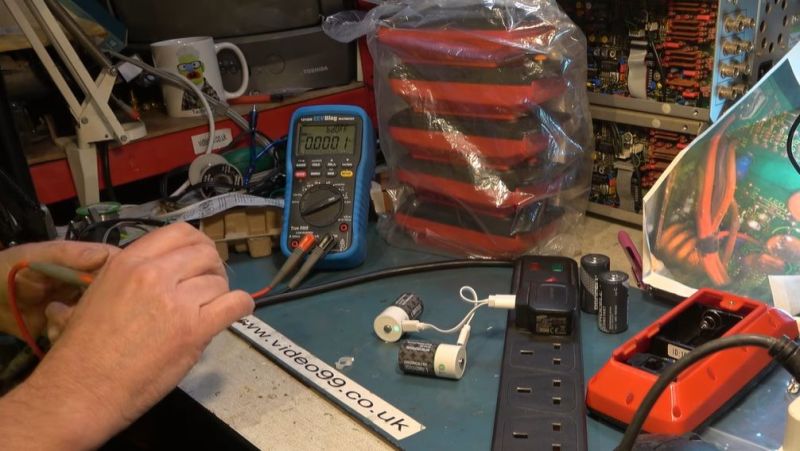
Can you charge those Li-ion based cells with USB-C charging ports without taking them out of the device? While this would seem to be answered with an unequivocal ‘yes’, recently [Colin] found out that this could easily have destroyed the device they were to be installed in.
After being tasked with finding a better way to keep the electronics of some exercise bikes powered than simply swapping the C cells all the time, [Colin] was led to consider using these Li-ion cells in such a manner. Fortunately, rather than just sticking the whole thing together and calling it a day, he decided to take some measurements to satisfy some burning safety questions.
As it turns out, at least the cells that he tested – with a twin USB-C connector on a single USB-A – have all the negative terminals and USB-C grounds connected. Since the cells are installed in a typical series configuration in the device, this would have made for an interesting outcome. Although you can of course use separate USB-C leads and chargers per cell, it’s still somewhat disconcerting to run it without any kind of electrical isolation.
In this regard the suggestion by some commentators to use NiMHs and trickle-charge these in-situ similar to those garden PV lights might be one of the least crazy solutions.












[I have no watched the video yet]
It should be pretty simple to include a switchover circuit which powers the load from the USB power and isolates the battery and lets it charge properly without killing the charger IC. I’m assuming these “cells” also have a switching converter integrated since the actual cell voltage is likely 3.7V and circuitry which uses these expects 1.5V.
For a stationary device I’d remove the batteries and power them with an adapter instead.
this! I’m sick of batteries everywhere! If you don’t need it portable, WHY use a portable power source??
Without having watched the video yet: I would also mention, that the batteries I recently purchased also provide 5V at the battery terminals – instead of the normal 1.5V – when the usb-c cable is attached to charged them, which leads to even more potential to damage a device.
That’s rather what I was thinking, indeed. There seems to be the implicit assumption with these rechargeable cells that people remove them from the device before charging, but what if you just plug in the USB-C cable after popping open the battery cover?
For the ones in the video it appears that just the grounds are all connected, but worse scenarios exist as you just demonstrated.
“this would have made for an interesting outcome”
Presumably it would have just tripped the protection circuit, resulting in the cells not charging but nothing more interesting than that.
It would also short the USB connection.
Strangely, I wouldn’t have ever tried to charge one of these while sitting in a device.
But I don’t think these things are really useful, anyway, to be honest.
They are nice for poorly designed devices that want 1.5V and stop working too early even with alkalines. For those devices that work fine on the lower voltages of NiMH, the li-ion ones are just extra complexity.
I wish more designers would actually read battery specifications and design to them. As you say, so many devices don’t like NiMH or NiCd cells because of their lower voltage. In reality, alkaline cells are generally considered fully discharged at 0.9v, while NiCd or NiMH have traditionally been considered discharged at 1.1v.
ah, good point!
The manufacturer really needs to change the placement of the USB-C port from the side of the cell to the end with the robot nipple. That way they can’t be charged in use, no need for any circuit changes.
There are battery replacement power supplies that are meant for this scenario. With versions for a 2-cell setup or a 3-cell setup, the wallwart generates the right voltage for the device and is connected to one cell-shaped object. The remaining cells are replaced with duds that just short circuit the position they are in so that the wallwart connections reach both poles of the object you want to power. There are also wallwarts that can power multiple objects in the same way.
My wife loves those candles with batteries in them; I replaced the batteries of almost all of them with these battery replacers to save a lot of money we otherwise had to spend on replacing the batteries every couple of days.
Cut a small corner off of the battery cover to let the wires come out without getting squeezed.
No more batteries in the device at all, and you can power them through a timer for instance, or something from you home automation. Now they can light up when it starts getting dark and go out when the last person leaves the room, magical.
This one for instance:
https://www.kabelshop.nl/Konstsmide-Batterijvervanger-2x-C-Konstsmide-3-meter-Binnen-5172-000-i20239.html
I’ve switched from using these to AA cells with a dedicated charger. These have a higher capacity (as they dont have space occupied by the USB-C connector. The circuit inside see the application of a high external voltage and changes from 3.7 to 1.5V stepdown to some sort of charge control. They seem pretty reliable, but are noisy, so might be a problem with sensitive equipment.
Obviously can’t be charged in-situ.
Replying to my own comment :-)
Just to be clear, the AA cells I mention are still LiIon packs with buck converters to step down to 1.5V, and are supplied with a dedicated multi battery charger.
oh! Clever idea with the “bridge cell”!
So ya install a small switch that the batteries rest on to not allow charging when in full circuit. I had to do that with an old computer that ran off of batteries but was not made for charging. Also having 2 or three BMS systems in play is gonna dumb down the charge current to useless. It would have been better if the bike manufacturer had actually come up with a decent solution initially, but I totally understand working with what you have and what bosses think is legit. Finally woohoo my yt feed is catching up after a couple of day lull. I am excited to see the other three video write ups later this week :)
Stop buying devices with USB C ports that require a USB A to C adapter. Return them as defective. Write a 1 star review explaining the issue. Stop letting POS manufacturers get away with making everyones lives harder to save $0.05 per unit.
It makes absolutely no difference in this case. It’s not the cable that’s the problem. It’s the fact that the charge circuit is DC coupled to the battery terminals and the usb c socket.
There are no requirements or guarantees that two apparently independent USB power sources do or don’t share a common ground. If they do, you’re screwed regardless of cable choices.
Does that mean they can be charged by just applying 5v to the terminals? that could be actually an advantage since the usb-c plug uses up some space. So you wouldn’t need the plug at all.
I have some of these, as well as some similar cells that require an external “charger” (which just applies 5V and monitors current draw to indicate when charging is complete.) Putting the USB-C equipped cells in the charger for the latter does seem like it would work, and the charging indicator on the battery lights up, but only for a minute or so.
These convert cells are meant to be taken out for charging obviously, otherwise they’d need isolation DC to DC converters in each cell.They have a common minus and a charging path to plus. Could some magnet and coil on the rim charge the battery?
Someday I will get into the dusty excersize bike on my porch, it has a Chrysler car alternator in it. Yet it has a line cord to run a board with LED speed and a big finned power resistor to bleed off that power.
Why were so many comments removed from here? They appear useful and perfectly polite:
https://web.archive.org/web/20260330174521/https://hackaday.com/2026/03/30/the-hazards-of-charging-usb-c-equipped-cells-in-situ/#comments
Pretty sure it’s those stupid “post must be removed within 30 minutes or fine” laws. Someone clicks all the report buttons, obviously it will take time to check so the comments are removed until they are checked but they are back now. Tool of the deep state for preventing people from seeing inconvenient truths wrapped up in “won’t somebody think of the children” sheep’s clothing.
LOL. It’s worse than your craziest conspiracy theories! It’s a backend database issue combined with concurrency issues that throw things into the wrong categories.
We have the ops folks working on figuring out how it happens, and I’m working on figuring out how to restore all the comments.
Sorry for the inconvenience — the comments are there in the database, they’re just all mixed up with spam and thrown in the moderation queue.