
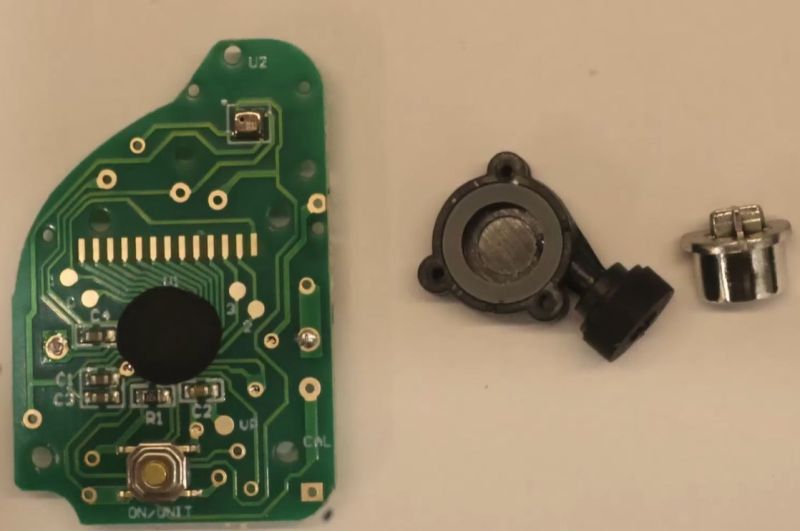
In this wonderful world of MEMS technology, sensor technology has been downsized and reduced in cost to the point where you can buy a car tire pressure sensor for less than $3 USD on a site like AliExpress. Recently [electronupdate] got his mittens on one of these items to take a look inside, and compare it against his trusty old mechanical tire pressure gauge.
Perhaps unsurprisingly, there isn’t a whole lot inside these devices once you pop them open to reveal the PCB. The MEMS device is a tiny device at the top, which has the pressurized air from the tire guided to it. The small hole inside the metal can leads to the internals that consist of a thin diaphragm with four piezoresistors that enable measurements on said diaphragm from which pressure can be determined.
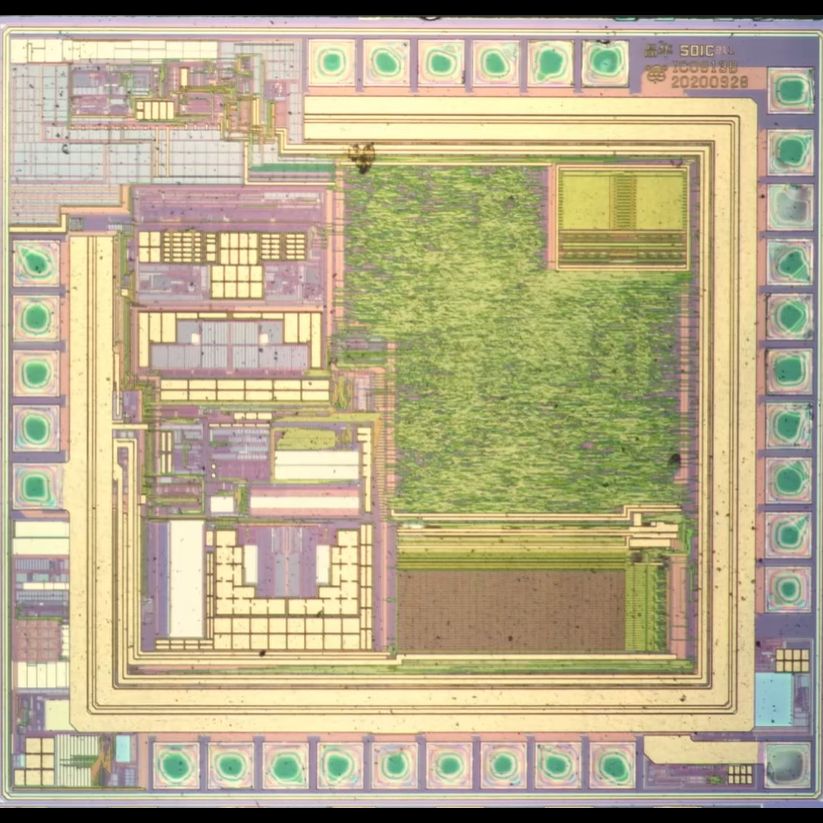
Handling these measurements and displaying results on the small zebra connector-connected LCD is an 8-bit MCU manufactured by Chinese company SDIC. Although the part number on the die doesn’t lead to any specific part on the SDIC site, similar SDIC parts have about 256 bytes of SRAM and a few kB of one-time programmable ROM.
This MCU also integrates the clock oscillator, thus requiring virtually no external parts to work. Finally, its sigma-delta ADC interacts with the MEMS device, rounding out a very simple device that’s nevertheless more than accurate enough for a spot check as well as quite portable.












Hasn’t @bigclivedotcom already looked into this already?
Great explanation and look inside incredibly inexpensive digital equivalents of mechanical gauges and how they work. Thank you!
I believe the author’s bias/experience shined through with: “trusty old mechanical tire pressure gauge” which he confirmed at the end of the video… the no-battery mechanical tire pressure gauge works when you need it. Even if it sits unused for years.
Along with other digitized tools like a micrometer or vernier gauge, as a hobbyist that uses fancy tools occassionally, I’ve sworn off many battery operated tools that have perfectly good (for me) mechanical… tried and true methods.
What I’d like to understand is just how low of a standby/sleep power consumption is possible. Perhaps these digital gauges can be sold with a 10 year battery life? Then I’d buy again.
I’ve had ones that lasted for that long without a battery change, although I also still prefer a simple mechanical gauge. They weren’t directly comparable since they were of course much older, a bit larger, and more expensive, though not unreasonably so.
Automotive TPMS sensors have a life of 5-10 years in a package smaller than this, and not only are they doing something more complicated in standby (listening for an RF trigger signal), they’re presumably spending a lot more time active than a handheld gauge. So presumably it’d feasible at some price point.
In fact, I’m not sure you need to consume standby current at all – if the device stored calibration data in flash/eeprom rather than sram, it could just have a real on/off switch. Warm-up time of other MEMS pressure sensors I’ve used is, at worst, a fraction of a second.
Battery life for a similar air pressure gauge I brought was just over 4 years then needed 3 new button cells (AG13) this was with ~5 minutes use every two months and stored in a car the whole time and this could probably be increased if you remove the blue LEDs it has that let you use it in the dark.
You could probably achieve your 10 year target with lithium primary (non-rechargeable) AAA cells and a real off switch but that would more than double the cost of the thing and no one would buy it.
I for one adore the cheap digital calipers because they are accurate enough for most things and cheap enough ($20) you don’t have a heartattack from dropping them unlike the real ones ($400+)
I can’t justify measuring a hundredth of a millimetre at home when a tenth is all I need.
RE: “…you can buy a car tire pressure sensor for less than $3 USD…” but making it work with your car is a different story. Not all cars (sold in the US) like third-party replacements; the ones I’ve tried accomplishing the same (Nissan Versa and Mazda 5) didn’t see the new $3 sensors at all. Visiting local unfriendly/hostile car dealership was out of the question, so we just went with the old school (aka “offline”) solution – ignore the permanently lit dashboard icon. Mind what you are thinking, I regularly inspect and top off tires.
What’s wrong with a plain bourdon(sp?) tube gauge that holds the reading until released? Been working fine for about 50 years.