
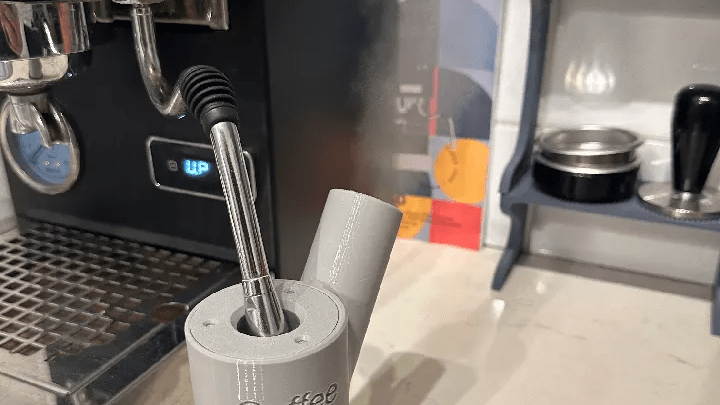
Sometimes a hacker has a specific sort of problem, and uses the tools they have to solve it in a way that just might be helpful to someone else. That’s the case with [Matvey Kukuy]’s Coffee Steam Dryer (V2), which performs the very specific job of safely swallowing up expelled steam and water from an espresso machine’s steam wand.
Steam wands are used to froth milk into a velvety texture, and some machines require purging the wand before using it for best results. Where does the resulting jet of steam and spatter of superhot water droplets go? Not the machine’s problem. That’s for the user to deal with, and [Matvey] decided to address it by designing and 3D printing a tool.
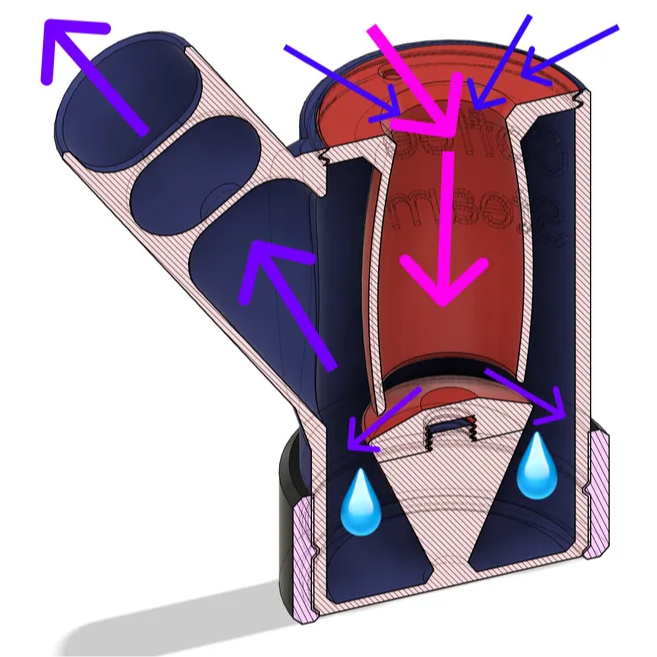
The pipe-like object works by having steam jet into the open top (printed in ABS or ASA for heat resistance) where the device redirects the hot gas and captures any expelled water in the process. The steam flows through expansion chambers, dragging cool air along with it in the process, until it ultimately gets redirected away from the user.
By the time steam exits the outlet, some has condensed and the remainder has cooled and slowed down enough to not be a worry.
It’s the second version of the device, and we like how it has no moving parts and can be disassembled for cleaning and drying.
Coffee is an area that is rich with hacker activity, from 3D-printed micro-brew machines to completely DIY roasters but tools like this show how improving the coffee workflow can also be beneficial.












On my machine I can point the wand down through a hole in the mesh on top of the drip tray.
You can even see the hole in his drip tray designed for the purge…
There appears to be a hole in the drip tray on the machine in the image too.
The majority of them do.
That hole is there for finger insertion, to remove the dip tray with said finger. It is not made for steam pipe insertion (at least not for the one I read the instruction manual for)
Makes me wonder if that wand shouldn’t have a warning sticker saying “not for rectal use”.
Don’t worry, in fifteen years the state of California will make it law that it has to come wrapped in 40 yards of safety warnings, and everyone will throw it directly in the landfill (exactly zero people will read it)
The U.S. federal government could request the U.L. to force all the manufacturers to use steam which is at 98°F max. Even if misused to froth milk, it would greatly reduce the chance of suffering a serious injury.
Please don’t give them any ideas
Better just to put it in a glass of water
Drip tray…
My coffee maker already has too many pieces in its normal workflow. I sure don’t need another, especially when under-caffeinated.
To catch the steam I put the always-handy dishcloth on the counter underneath. When I’m done making the coffee I wipe down the countertop and the coffee maker with the now-damp cloth.
I guess using a ceramic mug would be too easy?
I have the same espresso machine. Altough interestingly done, I find it a bit of an overdelivery for a non-existing problem.
This is a single boiler machine, so the same boiler needs to switch between brewing espresso, and making steam. You press a button to switch modes, right after you finished making the necessary espresso. It takes circa 30-40 seconds. (After a few minutes, the boiler automatically will switch back to coffee made and start to cool down. )
You can then purge for 3-4 seconds to clear the line of water and get steam. Any recipient is fine. I for example use a mug, tilted a bit .
I personally use the steam wand purge to dampen the rag I use to wipe the group head and also use the same rag to wipe the steam wand after I’m done.
In my coffee shop, they use just a kitchen towel…
Don’t most people just purge into the now empty milk container, and wipe everything down with a kitchen towel? These machines are best kept clean between uses….
Having worked at a Starbucks in the past, I can assure you that the water vapor coming out of the steam wand is only hot within 3-5 inches of the steam wand, after that it’s cooled down to room temperature. Wipe your steam wand down with a damp rag after each use and then purge it into the rag.
Also, surprised no one else has pointed out that the white stuff is water vapor, not steam. Steam is transparent and is only present for about 1/2 an inch from the end of the steam wand, after that it immediately condenses to water vapor.