
Flux is one of those things that you cannot really use too much of during soldering, as it is essential for cleaning the surface and keeping oxygen out, but as [Bits und Bolts] recently found, not all flux is made the same. After ordering the same fake Amtech flux from the same AliExpress store, he found that the latest batch didn’t work quite the same, resulting in a Geforce 2 GTS chip getting cooked while trying to reball the chip with uncooperative flux.
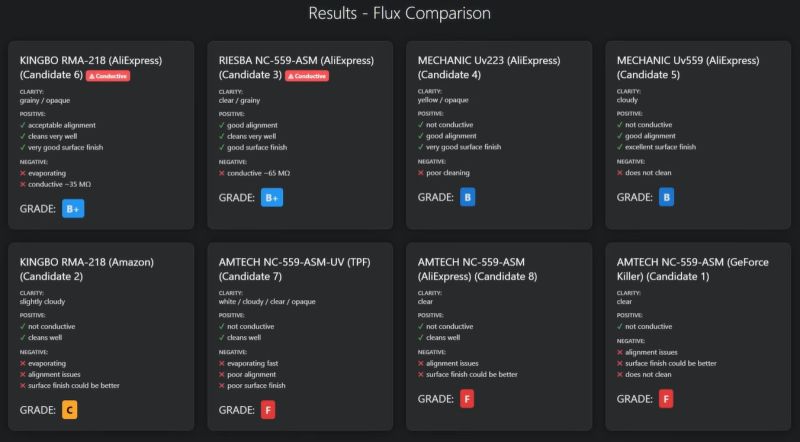
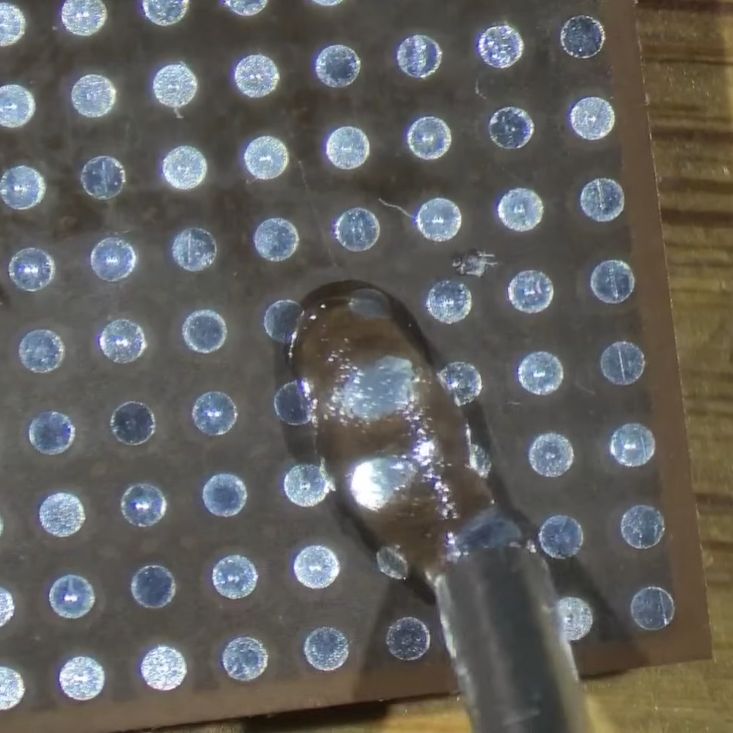
Although it’s easy to put this down to a ‘skill issue’, the subsequent test of eight different flux pastes ordered from both AliExpress and Amazon, including — presumably genuine — Mechanic flux pastes with reballing a section of a BGA chip, showed quite different flux characteristics, as you can see in the video below. Although all of these are fairly tacky flux pastes, with some, the solder balls snapped easily into place and gained a nice sheen afterwards, while others formed bridges and left a pockmarked surface that’s indicative of oxygen getting past the flux barrier.
Not all flux pastes are made the same, which also translates into how easy the flux remnants are to clean up. So-called ‘no clean’ flux pastes are popular, which take little more than some IPA to do the cleaning, rather than specialized PCB cleaners as with the used Mechanic flux. Although the results of these findings are up for debate, it can probably be said that ordering clearly faked brand flux paste is a terrible idea. While the top runner brand Riesba probably doesn’t ring any bells, it might be just a Chinese brand name that doesn’t have a Western presence.
As always, caveat emptor, and be sure to read those product datasheets. If your flux product doesn’t come with a datasheet, that would be your first major red flag. Why do we need flux? Find out.












“Flux is … essential for cleaning the surface and keeping oxygen out”
Perhaps an article on nitrogen or argon soldering?
Solder flux from Aliexpress – what could go wrong?
My thoughts exactly….
There´s excellent, good, bad and terrible , all at more or less the same price. They key is to carefully read the reviews.
Reviewers don’t know what they are smoking until it’s too late..
That´s what i mean by “carefully” : reviews that show the item in use and provide relevant information. Not “i received it, it´s great”
without fume extractor and proper ventilation nobody should use any flux even the original ones as animal trials showed side effects for liver and kidney, e.g. AMtech 559 sec.11 https://www.farnell.com/datasheets/2365521.pdf
a have some very decent flux from Aliexpress and some useless. But the smell of the original AEMtec 559 seems to be the hardest part to clone or they just dont care. But it seems that even AEMtec has batches without this smell.
The problem is, everything on AliExpress is cheap specifically because it is either remainders, or seconds (things that didn’t meet the quality test for the higher priced versions, or they weren’t tested at all), or cheap knockoffs, all with “badge engineering” to hide where they actually came from. And given that all of these are unreliable supply chains, you cannot count on ordering the same thing to deliver exactly the same thing, even if you order it from the same people.
I would not order anything there that I wasn’t willing to test myself and simply discard if it was a bad batch. Or willing to have fail either immediately or prematurely. Or assume that it is going to need hacking before it does what I expect it to.
Basically, you are dealing with the same effect that causes a 10% accuracy resistor to never be closer than 5% — because if it was, it would have been sorted into the 5% bin.
Note too that reviews may be before the product was restocked from another source. And I do not trust that they aren’t as sloppy as Amazon in making sure that reviews actually get applied to the product being reviewed rather than something vaguely similar.
The reason stuff is more expensive elsewhere is not just more levels of markup or price gouging. If you are willing to gamble, AliExpress and its cousins can be a win.
Or used to be. With what’s been happening on tariffs, global supply chains may no longer be available to the US at good prices. I paid a 20% surcharge on a $300 order from Hungary a few months ago, and they weren’t even a country Trump was annoyed with yet.
Not a real pro myself (only some 50ish reballings done) but I can confirm that a good tacky flux and fitting cleaning solvents are really important.
Some synthetic no-clean fluxes contain polymeres that just do not break down using IPA especially after heating them up. They seem to kind of swell, if IPA is applied. Stronger/specialized solvents are needed, e.g. aceton did always do the trick but proper venting is required and some substrates do not tolerate it.
If IPA is preferred, the “Rosin Mildly Activated” (RMA) fluxes are the best choice in my opinion.
But I would still redo this testing with a bit more than 250°C even for leaded balls as I think the balls are not liquifing homogeonously enough. A preheating plate might also improve this. And applying heat almost straight from above is also helping homogenous heating but likely interferes with the camera shot.
I can also recommend 45° air nozzles for under-microscope work.
Maybe some fluxes spread the heat a little bit better and the liquification is more homogenously this way?
But to be honest I mostly switched to a set of thick steel meshs and a bit of dried-out solder paste (dried = less boiling flux) for reballing as the results are the same and much faster for me than placing balls but your milage might vary.
If I understand correctly, he tried 8 different knockoff products, it would have been nice to compare it to good brand flux from a reputable source (Farnell, Mouser, RS).
heh, if you don’t push the limits (in this case, if you accept that BGA isn’t for home soldering) then you can get away with garbage :)
I just use Kingbo flux off Amazon as recommend by TronicsFix, no problems here and cheap!
for this type of soldering check out northwestrepair videos on youtube. He goes over countless different types and what they do good and bad. This video is descent but missing some things as well. There really is no do everything perfect solder it depends on what you are using it for at the end of the day.
Testing knock off things from aliexpress is waste of time. After several days you will get a different product…
What I’ve found boils down to this : “If what you’re buying is really important, don’t buy from AliExpress.” Otherwise, have fun!
I think people are getting hung up on the source of the flux and not understanding that there are many kinds of soldering flux which have properties that can cause issues. Even reputable name brand fluxes, if not activated correctly, used in excess, or not cleaned up properly can create corrosion and/or conductive paths in final assemblies.
Generally speaking, if something is “water soluble” then it’s inherently polar in nature. This means that it can create conductive pathways over surfaces. I had many issues with this when working with devices that had high-impedance circuitry. This can be especially disastrous if you apply conformal coatings over unactivated flux or improperly cleaned assemblies.
Just because a flux claims to be “no clean” doesn’t mean pockets of unactivated flux don’t need to be cleaned up.