
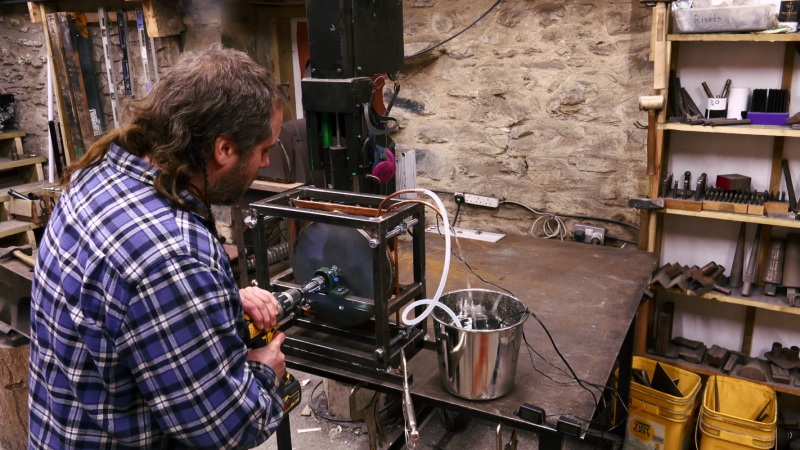
Producing hot water off-grid is a surprisingly energy-intensive activity, and although it looks simple on its surface it can get quite complicated especially when used in large scale for something like providing hot water for an entire home. When using combustion to heat the water there needs to be proper venting as well as control of the fuel, and even storage of the hot water needs to be meticulous to avoid certain pathogens. [Greenhill Forge] has built an off-grid solution for heating hot water that doesn’t necessarily rely on any combustion, though, provided he can find something to spin his custom electric machine.
The machine in question is, of course, an induction heater. It works similar to any simple electric motor, generator, or transformer except in this case the eddy currents generated are exploited rather than minimized. Normally these currents, generated when a magnet passes by a metal, are wasted heat in other machines but in this induction heater it’s the goal. The machine’s stator is built from copper tube wound in a spiral which allows water to flow through and absorb heat. The tube is soldered into one electrically solid mass to maximize the eddy currents. The rotor is taken from a previous generator built by [Greenhill Forge] which holds the permanent magnets.
During the initial tests using a power drill to drive the generator, he was able to heat 1.5 liters of water from 7.9C to about 24.4 C in three minutes. The math works out to providing 575 watts of power to the heater, and with something that could spin the generator faster it might have the potential to provide around 14.5 kW. Provided that there’s a source of energy around, such as a wind or water turbine, this could be a fairly sustainable way of generating hot water in off-grid situations. Some of [Greenhill Forge]’s other projects are centered around this idea as well, like one of his builds which uses waste sawdust to heat his workshop with a custom-built stove.












A longer article on the same or related topic, featuring a different version of the same idea:
https://solar.lowtechmagazine.com/2019/02/heat-your-house-with-a-mechanical-windmill/
Induction is less efficient than resistive elements, they both produce heat, but induction has other losses.
Why?
Why not?
If you use a small hydroelectric generator to power a resistive element, you have a more complex and expensive system, but it still has significant losses from induction, they just originate from producing electricity instead of heat. Not to mention waste heat from the generator, etc, etc.
There are a lot of experiments and projects we do that aren’t optimal, but by doing these things we learn. That’s why.
By making this project he may have learned something that he can use to develop another project.
It also may be the first step to optimising this approach using stuff he’s learned from other projects.
It’s a limited approach to say I know that’s not efficient, I won’t do it.
Because “heating water with a resistance doesn’t drag Youtube views. Yet, it’s the simpler (no mechanical failure), faster (you reach 100% efficiency here), cheaper (a waterproof resistance cost pennies), so better in all aspect.
There’s a reason why your home heating system is using a resistance and not a fancy induction cooking table.
“There’s a reason why your home heating system is using a resistance and not a fancy induction cooking table.”
Yeah because your home heating system is attempting to heat a large volume of air. Induction heats metal. Transferring heat from metal to fluid is fairly easy since most fluids have a high thermal conductivity. Water conducts heat ~24 times faster than air. Using an induction hob and a metal heat exchanger is a very efficient means of heating water on demand. It would be quite difficult to design a heat exchanger that be heated by induction, not melt, and have enough gas channel surface area to transfer heat into air. Its much simpler to just let air flow over glowing hot wires. Two very different scenarios.
He meant that water heating boilers normally use electric resistors you “genius”!
It is about input energy and output useful heat- induction is not that energy efficient in this case.
That’s an americanism specifically, though – here in the UK, our boiler (aka furnace in US English) heats water, which is circulated to radiators in each room (or underfloor heating if you’re fancy) – the main advantages to it are small (15mm) pipes to circulate water through, rather than the large ducts you’d need to circulate air
Many UK homes are older, brick-built structures with high thermal mass, which are not designed to accommodate the large ductwork required for forced-air HVAC systems.
Most US homes are newer Stick built structures with low thermal mass and are designed to accommodate ductwork.
The UK has an extensive, widely available natural gas network, making gas boilers highly accessible and inexpensive to run compared to electricity.
Roughly half of US homes do not have gas lines at all. It much easier for the UK to provide gas with a population density of 289 people per square kilometer compared to the US 38 people per square kilometer.
The average residential home in the UK is approximately 800 to 1,000 square feet.
The average new single-family home in the U.S. is approximately 2,300–2,400 square feet.
Forced-air systems are popular in North America largely because they also provide cooling, whereas the UK only needs efficient heating..
YES, As am American, on an American website, My comments are naturally from an American perspective.
You live in a teeeny little country about the size our state of Oregon in which youve packed 1/5 the US population. With an average house age of approximately 50 years and upwards to 25% are 100+ years old. Your perspective of housing standards and technology naturally quite different.
Your comments are quite Eurocentric. Unfortunately for your aging empire you havent been the center of the world for a century of two. Dont worry though, Our empires exceptionalism is rapidly failing as well.
If your home heating system using resistive heating, then look into getting a heat pump!
Heat pumps still require a booster element to get to the final temperature. At least the ones I’ve seen installed.
Did you even read the article or watch the video? There is zero electronics involved, it converts mechanical power from a wind or water turbine directly into heat.
You really think having a generator power a resistor is more efficient or reliable then this? No you don’t, you just assumed it was a ZVS induction heater because you triggered on the title and didn’t bother to look at the article.
I didnt “trigger” at all. My post wasnt an attack as yours seems to be. It was a discussion of the nature of heat transfer efficiency. Im fully aware that the article is about a cobbled together mechanical induction heater, a construction that poorly represents the potential efficiency of induction, Hence my inclusion of reference to an optimized representation of the technology. Take your meds, Touch some grass, Talk to someone who cares about you. Theres no need to remove the pins from your hinges. Its just the internet.
The point is to centralise the heat generation to where it can be usefully used. e.g. an electric system incurs 20% losses in the generator, which is typically somewhere useless like at the top of a wind turbine.
I do wonder how this compares to a simple Joule Machine, though (a simple friction-based water heater that just vigorously stirs the water until it heats up). They’re both 100% efficient, so the only difference is ease of construction and cost. Would the induction heater allow, say, directly coupling the generator to the turbine? That’d be an improvement over needing gearing.
So you take the output of the inductive process and power some resistive elements with it to assist the setup.
And then somehow rig the whole thing up with a heat pump to boot. :)
I’m not sure but i feel like maybe the other replies are missing the point?
A resistive element is 100% efficient at producing heat from electricity, but isn’t the point of this hack to harvest kinetic energy rather than electric energy? I mean it seems to me like you could run the kinetic energy through a generator (i.e., an induction step), and then you could run that electricity throuh a resistive heating element…hey wait! That’s exactly what’s happening here, just the generator and the resistor are a single physical component. Isn’t it just a question about whether his magnetic heater is more efficient than the magnetic generator?
At the end of the day this is just a question of how to generate friction without creating wear surfaces, i think.
Induction has far better heat transfer efficiency than resistive. Giving it the edge that makes it desirable. Yes resistive is 100 percent efficient converting electricity to heat but then loses by throwing that heat everywhere as well as as intended target.
heating water of grid is remarkably easy and doesn’t require something like this. You simply get an electric water heater and connect it to the power coming from your solar cells. And if you you don’t have enough power from your solar to do that then
1) put a timer on it for times when you do.
2) put a smarter controller on it to only turn it on when you have enough power.
3) put a smaller element in it – many of them are made with 1.2, 2.4, 3.6KW elements and you can swap them..
I was going to do (2), but ended up doing (1) and (3)…
“1) put a timer on it for times when you do.”
and a bell to alert you that you have hot water so you better hurry up and wash the dishes, your clothing, and bathe.
Most people want hot water on demand, they dont want to plan around the periodic availability of hot water.
sure, but as it says in the video description, this setup was specifically intended to
a) not require solar, but be powered directly by something like hydro or wind.
b) provide continuous heat while running, not be limited to a fixed storage tank.
In 2002 I discovered the joy of POINT B.
I had purchased a truckload of goods for resale from home depot through a liquidator. There was a pallet of 12 recalled tankless water heaters. It turned out there was a manufacturing defect on the control board that caused them to fail, a bad/weak trace that required a small wire patch and some solder to repair. I kept 8 of them and sold the rest, as well as most of the goods in the truckload.
Our family property runs on a large battery bank, and a pelton wheel that were installed in the 1950s, so I cant say much about the power savings there. But the one I installed in my city condo appears to have shaved about $10-15mo from my electric bill.
My father had installed our first electric water heater in the 80s, we had previously used a wood fired water heater. That was a huge improvement but still had the usual tanked drawbacks of long delays in hot water to tap, pressure drops from other users, and the inevitable running out of hot water in the middle of a shower.
One of these tankless heaters would have probably been sufficient on our homestead based on their ratings but since they were basically free we went all in.
We installed one for the kitchen, one for the laundry, one in an outbuilding we use for meat processing, and two on opposite sides of the house each of which feeds into two bathrooms. Total overkill, but now instead of waiting minutes to get hot water to the further away faucets, its HOT flow in a few seconds. No one ever has pressure drop because of someone starting laundry. And no matter how long you go the showers never get cold. LOVE THEM!
Now ours are resistive heater tankless systems, so not quite the same.
Ive heard good things about the newer generation induction heater tankless systems but unless I stumble into a half dozen of them for free I dont see us upgrading.
TL;DR: Doing things without electricity is easy, just buy generation equipment.
You can also heat the water by direct mechanical action, just by having something spin in it.
But with way more work/Watt. This one is about a simple but effective means to heat water.
More work per watt? What are you saying, work is measured in watts. Are you saying it’s less efficient? In that case, where is the extra power going? It has to go somewhere…
Yeah, came here to post this. Everyone forgets that fluids have friction.
This guys is a master shape rotator, the stuff he works out in his head is very impressive.
What’d make this interesting is if they managed to make a tank water heater sized vacuum flask and heated the water without contact to prevent heat loss.
Then you have a tank of water that’ll stay hot for a long time with no use.
So you want a big thermos with induction base for heating….
Mmm sun is providing heat too…
i built a whole elaborate system for heating water directly (like how a garden hose gets hot in the sun) from the sun. it’s a more more effficient use of roof real estate to do this instead of converting sunlight to electricity and then to heat, as going directly to heat is three or four times more efficient, even with the most efficient photovoltaic panels. of course there is the pain of running plumbing to your roof and then you have to worry about what happens in the winter (antifreeze, baby!)
http://asecular.com/projects/homebrewsolar.php
If you had a creek running through your property and added a waterwheel to drive this device you could have both hot and cold water coming from the creek. Quite elegant Actually
the problem is that it still takes a lot of watts to heat water no matter how you do it, and a powerful microhydro plant can generate maybe 500 watts, which will take a looooooong time to heat up a bathtub of water. i’d rather just have the electricity, since 500 watts is plenty for most non-heating household needs
I have a tankless water heater that cost $80, and the BBQ tank I get filled for $15 lasts 6 months.
The trick is to get a handle on the power being put into the device vs the power output. The battery powered drill does it but at what power and when kind of water flow or air flow to get enough power to generate enough heated water to make a difference.
Because why wouldn’t you just turn a compressor of a heatpump use the laws of thermodynamics as is so popular these days. I’m thinking it’s going to require a good sized water-wheel or turbine setup or a rather large windmill.
Great experiment though.
Because this is simple, doesn’t require refrigerant gas, and will still work after it’s been outside for 15 years and dropped of a cliff twice.