
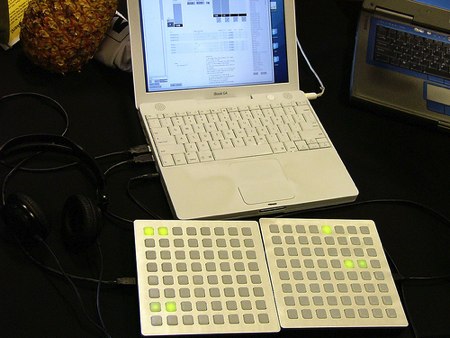
The people from the Monome project are out in full force at the Faire. They’ve got five of the 8×8 pads hooked up for people to play with. The first two pictured above actually work together as a 16 step loop system. There’s also one hooked up as a mixer and another as a drum machine. The fifth one is showing pixelated video from an iSight. The box is really well built. The $500 price point has shocked a lot of people, but it’s really unavoidable since they’re only doing a 200 device run. Something I hadn’t realized before is that the buttons are unique to the device, not off the shelf parts. The button is really a rubber cap that sits over the LED and has a conductive ring at the base. I hope they post a schematic for their 8×8 matrix controller so that anyone could build one. Here are a few more pictures: one, two, three.
CCC Videos Now Available
I know a lot of you can’t make the Faire this weekend, but there’s still hope. The videos from the CCC hacker con in Berlin last December are now available via bittorrent which should provide plenty of nerdtainment this weekend.
MF2006: The Electric Unicycle

The nice thing about Maker Faire is all of the fun projects you can try out for yourself. Trevor Blackwell brought his balancing scooter and electric unicycle for people to ride. We’ve got more photos from the Faire on Flickr.
Maker Faire Tomorrow

Will and I arrived safely in San Francisco and headed over to the Maker Faire to check out the setup. Well, we already found one thing we like FIRE. The venue is huge and we can’t wait to see everything tomorrow.
Iridium Flare Tracker

Iridium is a constellation of 66 communication satellites. Each one features 3 large polished antennas. The reflection of sunlight off of these panels causes brilliant flashes of light. Since the satellite’s orbit is known the time and location of these flares can be calculated ahead of time. C.L.I.V.E. is a project designed for Burning Man to assist in observing these flares. It has a DPSS laser mounted to a turntable that automatically points at the location of the next flare. A large clock counts down the time till the event. Everything is controlled by an Xport 2.0 FPGA development board for the Game Boy Advance. All power is provided by a solar array and wind turbines.
Barcode Scanner Based Line Follower

Brody thought it was high time we featured another robot project and directed us to his site: bfrdesign.com. For his line follower bot he used an old barcode scanner he found cheap at a junk shop. The scanner has a 2088 pixel ccd linear image sensor. Several red LEDs are used to illuminate the image and the data is fed to an ATmega8. The wheels are then driven using two Sanwa servos modified for continuous rotation. He’s got a couple other projects on the site and I’m sure we’ll see more in the future.
Touch Probe For 3D Scanning

Graham calls this touch probe his first useful milling project. He had already built the CNC mill and once he built this probe on the mill he essentially had a 3D scanner. The central hub is supported by three shafts spaced evenly around its axis. These shafts each rest on a pair of ball bearings to make a complete circuit. If the probe bumps into anything, one of the shafts will lift, breaking the circuit. TurboCNC has a built in routine for scanning with a touch probe. The program generates a point file which Graham pulled into Rhino for modeling. His example application was cloning a model airplane prop that had gone out of production. The TurboCNC routine isn’t very quick since the probe always returns to the same height so he’s coding a faster algorithm. This type of touch based scanning was also employed in agiecco’s LEGO 3D scanner.









