Excel Based Drum Machine

drumpad

[Thomas] just wanted a simple, free drum machine to play with. He decided to build one himself using MS Excel. To get it up and running you need to download a .zip file that contains the .xls and .dll files. Grab some drum samples and you are ready to go. Each drum is mapped to a key and can be used with a game pad. Don’t worry he’s got some simple, Meg White, patterns to get you started. Not impressed? Well, tear it down and build your own machine.
Continue reading “Excel Based Drum Machine” →

SuperCap 9V Battery

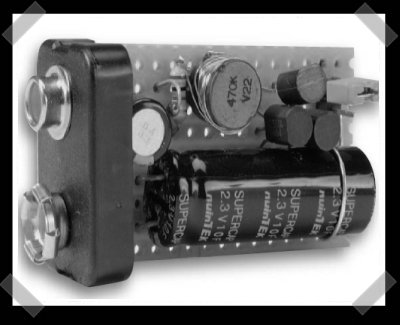
9V batteries are often found in devices that aren’t used very often. If you use a NiCd rechargeable battery you may find it completely discharged by the time you need it. Capacitors on the other hand can maintain their charge for years. This circuit uses a 10F cap with a switching voltage regulator to increase the voltage from 2.3V to 9V. With a light load the cap will last up to 3 hours and once discharged it can be recharged in less than 20 seconds. Warning: PDF link.

[thanks nullset]

Continue reading “SuperCap 9V Battery” →

6502 Driven Nixie Tube Clock

nixie clock

I love Cold War chic like [ryan brooks]’s great looking nixie tube clock. There have been other microcontroller based nixie tube clocks so Ryan decided to base his on the venerable MOS Technology 6502. The 6502 is the same 8-bit processor used in the Apple II and Commodore 64. He’s got a couple interesting notes from the construction:

Be very organized with your digit wiring; use lots of cable ties or something. 6 digits is 120 solder joints on 60 wires.

Don’t be afraid to make your own Nixie sockets. I stood my tubes up on my flatbed scanner, arranged them with a ruler and then scanned. Imported to Photoshop, did a levels to make the pins contrasty and printed the output 1:1. Glued the paper onto my plexi, drilled all the holes, dropped in pin-sockets w/CA glue and bam! Instant Nixie Tube Clock Socket!

Continue reading “6502 Driven Nixie Tube Clock” →

Electrostatic Headphones

electrostatic headphones

Most headphones and speakers use electromagnetic force to drive speaker coils. Electrostatic speakers use electrostatic force to modulate a diaphragm. Mylar is used as the diaphragm in these headphones. Two insulating rings sandwich the mylar and a perforated stator is placed on either side. Ideally these stators would be acoustically transparent, but sheets of metal with 2mm (or smaller) holes that make up at least 25% of the area work. Construction problems can arise from glue not sticking to the mylar and the mylar having not enough or too much tension. A special amp has to be built for the headphones to generate a 450V difference between the stators.

[thanks mrdelayer]

Continue reading “Electrostatic Headphones” →

Depth Of Field Machine For DV

dof

The small footprint of a CCD makes it hard for digital video cameras to emulate the short depth of field of film cameras. You’ll notice depth of field in movies when they have one actor close to the camera and you see the second actor over the shoulder; the actors will alternate being in focus because of the short depth of field. Here are some examples. To emulate this using a DV camera you have to change the size of the target area.  A smaller image is projected on a clear screen in front of the camera which is then recorded. This project uses a clear CD blank for the screen. The CD is rotated using an old CD player; otherwise the camera would pick up the grain of the plastic. Pretty easy, right? I haven’t even mentioned that the resulting image is upside down.

[thanks Angstrom]

Continue reading “Depth Of Field Machine For DV” →

Build Your Own Computer Rack

rack server

Most geeks dream of rackmounting their gear. The fact that most rack equipment is purchased by companies means it’s way too overpriced. Seriously, $60 for a drawer? The best solution for us is to build our own. Here’s a build from the ground up. It starts with the basic 19″ rack. Then adds fileservers and other components. Make sure you check out the homemade power rails.

Continue reading “Build Your Own Computer Rack” →

SNES Super FX Overclocking

SuperFX

marshallh from the benheck.com forums has managed to overclock a Super FX chip. The Super FX was an extra graphics processor included in some Super Nintendo games. Using this chip, games like Star Fox were able to handle polygons and intensive sprite scaling. marshallh removed the 21.4Mhz ceramic resonator from a Vortex cartridge and replaced it with a 24Mhz oscillator and a couple caps. The result is a smoother frame rate and minimal slow down with multiple enemies.

[thanks vb_master]

Continue reading “SNES Super FX Overclocking” →