

Many of the image formats we’re familiar with have been around for decades. We all know JPEG and PNG like the back of our hands, and GIF even had a bit of a resurgence when tiny annoying looping animations became cool again on social media. There has been a growth in newer formats, though, like WEBP, and AVIF, with various platforms and software companies adopting them for greater efficiency, performance, and image quality.
Amongst the new crop of formats vying for relevance is JPEG XL. It was touted as a format that improved on what JPEG could do in the lossy compression space, while also adding on a lossless mode. There were grand hopes that it would become a universal replacement for all existing raster formats on the Web. A major problem was that Google was seemingly against it, only to backflip—with the format now slated to hit the big time with renewed backing from the search giant. So what’s going on?
Got You JPEG’d
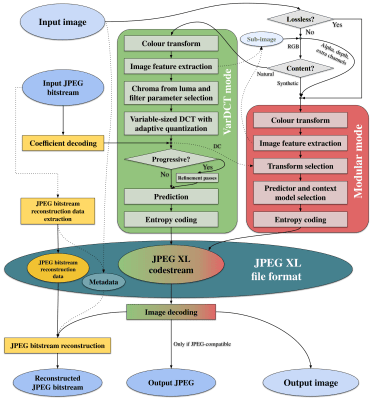
The JPEG XL standard is modern, but by no means brand new. It was initially released on 13 October 2021, having been developed by a consortium of the Joint Photographic Experts Group, Google, and Cloudinary. It was deveoped from earlier work from Jon Sneyers on the Free Universal Image Format (FUIF), and work from Google on the PIK format.
It was decided the resulting format would use the *.jxl file extension. The spec defined a format with a wide range of features well beyond what classic JPEG ever offered. It has lossless compression, including for the alpha channel, but also lossy compression available in different modes to suit both photographic and synthetic imagery.
It remains fast to decode—almost as fast as JPEG and much quicker than HEIC with x265. A key future proofing feature is that it can also handle 32-bit sample precision, and images with over a billion pixels per side—that’s a terapixel, if you’re playing along at home.

A wide range of major tech companies have backed the standard in the years since it dropped, from Meta, to Adobe, Intel, and Flickr. While it might seem like Google was fully onboard from the get-go, having literally been involved in development of the standard, the history is more complicated, as reported by TT Lab.
Chromium implemented a libjxl-based decoder all the way back in 2021, which seemed to signal JPEG-XL support would soon be a thing in Chrome and other products besides. However, soon enough, there was a change in direction. In late 2022, it was slated for removal, with a notice that ecosystem support wasn’t great enough to justify continued efforts to bring JPEG-XL into the fold.
In Chrome 110, there was no trace left—JPEG-XL was not going to be a part of things. And yet, in the years that followed, debate raged on the Chrome issue tracker as to whether the nascent format would earn its inclusion. Elsewhere, JPEG-XL was struggling to find a footing. Apple rolled it into Safari in 2023, while Mozilla continued to hedge, noting that including another C++ image decoder was undesirable for reasons around memory safety.
New movement happened in November 2025, when Rick Byers, Area Tech Lead on Google Chrome, noted that the landscape had shifted. He posted that in light of JPEG-XL support being added to things like the PDF format and Safari, amidst other signals of support in the wider ecosystem, that the development team would be open to “integrate a performant and memory-safe JPEG XL decoder in Chromium.”
With Chrome having over 65% of the browser market, this would be a game changer for the format and likely see its adoption skyrocket across the web. It just needed to actually be implemented. However, Byers was careful to note that the inclusion of the new format would be contingent on a commitment to long-term maintenance of the decoder.
Things moved fast, and when Chrome 145 dropped in February this year, JPEG-XL was on the docket. This was thanks to the development of the jxl-rs decoder, which was implemented in Rust. This was an intentional decision for security reasons, with Google relying on the Rule of 2 to keep its browser safe. However, the new decoder was not activated by default. It would take another half a year or so before the new format would become a mainstream part of Chrome, rather than being hidden behind an experimental flag or anything like that. As of Chrome 155, though, JPEG-XL will be fully supported in the browser.
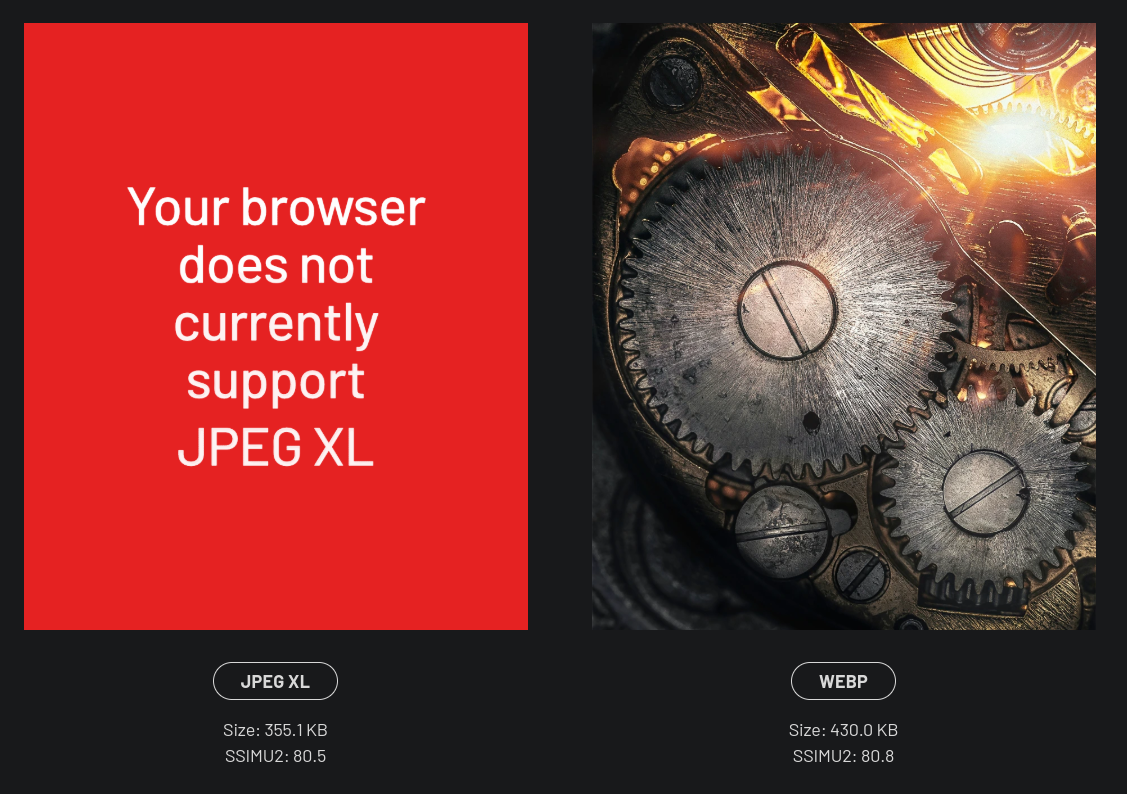 Don’t expect to see a ton of *.jxl files out on the wider web immediately. However, with the new format offering 30-50% better compression than JPEG, it will be appealing to just about any content provider looking to slimline data budgets and improve page loading times. When the performance gains start boosting traffic to a degree that makes up for the loss of users from older non-compliant browsers, expect to see things changing more quickly.
What does it mean for you, the end user? Probably little more than some minor headaches. You’ll struggle here and there when you download a *.jxl and try and load it into older software that doesn’t support it. You might get a device that shoots pictures in JPEG-XL and then find you can’t upload them to an older website with an out-of-date image submission form.
It’s the same problem we’ve all dealt with as HEIC, AVIF, and WEBP have started bouncing around the web, and we’ll have to weather it again. At least, at the end of the day, we’ll have slightly prettier images that take up a little less space. It’ll all be worth it, to be sure.









JPEG-XL at least is properly designed for the web, including the final image size in the very first header, fully supporting partial decode – with quality increasing the more of the image you load, and of course being able to do both lossy and lossless encoding.
I especially like how the design allows for doing low-quality thumbnails through simply truncating the image to a chosen size.
webP – “first stable version of … supporting library in April 2018”
AVIF – “Initial release 19 February 2019”
HEIC – “Introduced in 2015” (really?!)
JPEG-XL – “Initial release 13 October 2021”
I never had to deal with HEIC or AVIF but the XKCD about “just another standard” doesn’t really apply to JXL does it?
I does to webP, AVIF and HEIC.
I mean JPEG-XL had(has?!) wide industry support, was literally developed as a successor to JPEG, is backwards compatible to JPEG (or is JPEG upwards compatible to JXL?), better compression / better quality, similar decoding speed, etc. and so forth …
IMO JXL is better it pretty much every aspect while the other three are at most better in one or two aspects (each).
The really cool part is no longer having to choose between jpeg and png.
But instead the user has to choose the correct mode, lossy or lossless. So we’re still going to see the occasional gigantic image file. Hopefully programs like Photoshop will auto detect the more appropriate compression.
There’s nothing to autodetect and this was never an issue with other formats to this day.
People know wether they want to save an image as lossy (selecting a quality level matching their desired target filesize) or lossless.
For context, vardct is jpeg-style compression (always lossy), and modular is png-like (typically lossless but can be lossy like with ‘lossy pngs’).
An implementor can choose wich behaviour is default or how its tweaked for their deployment.
Really? The number of issues with “upload up to 256kB avatar” and support questions “why can’t i upload 112megapixel profesional photo as avatar” get massively better if you only allow jpegs. And transcoding to size on server does not really help, support tickets like “blurry avatar when downloaded” compete with decompression bombs crashing the system quite often.
People know? Which people? The same ones I have repeatedly told to use png instead of jpeg because they include text in the image and jpeg tends to cause ringing around the lettering when it gets resized dynamically? Because I can assure you they still send me jpegs and even 400MB PS files when I ask for a png.
I thought the encoder is supposed to autodetect it, and be able to combine different modes in different parts of the image. But yeah, it requires a smart enough compression implementation.
Nobody will ever be satisfied. It has lossless, but right now I’m working with a microcontroller with no dedicated jpeg hardware, and the Huffman decoding is killing me on clock cycles. How about extra lossy but no huffman? The iDCT is simple, the Huffman, not so much.
I’m looking at a bookshelf of C / Java / Python sample code, all using graphic images as encode/ decode examples. Sounds like I need to add another book.
Maybe I should throw out on of the older ones. Programmer’s Guide to EGA, VGA, and SVGA (Ferraro, 1994) is gathering dust, and there’s a copy in the Internet Archive…
This is, obviously, not a long-term argument for or against JPEG-XL; but for anyone using it or running a config where it is possible for someone to decide to use it even if you don’t; be aware that the it uses brotli compression and is in scope for CVE-2026-111497. Patch that.
Whatever happened to JPEG-2000? Failed so completely that it didn’t even rate a mention?
Completely different technology.
It became popular in other sectors (medical, archival, digital cinema/imax, pdf), especially offline.
And despite popular impression, the most popular browsers all had had jp2 support but it was as an unavoidable cog of the spec-conformant pdf reader they ship with (pdfium, pdf.js, and edge’s pdf reader by adobe), and not part of the browser or rendering engine itself.
The original jp2 reference encoder and decoder was in a bad state for long and implementors messed their use of it. By the time this improved, the concept of wavelet compression started trending out and video-based codecs started receiving attention.
I remember J2000… a company I worked for used it as the image format for their product warranty service submission system. The idea was that people could submit pictures of their defective product.
What we got was a bunch of high resolution d1ck picks.
At a billion pixels per side, the new d1ck pics could show individual skin cells.
Finally, I’ll be able to take dick pics without an anamorphic lens
They could show individual atoms if a short enough wavelength were used.
JPEG-2000 ended up in cinemas, and being underlying technology of the scam known as REDCODE RAW where Red patented “JPEG-2000, but in a video camera compressing RAW data”
Different technology and all in all very successful, just not as originally envisioned.
It is used in digital cinema, content production, medical (see dicom), satellite imaging, and many more.
Many JPEG standards are like this btw: used behind the scenes, like JPEG XS (a lot of broadcast and proAV relies on this today). Always designed from the ground up with strict requirements to solve specific use cases.
To back this: both 2000 and XS received their Emmy awards to highlight their importance.
JPEG XL is now at last a real modern update to JPEG-1, as envisioned by JPEG and backed by industry. The latter is the most important thing to have of course.
I’m fairly certain an image with 10^9 pixels per side would be an Exapixel image, since it’s based on the (approximate) total count of pixels.
The writer was correct.
“over a billion pixels per side—that’s a terapixel”
Per side, not per image.
Wouldn’t that then be a gigapixel (billion, 10^9), not a terapixel (trillion, 10^12)? Unless it had an odd limit of 10^9 by 10^3 for the widest of wide aspect ratios. Or we are talking about length rather than area, but getting into long scale/short scale.
From what I can tell the ACTUAL limit is roughly a billion pixels per side (specifically 2^30 by 2^30-1, or 1,073,741,824 by 1,073,741,823) for a total possible of about an exapixel – i.e., ballpark of 10^18 or 2^60 pixels in the image.
Gonna play armchair editor here, but I suspect the HaD author got the terapixel line from the Wikipedia article’s clumsy paraphrasing of “ultra-high-resolution images (up to 1 terapixel) with dimensions of over a billion (2^30-1) pixels per side”, where the cited source just mentions “huge images (gigapixel or even terapixel)”. Since regular ol JPEG is limited to 2^16-1 by 2^16-1 or about 4 gigapixels, it was really just a casual way to say “bigger images than plain JPEG”.
Lotta exponents in this comment; hopefully all those carets don’t accidentally trigger a formatting disaster.
How about stop with the 10 megs of sloppy javascript and 3/4’th of the page dedicated to advertising?
👏 👏 👏
Weirdly, the 10 megs of sloppy js is usually the advertising/tracking/conversion-optimisation crap marketing forced to be added at the end of a development project.
It’s little surprise the parasite companies which do advertising and tracking crap don’t care about user experience and privacy.
1 billion * 1 billion is a quintillion. it’s a 1 quintillapixel(?), not a terapixel
It is one petapixel. 1 gig = 10^9 1G x 1G = 10^18 = peta
I tried to save some animation in this format but not even FFMpeg seems incapable of doing that since the default does not have the lib to do it.
It’ll take a long time to have all the software support its functionality yet, but by that time it might be replaced again. I read that soon YT will go AV2 for video, and I hadn’t even heard that existed yet, sigh, but it shows the constant flood of YAF. I wonder if this is purely for efficiency or if it’s part of that BS they do to make you constantly update software which I have a sneaky suspicion is so they can sneak in nasty stuff through the backdoor as people click ‘yes’, as sometimes happens. While they simultaneously ‘update’ the EULA and add ‘billing’ and/or ‘telemetry’ if at all possible.
CORRECTION:
I mean to say ‘not even FFMpeg seems capable of doing that’
Sorry for the ‘double negative’ mistake there.
What about JPEG2000?
that is sooo jpeg1999…
Well, instead of making a comment about the official JPEG XL logo, the article could have used it properly at the top in place of the less official logo :) Anyway, not too important…
That was on me. The official logo is not super attractive. The community logo is more visually appealing.
The files are usually larger than AVIF and en/decode slower, but… yayyyy!
If you want an actually interesting image format, have a look at QOI which is just 300 lines of C
https://qoiformat.org/
They are, the best of all worlds I have found is jxl for lossless (big savings over png) and avif for lossful. Jxl also works well for animated. I even ported jxl back to dos for a dos retro game I am working on. https://github.com/rbroderi/jxlOpenWatcom
JPG at quality 100 is effectively lossless.
If you want a container that can do everything and more, just use TIFF.
One of the real beauties of JPG is the fact it adheres to the *nix rule: do one thing and do it well. Just as PNG.
According to wikipedia, “There is an optional lossless mode defined in the JPEG standard. However, this mode is not widely supported in products.”
My understanding is that the encoding quality is not defined by the standard and not consistent among encoders.
There is already plenty of pixel stuff on the ‘web and I can’t get excited by that. I’m still waiting for a widely adopted vector format. There is of course SVG, and web browsers support it these days, but if you for example drop a .SVG drawing on a forum, it mostly just does not work.
I like that it supports more than 8 bits per channel; maybe it’s worth converting my Pentax raw files to this format, to get a bit of compression without losing anything. Rawtherapee can even import it afterwards. And jxl works for high-dynamic-range photos too, in case you have one of those screens that can show extra-bright colors. What I don’t quite get yet is how to (use FOSS to) convert a Pentax raw file into the form of jxl that will be seen as HDR by all the browsers and viewing software. Likewise I’d like to convert Sigma X3F raw files that way; but software to deal with that format has been scarce all along.
I am serving jpeg xl hdr with a fallback of gain mapped avif on https://www.mark-heath.com. It works really well.
I need my billion-pixel-square texture atlas, just put an entire game’s assets on one giant raster. Or a library of games.