Rotary Pinhole Camera

rotary pinhole camera

Pinhole cameras use a tiny pinhole as their aperture instead of a lens. Fran?s Besson designed this camera to take a 240 degree panoramic picture. The camera aperture slot rotates on one axis while the film rotates on a separate axis. The 8×20″ film is attached to a large drum mounted to the second spindle. The exposure length can be 18, 6, or 3 minutes depending on the voltage supplied to the drive motor.

Continue reading “Rotary Pinhole Camera”

Excel Based Drum Machine

drumpad

[Thomas] just wanted a simple, free drum machine to play with. He decided to build one himself using MS Excel. To get it up and running you need to download a .zip file that contains the .xls and .dll files. Grab some drum samples and you are ready to go. Each drum is mapped to a key and can be used with a game pad. Don’t worry he’s got some simple, Meg White, patterns to get you started. Not impressed? Well, tear it down and build your own machine.

Continue reading “Excel Based Drum Machine”

SuperCap 9V Battery

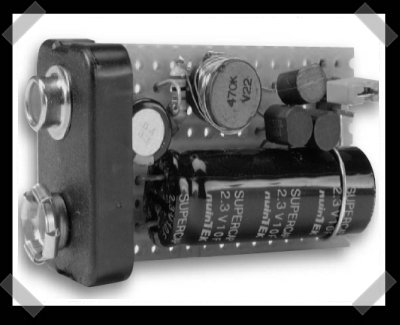
9V batteries are often found in devices that aren’t used very often. If you use a NiCd rechargeable battery you may find it completely discharged by the time you need it. Capacitors on the other hand can maintain their charge for years. This circuit uses a 10F cap with a switching voltage regulator to increase the voltage from 2.3V to 9V. With a light load the cap will last up to 3 hours and once discharged it can be recharged in less than 20 seconds. Warning: PDF link.

[thanks nullset]

Continue reading “SuperCap 9V Battery”

6502 Driven Nixie Tube Clock

nixie clock

I love Cold War chic like [ryan brooks]’s great looking nixie tube clock. There have been other microcontroller based nixie tube clocks so Ryan decided to base his on the venerable MOS Technology 6502. The 6502 is the same 8-bit processor used in the Apple II and Commodore 64. He’s got a couple interesting notes from the construction:

Be very organized with your digit wiring; use lots of cable ties or something. 6 digits is 120 solder joints on 60 wires.

Don’t be afraid to make your own Nixie sockets. I stood my tubes up on my flatbed scanner, arranged them with a ruler and then scanned. Imported to Photoshop, did a levels to make the pins contrasty and printed the output 1:1. Glued the paper onto my plexi, drilled all the holes, dropped in pin-sockets w/CA glue and bam! Instant Nixie Tube Clock Socket!

Continue reading “6502 Driven Nixie Tube Clock”

Floppy Drive Heliostat

floppy drive

This is an ongoing project to build a heliostat from a floppy drive. Heliostats are used by solar arrays to track the sun. This mod uses the main logic board to control the head stepper motor. The board will power up with 5V and consumes 1Watt when the motor is running. There are a couple quirks to the motor operation since this a floppy drive; large head movements require a backtrack every so often. Luckily, this device doesn’t move too far or fast. Two sets of LEDs are wired on opposite sides of a reflective strip. They’re wired opposite each other so that the device will track back if it overshoots.

Continue reading “Floppy Drive Heliostat”

Total Christmas Light Control

christmas light control

Now that Thanksgiving is in full swing, I think I can safely mention Christmas without receiving the beat down.  In this project, Christmas is just an excuse to build a parallel port connected control box capable of switching 320 individual circuits. The interface is constructed out of two types of chips: the 138 decoder and the 374 flip-flop. Each flip-flop is attached to an individual serial port that is connected to an 8 outlet switch box. Along with this system the site features lots of other home built and modified controls.

[thanks yo_tyler]

Continue reading “Total Christmas Light Control”

Thermal Keypad Combo Snooping

thermal image

This is interesting demo of how residual heat in a safe keypad could expose the key sequence. Using a hand-held thermal imaging device (not cheap) you can read which buttons on a keypad were pressed 5 to 10 minutes after the event from up to 10 meters away. Even though each key press is momentary there is enough heat transfer to distinguish the button in a thermal image. The sequence can be determined since the first button pressed has the least heat. This method break s when buttons are reused in the sequence, but being able to see the unused keys cuts down the number of possible permutations.

[thanks Mr. Mistoffolees]

Continue reading “Thermal Keypad Combo Snooping”