
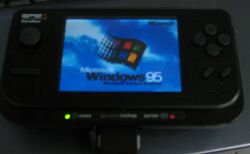
Windows 95 On A GP2X

bochs-gp2x-1-thumbThe GP2X is a portable game console that runs Linux and was released in November last year. This is a console that encourages you to hack its open platform and has a dev wiki to document those projects. Mandleman has recently gotten Bochs, the x86 emulator, running on the platform. He then booted Windows 95 (Internet Archive) on top of that; It takes six and a half minutes. He’s also built emulators for the NES, NeoGeo pocket, and Wonderswan. Recently released Linux based devices like the GP2X and the Nokia 770 are interesting because they encourage development. I hope in the future we’ll see an open device that has the market penetration of the PSP.

[thanks togi]

Continue reading “Windows 95 On A GP2X”

DIY Fig Rig

fig rig

The Fig Rig is the brain child of director Mike Figgis. The Rig is designed to provide stability while using a handheld camera. If you’ve seen the continuous 90 minute takes in Figgis’s Timecode you know what prompted him to come up with this contraption. Like most digital video camera accessories the Rig comes with a premium price. KingVidiot has a forum post detailing his attempt at creating a homemade Fig Rig. He used an old steering wheel, a piece of aluminum plate and a wooden dowel. It isn’t that pretty to look at, but it definitely didn’t cost him $300 and it works pretty well too.

[thanks DVguru]

Continue reading “DIY Fig Rig”

Lightweight Eye Tracker

eyetrack

[Jason S. Babcock] and [Jeff B. Pelz] put together this paper on building a simple, lightweight eyetracker (PDF) to foster the creation of open source eyetracking software. All of the components are mounted to a cheap pair of safety glasses. The eyetracker uses a technique called “dark-pupil” illumination. An IR LED is used to illuminate the eye. The pupil appears as a dark spot because it doesn’t reflect the light. A bright spot also appears on the cornea where the IR is directly reflected. An eye camera is mounted next to the IR LED to record the image of eye with these two spots. Software tracks the difference between the two spots to determine the eye orientation. A laser mounted to the frame helps with the initial calibration process.  A scene camera placed above the eye records what the eye is viewing. The video from these two cameras can be compared in real time or after the experiment is concluded.

[thanks austin y.]

Colecovision Portable

colecovision

Ben Heckendorn has been busy this holiday season. His latest project is cramming the guts of a Colecovision into a portable case. The project was commissioned, otherwise he probably wouldn’t have tackled it. The first bit of weirdness he found was the use of +12V, +5V, -5V lines to power the console. To get the board to fit in a smaller space he “flattened” it, remounting the components so they have a lower profile. The screen and case are standard issue Ben Heck, which he admits he can pretty much build with his eyes closed now. All told, it still looks great, but Ben says he isn’t going to be repeating this project any time soon because of the complexity involved.

[thanks HK-47]

Continue reading “Colecovision Portable”

Depth Of Field Machine For DV

dof

The small footprint of a CCD makes it hard for digital video cameras to emulate the short depth of field of film cameras. You’ll notice depth of field in movies when they have one actor close to the camera and you see the second actor over the shoulder; the actors will alternate being in focus because of the short depth of field. Here are some examples. To emulate this using a DV camera you have to change the size of the target area.  A smaller image is projected on a clear screen in front of the camera which is then recorded. This project uses a clear CD blank for the screen. The CD is rotated using an old CD player; otherwise the camera would pick up the grain of the plastic. Pretty easy, right? I haven’t even mentioned that the resulting image is upside down.

[thanks Angstrom]

Continue reading “Depth Of Field Machine For DV”

JuiceBox Custom Linux Cart

rom cart

The JuiceBox is a personal video player that was sold by Mattel that no one cared about. It was capable of playing MP3s off of an SD card and this summer you could pick them up for cheap as retailers dumped their stocks. [prpplague] has been hard at work creating a custom bootable rom cartridge. The MP3 adapter is a simple pc board with a SD card holder attached to it. The card is modified so the JuiceBox believes it is a video cartridge. An xD memory card is then soldered onto the back to act as storage. Using the JTAG connection on the JuiceBox and a serial console you can flash the bootrom, kernel, and ram disk from the SD card onto the xD. Once flashed the new custom cartridge will work on any JuiceBox. [prpplague] is still cleaning up the flash code, but it should be ready to go shortly.

Continue reading “JuiceBox Custom Linux Cart”

CVS Camcorder Download Alpha

cvs camcorder

A few people sent this in, but credit goes to [chris tt] for providing all the necessary links. Here is the process for using the camera with windows. First you need to build a USB cable [pdf]. Next, plug in the camera and create an inf file using libUSB. Finally, grab the OPS program and start extracting the video. Here is the thread announcing the release. Congratulations to BillW, morcheeba, daBass and anyone else who helped contribute to the project.

UPDATE: MAKE:Blog has a chronology of how this latest development happened.

Continue reading “CVS Camcorder Download Alpha”









