Rooting An Amazon Echo Dot

The Amazon Echo Dot is one of Amazon’s so-called ‘smart speaker’ offerings that tie into their larger Alexa-fueled ecosystem, designed to be a pretty minimalistic device that gives you access to this voice assistant and also the Amazon AWS cloud access to your home. If that latter part isn’t really your jam, you can always try to unshackle the device from the Amazonian cloud by rooting the device, as [Andy] recently did with a 2018 Echo Dot 3.

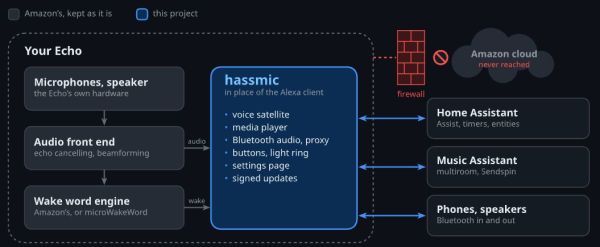
In addition to the video there is also a blog post in which the steps required to root the device are covered. This is then used to turn the device into a Home Assistant voice satellite, using a Claude-vibecoded project created by [Julian Imhof]. As [Andy] notes, this code seems to work, but it’s completely unaudited so YMMV. Device support is also limited to only certain Echo Dot and Echo Show devices as listed on the project page.

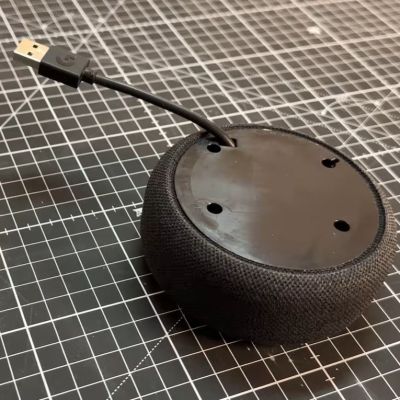
The first step is to gain USB access to the board inside the device, which for USB-less devices like the Dot in question requires opening the device to solder a USB connector onto the test pads that are available on the PCB. For other Echo devices you can just use the existing USB port, which makes this first step slightly easier.

These devices run Fire OS, so basically Android, which means a fairly standard process of unlocking the bootloader and installing the hassmic application that replaces Alexa. During testing [Andy] noticed that voice processing was rather slow, requiring switching from Whisper to Speech-to-Phrase to make simple things like turning a light on not take a minute.

Overall it seems like a pretty decent way to repurpose these devices as ESPHome devices, with a few gotchas when it comes to the resources required for local voice processing.
Continue reading “Rooting An Amazon Echo Dot” →

Amazon Echo Dot Upgraded To Retro Futuristic Look

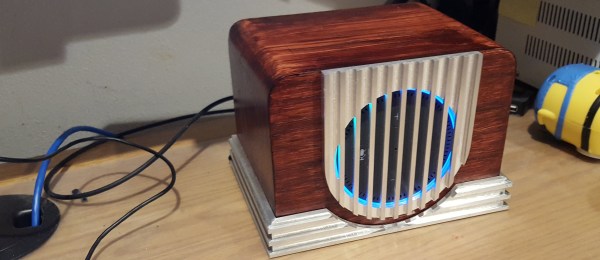
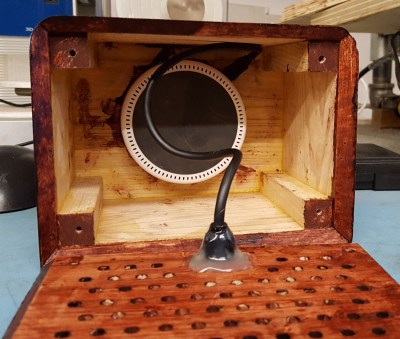
It takes a surprising amount of planning and work if you want something to look old. [vemeT5ak] wanted the Echo Dot sitting on his desk to fit a different aesthetic motivated by a 1940s Canadian radio. Armed with Solidworks, a Tormach CNC, and some woodworking tools at Sector67 hackerspace, he built a retro-futuristic case for the Amazon Alexa-enabled gadget. Future and past meet thanks to the design and material appearance of the metal grille and base molding wrapping the wood radio case. The finishing touch is of course the ring of blue light which still shines through from the Echo itself.

A short USB extension cable connects the Echo Dot to the back of the enclosure, and the cavernous inside plus ample holes provide a nice rich sound.

It took about 15 hours of modeling, scaling, and tweaking in Solidworks with an interesting design specification in mind: single-bit operation. This single-bit is not in the electrical sense, but refers to the CNC milling operation. All pieces are cut with a 1/4″ end mill, without any tool changes. Metal pieces were milled from 6061 aluminum and the hickory case (with burgundy stain) was mostly cut on a table saw, but the holes were CNC machined.

What looks like an otherwise perfect build has a single flaw that eats up [vemeT5ak]’s soul; the Echo Dot has a draft angle that wasn’t considered during modeling, and the hole is ever so slightly too wide, meaning it didn’t press fit perfectly flush. Fortunately it’s not noticeable behind the metal grill, and unless you knew (please help keep his dirty little secret), you would think everything turned out perfectly.

It turns out building a case for the Echo Dot is challenging for a few reasons; the rubbery material on the bottom doesn’t allow anything to stick to it, and the sides are smooth and featureless with a taper that makes it difficult to lock it in. Many cases resort to clipping over the top to hold it in place. Others install it into a fish or a furby.

Control Alexa Echo From Anywhere In The World

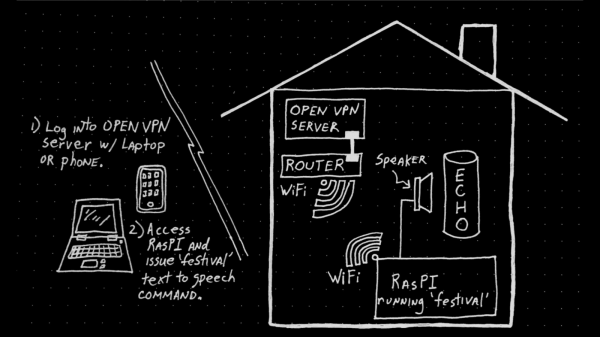
If you are not within ear-shot of your Alexa Echo, Dot or Tap device and need to command it from anywhere in the world, you’d most likely use the handy mobile app or web interface to control it. For some strange reason, if you’d rather use voice commands from anywhere in the world, you can still do it using apps such as Alexa Listens or Reverb, among many others. We’d be the first ones to call these out and say “It’s not a hack”. But [pat dhens] approach is above reproach! He has posted details on how to Remote Control the Alexa Echo from Anywhere in the World. Short version of the hack — he’s using a Raspberry Pi with a speaker attached to it which commands his Alexa Tap using a text-to-speech converter program.

The long version is short as well. The user uses a VPN, such as OpenVPN, to log in to their home network where the Alexa device is located. Then, use VNC to connect to the Raspberry Pi to access its shell. Finally, the user issues a text command which is converted to speech by the ‘festival‘ program on the Raspberry Pi. The output goes to an external speaker via the Raspberry Pi’s 3.5 mm audio out jack. And that’s all there is to it. You’ve just issued a voice command to your Alexa from across the world.

Maybe it will save your vocal chords from damage due to excessive hollering, we guess. He’s even made a short video to prove that it works. Now all it needs is a microphone to listen to Alexa, convert speech-to-text, and then transmit it back to you across the world to complete the cycle.

We’re not sure, but he thinks this hack will lead him to world domination. Good Luck with that.

Continue reading “Control Alexa Echo From Anywhere In The World” →