You’ll Shoot Your Eye Out, Another Coilgun

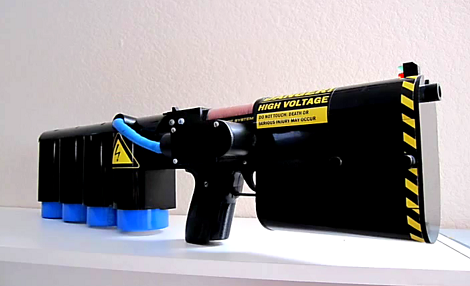
All we needed to read was 4x 3900uF capacitor bank to know we had yet another decently sized homemade coilgun on our hands. And for the math buffs, that equates out to 1.25kJ of potential energy (efficiency kills it down to 37j of kinetic, but large numbers are more fun) which is more than enough to break skin; of course we recommend you just shoot old electronics rather than friends. On the more technical side, sure its only a single stage for now and we’ve seen some slightly more impressive triple stage guns, but it may just be more beautiful than our previously featured coil pistol. You guys be the judge. Catch a complete video after the jump of the internals and build process, skip ahead to 2:40 for the destruction.

[via TheDailyWh.at]

Continue reading “You’ll Shoot Your Eye Out, Another Coilgun”

Easy High Voltage Power Supply

hv_supply

[rocketman221] wrote up one of the simplest ways to build a high voltage power supply. This one in particular was used on his coilgun. Instead of building a custom circuit, he’s using flash charging boards from disposable cameras. Six 450V 470uF caps are wired in parallel to make up the bank. Two of the charger boards are wired to one switch to initiate the charging process. Four additional boards are wired two a second switch for the second charging stage. The part cost on this is incredibly cheap and it only requires a 3.3V input to reach 450V. The writeup has plenty of warnings about the dangers of high voltage; you need to clean off all flux residue to prevent arcing across the circuit boards. Embedded below is a video of the bank being discharged through several objects. Continue reading “Easy High Voltage Power Supply”

Low Voltage Coil Gun


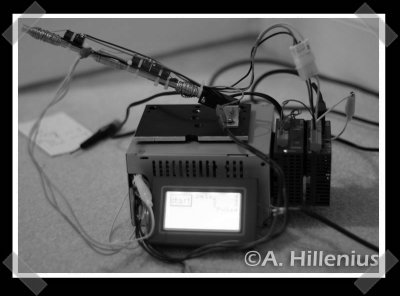
[Andrew] sent in his low voltage coil gun. He used some control hardware that most hardware hackers probably don’t have on their shelf, bit it’s still a good proof of concept. Each coil is driven by a dedicated relay, and a PC power supply feeds the system juice, while a programmable logic controller does the work. Since it’s just a matter of triggering the coils in order, the PLC could be easily replaced by a micro controller.