Two threads running concurrently

The Staggering Complexity And Subtlety Of Concurrency

If you’re gonna be a hacker eventually you’re gonna have to write code. And if you write code eventually you’re gonna have to deal with concurrency. Concurrency is what we call it when parts of our program run at the same time. That could be because of something fairly straightforward, like multiple threads, or multiple processes; or something a little more complicated such as event loops, asynchronous or non-blocking I/O, interrupts and signal handlers, re-entrancy, co-routines / fibers / green threads, job queues, DMA and hardware level concurrency, speculative or out-of-order execution at CPU-level, time-sharing on single-core systems, or parallel execution on multi-core systems. There are just so many ways to get tied up with concurrency.

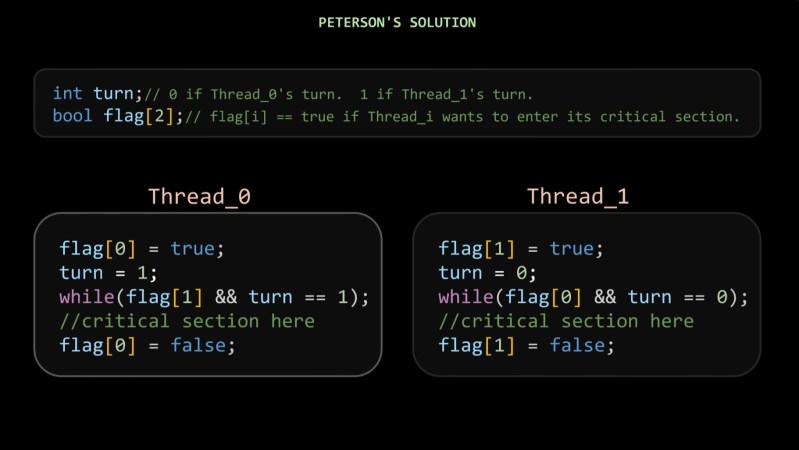
In this video from [Core Dumped] we learn about The ’80s Algorithm to Avoid Race Conditions (and Why It Failed). This video explains what a race condition looks like and talks through what the critical section is and approaches to protecting it. This video introduces an old approach to protect the critical section first invented in 1981 known as Peterson’s solution, but then goes on to explain how Peterson’s solution is no longer reliable as much has changed since the 1980s, particularly compilers will reorganize instructions and CPUs may run code out of order. So there is no free lunch and if you have to deal with concurrency you’re going to want some kind of support for a mutex of some type. Your programming language and its standard library probably have various types of locks available and if not you can use something like flock (also available as a syscall, to complement the POSIX fcntl), which may be available on your platform.

If you’re interested in contemporary takes on concurrency you might like to read Amiga, Interrupted: A Fresh Take On Amiga OS or The Linux Scheduler And How It Handles More Cores.

Continue reading “The Staggering Complexity And Subtlety Of Concurrency”

Embedded Rust Hack Chat

Join us on Wednesday, May 12 at noon Pacific for the Embedded Rust Hack Chat with James Munns!

Programming languages, like fashion, are very much a matter of personal taste. Professional developers often don’t have much say in which language they’ll use for a given project, either for legacy or team reasons, but if they did have a choice, they’d probably choose the language that works best with the way they think. Some languages just “fit” different brains better than others, and when everything is in sync between language and developer, code just seems to flow effortlessly through the keyboard and onto the screen.

One language that consistently scores at the top of developers’ “most loved” lists is Rust. For a language that started as a personal project and has only existed for a little more than a decade, that’s really saying something. The emphasis Rust puts on safety and performance probably has a lot to do with that. And thanks to its safe concurrency, its memory safety, and its interoperability with C and other languages, Rust has made considerable in-roads with the embedded development community.

To learn more about Rust in embedded systems, James Munns will stop by the Hack Chat. James is an embedded systems engineer, with a history of working on software for a wide range of systems, including safety-critical avionics, and rapidly prototyped IoT systems. He’s a founding member of the Rust Embedded Working Group, as well as a founder of Ferrous Systems, a consultancy focused on systems development in Rust, with a specialty in embedded systems development. James also used to write for Hackaday, so he must be a pretty cool guy. So swing by the Hack Chat and find out where Rust might be able to help you out with your next embedded project.

join-hack-chatOur Hack Chats are live community events in the Hackaday.io Hack Chat group messaging. This week we’ll be sitting down on Wednesday, May 12 at 12:00 PM Pacific time. If time zones have you tied up, we have a handy time zone converter.

Click that speech bubble to the right, and you’ll be taken directly to the Hack Chat group on Hackaday.io. You don’t have to wait until Wednesday; join whenever you want and you can see what the community is talking about.
Continue reading “Embedded Rust Hack Chat”