PC-1: The 1954 Computer With No Tubes, Relays, Or Transistors

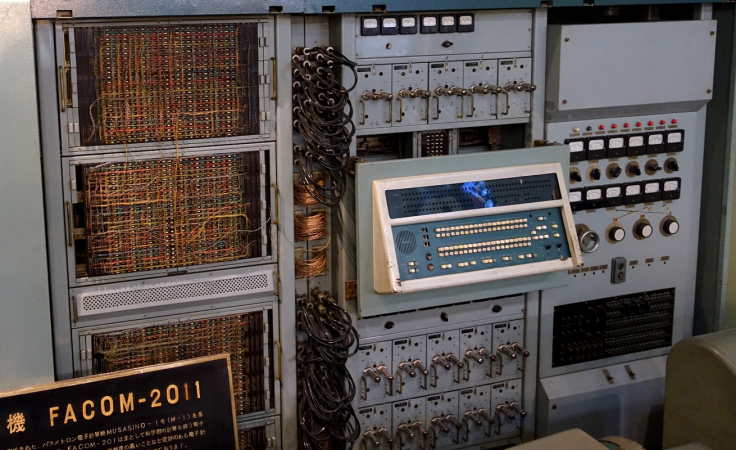
However you make a digital computer, you need something to represent a binary digit. Usually this is some form of switch: a relay, a tube, or a transistor, although there have been other ways to represent state. In 1954, [Eiichi Goto] of Japan invented the parametron, a resonant circuit using a ferrite core and a capacitor that could be moved between two phases.

According to [Goto’s] 1959 paper, the device is effectively a parametric oscillator, similar to some used at UHF frequencies by hams. The idea is that a tuned circuit is set to some frequency and driven with twice that frequency.

A What?

A parametron is essentially a resonant circuit made with inductors or capacitors whose reactance is varied at twice its resonant frequency. That “pumping” causes the circuit to oscillate at half the pump frequency. The neat trick is that there are two equally stable oscillation states at half the pump frequency, separated from each other by 180° of phase. Those two phases become binary 0 and 1. Depending on the incoming signals, one phase will win over the others.

Continue reading “PC-1: The 1954 Computer With No Tubes, Relays, Or Transistors”
Visiting The FACOM 128B 1958 Relay Computer

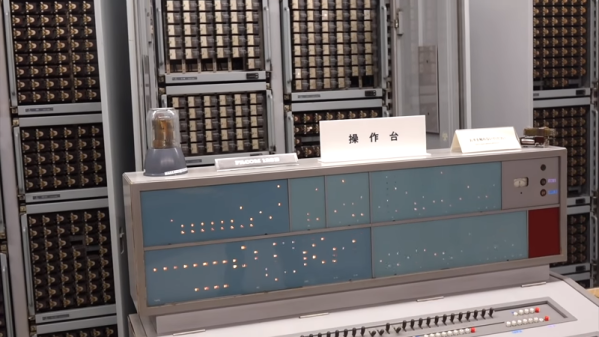
If you study the history of computing you might have heard of the FACOM 128B, a Japanese relay computer from 1958. It holds the distinction of being a contender for the oldest computer that still works in its original form, as it resides in a Fujitsu building in Numazu Japan. [CuriousMarc] visited the old computer and created a video about it as well as painting a picture of other contemporary machines. You can see the video below.

[Marc] explains how a relay machine was already behind the times in 1958, and also shows how the 5,000 relay machine is laid out. The machine on display came from a Tokyo university and did the kind of computations you might use a computer for today to do engineering design.

Continue reading “Visiting The FACOM 128B 1958 Relay Computer”

Maybe The Oldest Computer, Probably The Oddest

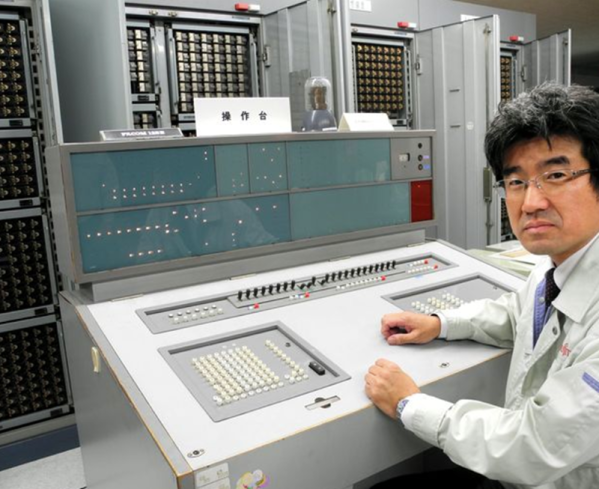
[Tadao Hamada] works for Fujitsu Tokki, a subsidiary of the more famous Fujitsu. In 1956, Fujitsu decided to compete with IBM and built a relay-based computer, the FACOM128. The computer takes up 70 square meters and weighs about 3 tons. By 1959, they’d learned enough to make a FACOM128B model that was improved. [Hamada’s] job is to keep one of these beasts operational at Fujitsu’s Numazu plant. According to the Japanese Computer Museum, it may be the oldest working computer.

Continue reading “Maybe The Oldest Computer, Probably The Oddest”