
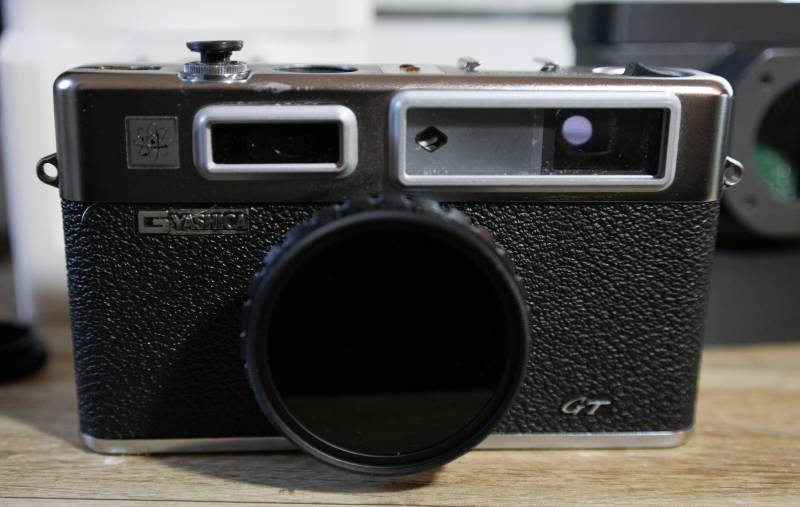
Photography is great, but sometimes it can get boring just reusing the same wavelengths over and over again. There are other options, though and when [Malcolm Wilson] decided he wanted to explore them, he decided to build a (near) IR camera.

Image : Malcom Wilson.
The housing is an old Yashica Electro 35 — apparently this model was prone to electrical issues, and there are a lot of broken camera bodies floating around– which hides a Pi NoIR Camera v3. That camera module, paired with an IR pass filter, makes for infrared photography like the old Yashica used to do with special film. The camera module is plugged into a Pi Zero 2 W, and it’s powered by a PiSugar battery. There’s a tiny (0.91″) OLED display, but it’s only for status messages. The viewfinder is 100% optical, as the designers of this camera intended. Point, shoot, shoot again.
There’s something pure in that experience; we sometimes find stopping to look at previews pulls one out of the creative zone of actually taking pictures. This camera won’t let you do that, though of course you do get to skip on developing photos. [Malcom] has the Pi set up to connect to his Wifi when he gets home, and he grabs the RAW (he is a photographer, after all) image files via SSH. Follow the link above to [Malcom]’s substack, and you’ll get some design details and his python code.
The Raspberry Pi Foundation’s NoIR camera shows up on these pages from time to time, though rarely so artistically. We’re more likely to see it spying on reptiles, or make magic wands work. So we are quite grateful to [Malcom] for the tip, via Petapixel. Yes, photographers and artists of all stripes are welcome to use the tips line to tell us about their work.

Image: Malcom Wilson












Still remember when my dad bought an IR film for his camera! This was maybe 30 years ago. Very cool project!
Normal Pi camera is sensitive from 400-700 nm
No-IR Pi camera is sensitive from 400-1000 nm
A typical consumer grade thermal camera for comparison goes to 12000 nm (12 μm). It is the one that if you put your hand inside a single black polyurethane bin bag, you can see your arm and hand. And it is unable to see through a normal sheet of glass (unless someone it holding their hand in contact with the other side of the glass for a few minutes).
So in reality unless you can see through items of clothing under bright red light, you are really not going to see through them with the No-IR Pi camera. The only thing that I have not tried, because it does not interest me, is if the subject was illuminated with with multiple watts of near IR lighting.
Using a R72 filter (strongly attenuates visible light 350-719nm and has a high transmittance of from 720-1200nm), might help.
Exactly as stated in the linked article.
I looked up your mention of a ” Sony Nightshot camcorder”, and it appears that it used a narrow 950 nm bandpass filter.
The NightShot used a pretty powerful IR LED of a fixed wavelength. They would have used a filter with the corresponding bandpass.
I used one for a while at work. It was remarkably effective at seeing through certain dyes. Some dyes (like Nigrosin, which looks black to the eye in white light, and which we used in a process at work) are almost entirely transparent beyond 700 nm. Certain blues were similar.
I guess this tosses out the lens in favor of the one on the module instead of dealing with the insane crop factor?
That’s correct but I do have another build that utilizes a focal reducer to use full frame lenses. I have it detailed on my Substack.
Great project. I’m trying to do something kinda similar: use pi hq camera module + cm4 to make a “camp snap” type camera that saves 12bit raw. I had similar idea to offload the raw via WiFi at home, and converts to dng.
Any tips?
Likely much cheaper than having a camera converted to IR by replacing the IR block filter with a visible block filter.
Not if you do it yourself. I still have an HP R707 I modified suchly about 15 years ago, replacing the IR block filter with a piece of IR remote control window plastic. Total cost: $0.00 and ten minutes work.
I tried to fix a camera recently, I’m still stuck at getting it open in a way that allows it to be closed again.
And that camera is a mirrorless interchangeable lens type, it’s just so many screws and so many hidden and hard to reach.
It’s to fix the power button though and I need to really get it well apart for that.
(I even played with the idea of dremeling the damn case for direct access.)
But getting off the filter can also be tricky depending on the sensor, with some of them it’s near impossible to not damage it.
I once had a webcam I was thinking of removing the IR filter from, but the internet said ‘it’s not possible’ although in the end I did find someone who did it. But in that one the filter was really designed to not be removed without damage. So I just did it to another cheap webcam where the filter was a little sliver glued to the back of the lens :)
Although I think that there sometimes is another filter on the sensor itself with some webcams with external filters, so you’d get better results if you could get at that too I suppose.
Oh and an additional problem is if the camera has IBIS and/or focus, like with phone sensors, hard to not damage those focus coils working on those things I bet.
Very nice, UV next?
There are cheap ($20-$50) USB cameras 1280×720 for UV called “Mini UV Camera for Portable Visible Facial Sunscreen Test” for phones. I am guessing that they can only get down to 350 nm at best, but that is probably fit for purpose and good enough to check sunscreen protection.
There is an interesting paper (“Ultraviolet Imaging with Low Cost Smartphone Sensors: Development and Application of a Raspberry Pi-Based UV Camera”) which describes modifying a raspberry pi camera module, to be able to get all the way down to 300 nm!
They chemically remove the microlens and Bayer filter layers using Posistrip EKC830 (Photoresist Remover) heated to 70°C to 100°C for 10 to 30 minutes.
Makes me wonder if any PCB photoresist remover could work.
I bought one the resolution of a mini uv “sunscreen camera” (H2 is written on the box) is 1920×1440 for photos and 1920×1080 for video. It contains an always on UV LED (no idea what wavelength) because at a guess the image sensor is really inefficient in the UV part of the spectrum. But it is a UV camera, I have no idea how low it goes but it is definitely below 400 nm. It is really scary pointing it at your skin, cosmetic companies should be giving these away for free to turbo boost their sales.
Anyone got any ideas of common everyday materials that I can point the camera (with or without the UV LED) to work out the spectral range.
Perverts were responsible for the death of affordable commercial multispectral cameras. :-D In the early 2000s, Sony had some good cameras with sensors that were very sensitive to the IR spectrum. The fact that they were used to photograph people in swimsuits, without their consent led the brand to initially install a mechanical filter that prevented use in sunlight. Those filters could be easily hacked, using a simple magnet to lock them in off position. Eventually, Sony discontinued “nightshoot” cameras to avoid bad publicity. Multispectral cameras since have become a niche market, used for scientific purposes, with high prices and sometimes only sold to institutions/companies that have proven to work in the area (e.g. forensic laboratories). The interesting part is that this gap in supply has led to the emergence of a culture of camera hacking to remove IR filters from sensors, and small conversion businesses have sprung up especially for hobbyists in the field of astronomy and nature photography. With the growing interest in IR/UV photography, it is probably only a matter of time before the big brands start providing cameras with these capabilities at affordable prices.
With the M12 mounting standard, the IR filter is almost always on the lens itself, making removal much easier and low risk.
Even more interesting, monochrome sensors designed for IR CCTV have much better low light performance compared to an RGB sensor of the same physical size, as the pixel elements have 3-4x the area.
Also, there are inexpensive (~£30) high speed cameras running at 720P and 120FPS, with a really valuable feature: global shutter! Completely eliminates rolling shutter jello effect, as all lines are read at once instead of sequentially!
The specific model I’ve used is OV9281, as well as a stereo-synced version with two sensors.
@rc I’d say it were the panicky Japanese responding to hype that were the issue there, in reality it was a nothing-burger, but the media and the US congressional fools made it a thing.
As for a change of attitude, I fear it might be another 50 years because at some point someone discovered a certain brand of phone had a depth camera that was wide spectrum and the reaction was once again over the top. Perhaps even more than originally, although that is hard to tell for me, you’d have to ask a cultural historian.
Perhaps you can force it by complaining that the ukrainians are suffering war hardship by not having access to cheap wide spectrum cams :)
My, that moderation knife is a large and imprecise.
How’s the bootup time? No details on that.
I propose a middle ground. Don’t try to do a video viewfinder, but use the wifi on the Pi to host a webpage that just shows the last photo. At first glance that might sound dumb, but it means you can use e.g your phone to check for stuff like correct framming, a blade of grass in the foreground etc.