3D Printable Lenticular Indicators

You can 3D print all kinds of things, from Yoda heads to little models of Pikachu. Eventually, though, most of us get to a point where we want to print something a little more interesting. The lenticular prints developed by MIT CSAIL are very much that. (h/t Core77).

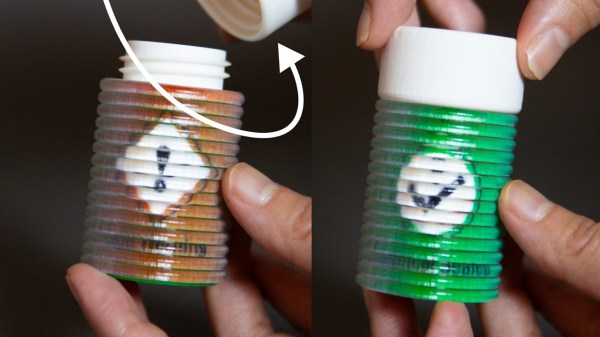
The ShiftLens concept is simple enough—there’s a lens layer printed in transparent material. Beneath that, lives a patterned layer in alternating colors, corresponding with the linear lenses of the layer above. Then, there’s an actuation mechanism that can shift the lens layer relative to the pattern layer. This creates a changing color effect as the mechanism is shifted. The actuation mechanism can be a knob, switch, or roller—anything that moves the layers relative to each other. On its own, it’s a bit of a curio—but there are some fun demos. In particular, using the lenticular printing on a bottle to form an indicator for when the container is closed properly. There isn’t a publicly available design tool for these prints yet, though the team developed one for Rhino that they used internally for the project.

It’s a pretty interesting application of 3D printing, and one that we fully expect a bunch of YouTubers to replicate within the month. We’ve featured some other great print hacks lately, too, like a slicer that lets you print horizontal overhangs without support. Video after the break.

Continue reading “3D Printable Lenticular Indicators”

Embedding Lenticular Lenses Into 3D Prints

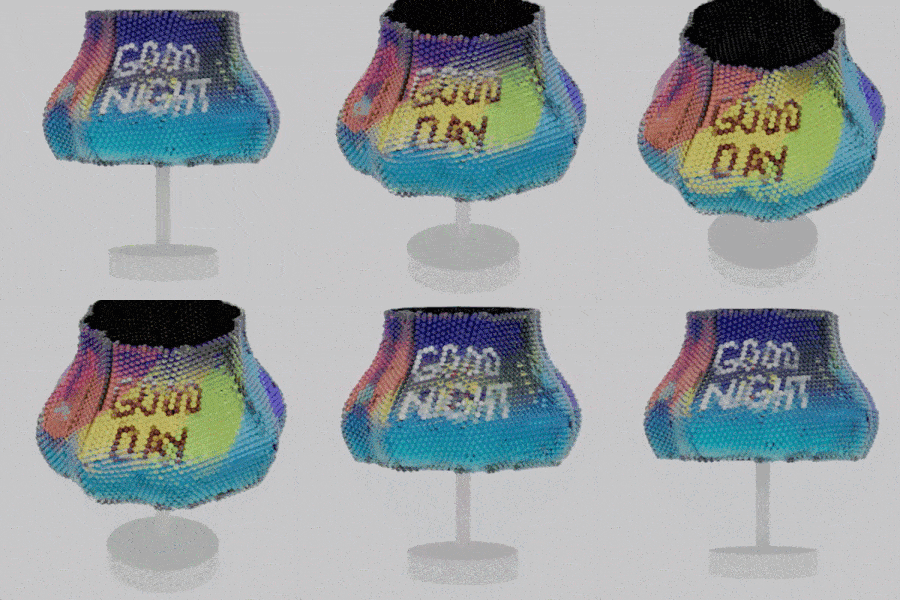
A research project shows that it’s possible to create complex single-piece lenticular objects, or objects that have lenticular lenses built directly into them. The result is a thing whose appearance depends on the viewer’s viewpoint. The object in the image above, for example, is the same object from five different angles.

What’s really neat is that these colorful things have been 3D printed as single objects, no separate lenses or assembly required. Sure, it requires equipment that not just everyone has on their workbench, but we think a clever hacker could put the underlying principles to work all the same.

This lampshade (which was 3D printed as a single object) changes color and displays Good Day or Good Night depending on viewing angle.

The effect is essentially the same as what is sometimes seen in children’s toys and novelties — where a perceived image changes depending on the viewing angle. This principle has been used with a lenticular lens sheet to create a clever lenticular clock, but there’s no need to be limited by what lenses are available off the shelf. We’ve seen a custom 3D printed lenticular lens slapped onto a mobile device to create a 3D screen effect.

Coming back to the research, the objects researchers created go beyond what we’ve seen before in two important ways. First is in using software to aid in designing the object and it’s viewpoints (the plugin for Rhino 3D is available on GitHub), and the second is the scale of the effect. Each lens can be thought of as a pixel whose color depends on the viewing angle, and by 3D printing the lenses, one can fit quite a lot of them onto a surface with a high degree of accuracy.

To make these objects researchers used PolyJet 3D printing, which is essentially UV-cured resin combined with inkjet technology, and can create multi-color objects in a single pass. The lenses are printed clear with a gloss finish, the colors are embedded, and a final hit of sprayed varnish helps with light transmission. It sure beats placing hundreds of little lenses by hand.

Continue reading “Embedding Lenticular Lenses Into 3D Prints”

3D Printed Lenticular Lens Makes 3D Display

[Bitluni] has been experimenting with resin printing lenses — in particular, lenticular lenses. You’ve probably seen lenticular lenses before in 3D greeting cards or children’s books. By presenting a slightly different image at different angles, your eyes perceive stereo vision giving the illusion of depth. You can see his results in the video below.

Honestly, even if you don’t want to make a display like this yourself, the demonstration of how a lenticular lens works using a laser is worth watching. Sure, you know in theory what’s going on, but seeing it visually exposed is great.

Continue reading “3D Printed Lenticular Lens Makes 3D Display”

Racing Game Crashes Into Its Next Life As A Sound Bender

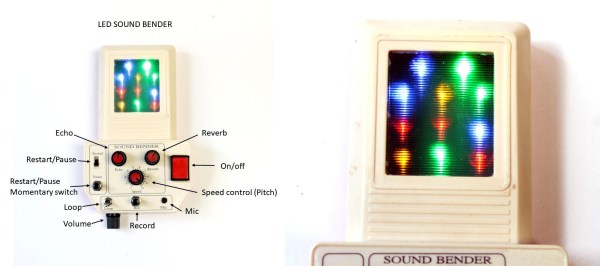
They say the best things in life are free, but we would loudly argue that a dollar can go a long way, too. It all depends on what you do with it. When [lonesoulsurfer] saw this busted-up handheld racing game at the junk store, he fell in love with the lines of the case and gladly forked over a buck in order to give it a new life as a wicked little sound-bending machine with dancing LEDs.

Here’s how it works: [lonesoulsurfer] records a few seconds of whatever into the mic with the looping function switched off, then turns it back on to start the fun. He can vary the pitch with the speed controller pot, or add in some echo and reverb. Once the sound is dialed in, he works the pause button on the left to make melodies by stopping and restarting the loop, or just pausing it momentarily depending on the switch setting.

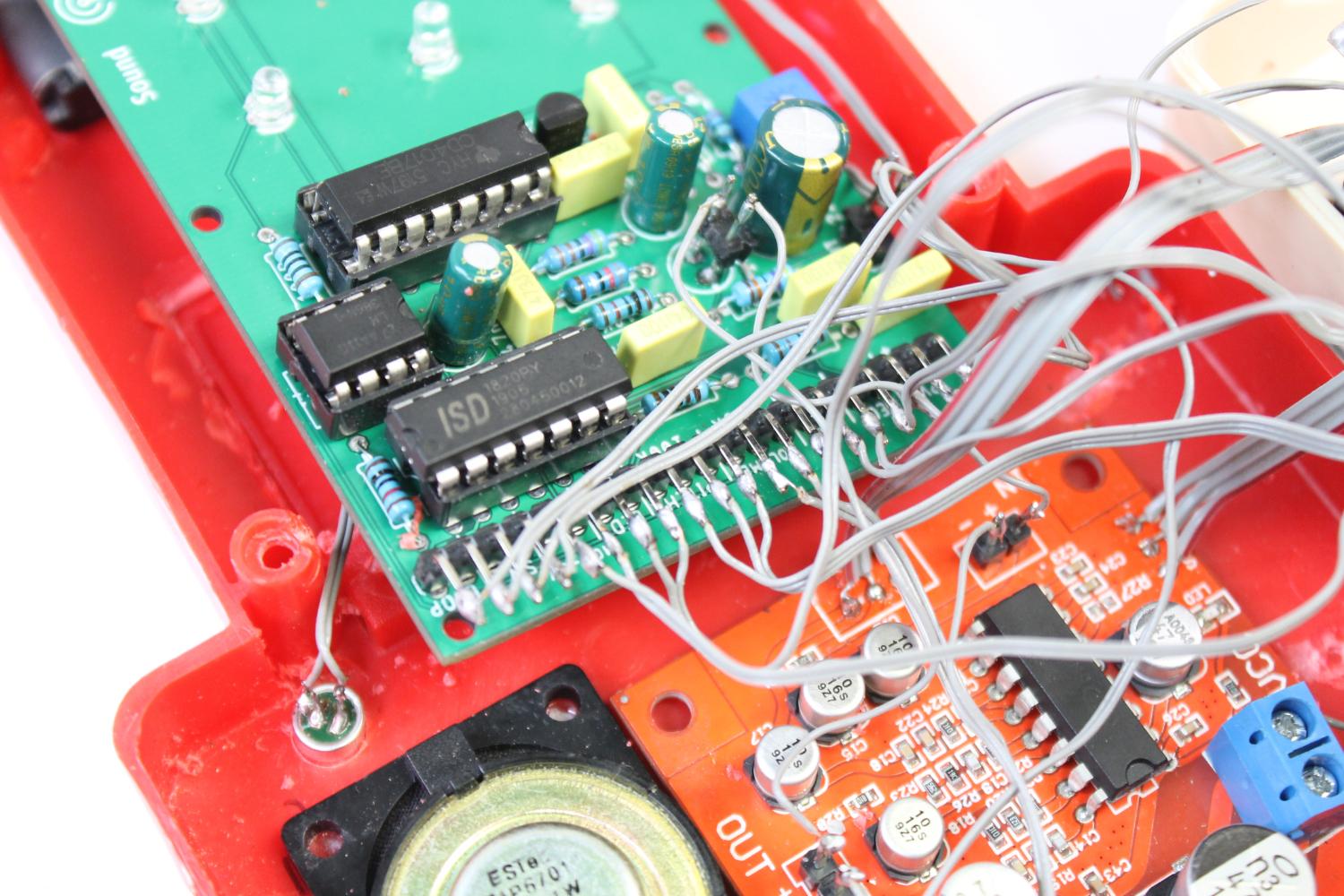
The electronics are a mashup of modules mixed with a custom PCB that combines the recording module with an LM386 amplifier and holds the coolest part of this build — those LEDs that dance to the music behind the toy’s original lenticular screen. Like most of [lonesoulsurfer]’s builds, it’s powered by an old cell phone battery that’s buck-boosted to 5 V. Check out the build and bleep-bloop video after the break.

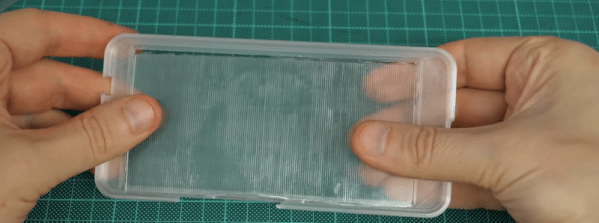
Lenticular lenses are all kinds of fun. Get one that’s big enough, and you can use it to disappear for a while.

Continue reading “Racing Game Crashes Into Its Next Life As A Sound Bender”

Lenticular Lens Makes Things Invisible

Sure it is a cheap stage trick, but using a lenticular lens at the right angle and in front of the right background can render what’s behind it invisible. That’s not news, but [Ian] spent some time investigating how to make the best one he could. His instructions cover how to create your own with polycarbonate, the right lens, and some optically clear adhesive. You can see some details about the shield along with some demonstrations in the video below.

The first iteration of the design worked, but it had some distracting lines and curvatures. The second version uses a large sheet of polycarbonate and liquid adhesive to attach the lens. It looks much better.

Continue reading “Lenticular Lens Makes Things Invisible”